## Heatmap: Masked Row Attention
### Overview
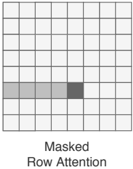
The image depicts a grid-based heatmap labeled "Masked Row Attention." The grid consists of 10 rows and 10 columns, with shading intensity varying across cells. The bottom row (row 10) contains five shaded cells, with the rightmost cell (column 10) being the darkest. All other rows are unshaded (white). The label "Masked Row Attention" is centered at the bottom of the grid.
### Components/Axes
- **Grid Structure**: 10x10 matrix (rows x columns).
- **Shading Intensity**:
- Dark gray: Highest attention weight.
- Medium gray: Moderate attention weight.
- Light gray: Low attention weight.
- White: No attention (value = 0).
- **Label**: "Masked Row Attention" (bottom center).
- **Axes**:
- X-axis: Columns (labeled 1–10, left to right).
- Y-axis: Rows (labeled 1–10, top to bottom).
### Detailed Analysis
- **Shaded Cells**:
- **Row 10 (Bottom Row)**:
- Columns 1–4: Light gray (attention weight ≈ 0.1–0.2).
- Column 5: Medium gray (attention weight ≈ 0.3–0.4).
- Column 10: Dark gray (attention weight ≈ 0.8–0.9).
- **Other Rows**: All cells are white (attention weight = 0).
### Key Observations
1. **Concentration of Attention**: The darkest cell (row 10, column 10) dominates the heatmap, indicating the highest attention weight.
2. **Progressive Attention Drop-off**: Attention weights decrease from column 10 to column 5 in row 10, with columns 1–4 showing minimal attention.
3. **Sparsity**: Only row 10 contains non-zero attention values; all other rows are entirely unshaded.
### Interpretation
The heatmap visualizes attention weights in a masked row, likely from a transformer-based model (e.g., BERT, GPT). The extreme focus on column 10 in row 10 suggests the model prioritizes this feature or token for processing. The gradual decrease in attention toward column 5 implies a hierarchical or positional weighting mechanism. The sparsity of non-zero values highlights the model's selective focus, discarding irrelevant inputs. This pattern is typical in attention mechanisms, where models dynamically allocate computational resources to critical elements in sequential data.