## Line Chart: Speedup vs. Context Length
### Overview
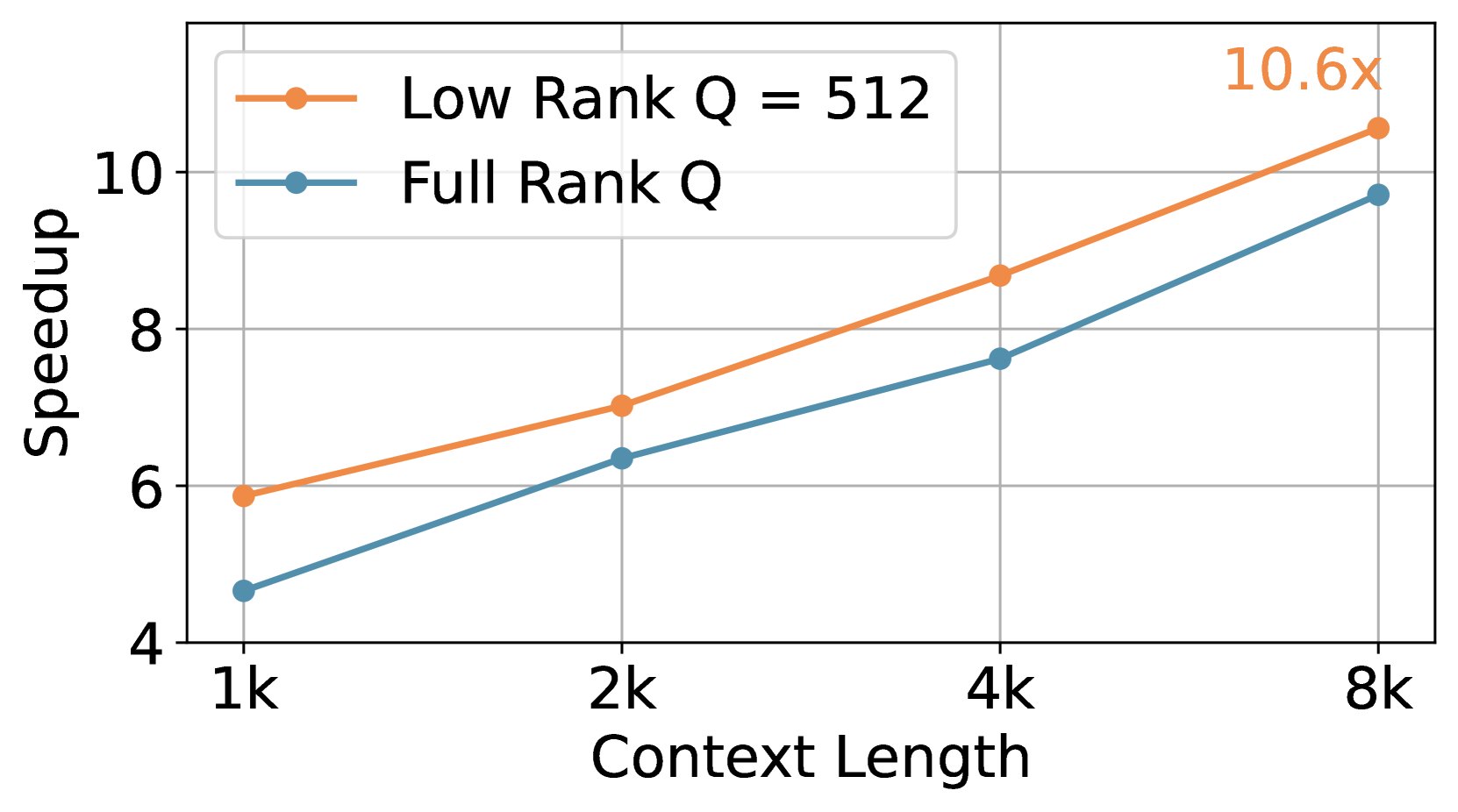
The chart compares the speedup performance of two configurations ("Low Rank Q = 512" and "Full Rank Q") across varying context lengths (1k, 2k, 4k, 8k). Speedup is measured on the y-axis (logarithmic scale implied by the 10.6x annotation), while context length is plotted on the x-axis. The legend is positioned in the top-right corner.
### Components/Axes
- **Y-Axis (Speedup)**: Labeled "Speedup" with a linear scale from 4 to 10.6x. Gridlines are visible at intervals of 2.
- **X-Axis (Context Length)**: Labeled "Context Length" with discrete markers at 1k, 2k, 4k, and 8k.
- **Legend**: Located in the top-right corner, with:
- **Orange line**: "Low Rank Q = 512"
- **Blue line**: "Full Rank Q"
### Detailed Analysis
- **Low Rank Q = 512 (Orange Line)**:
- **1k**: Speedup ≈ 6.0
- **2k**: Speedup ≈ 7.0
- **4k**: Speedup ≈ 8.5
- **8k**: Speedup ≈ 10.6x (annotated as "10.6x" at the endpoint)
- **Full Rank Q (Blue Line)**:
- **1k**: Speedup ≈ 4.5
- **2k**: Speedup ≈ 6.2
- **4k**: Speedup ≈ 7.6
- **8k**: Speedup ≈ 9.7
### Key Observations
1. Both configurations show **increasing speedup** with longer context lengths.
2. The **Low Rank Q = 512** configuration consistently outperforms **Full Rank Q** across all context lengths.
3. At **8k context length**, the speedup ratio between the two configurations is **~1.1x** (10.6x vs. 9.7x), though the orange line's endpoint annotation emphasizes its superior performance.
### Interpretation
The data suggests that **Low Rank Q = 512** scales more efficiently with increasing context length compared to Full Rank Q. The 10.6x speedup at 8k context implies a **10.6x performance improvement** over a baseline (likely 1x speedup at 1k, though not explicitly shown). This trend highlights the advantage of using lower-rank quantization for large-scale context processing. The blue line's slower growth indicates diminishing returns for Full Rank Q as context length increases.