## Text Block: Supplementary Note 2
### Overview
The image presents a mathematical lemma and its proof related to quantum information theory, specifically concerning the relationship between high fidelity and low entropy.
### Components/Axes
* **Title:** Supplementary Note 2
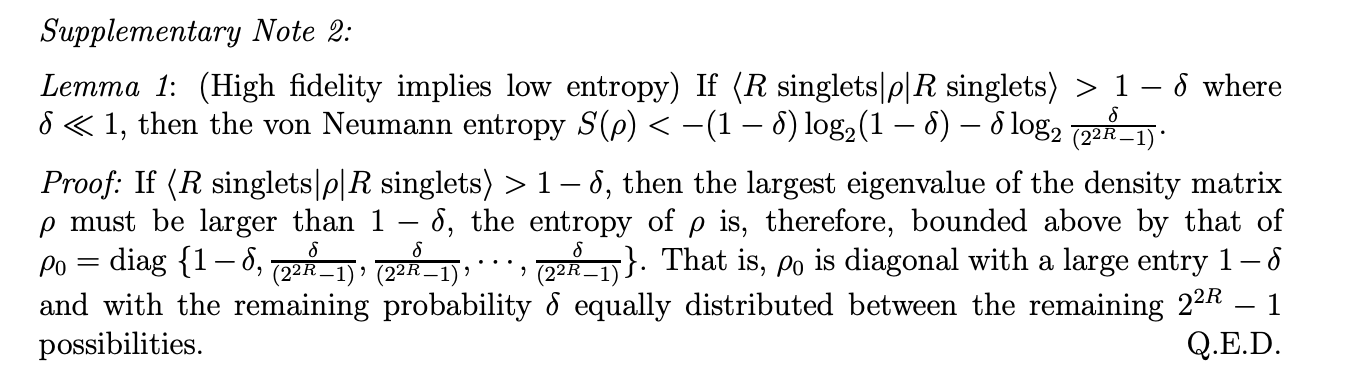
* **Lemma 1:** (High fidelity implies low entropy)
* **Mathematical Condition:** If `<R singlets|ρ|R singlets> > 1 - δ where δ << 1, then the von Neumann entropy S(ρ) < -(1 - δ)log₂(1 - δ) - δlog₂(δ/(2^(2R)-1)).`
* **Proof:** If `<R singlets|ρ|R singlets> > 1 - δ`, then the largest eigenvalue of the density matrix ρ must be larger than 1 - δ, the entropy of ρ is, therefore, bounded above by that of ρ₀ = diag {1 - δ, δ/(2^(2R)-1), δ/(2^(2R)-1), ..., δ/(2^(2R)-1)}. That is, ρ₀ is diagonal with a large entry 1 - δ and with the remaining probability δ equally distributed between the remaining 2^(2R) - 1 possibilities.
* **End of Proof:** Q.E.D.
### Detailed Analysis or ### Content Details
The text presents a lemma stating that high fidelity implies low entropy in a quantum system. It provides a mathematical condition under which this implication holds, involving the density matrix ρ, a small parameter δ, and the von Neumann entropy S(ρ). The proof outlines the reasoning behind this lemma, relating the fidelity to the largest eigenvalue of the density matrix and bounding the entropy.
### Key Observations
* The lemma establishes a connection between the fidelity of a quantum state and its entropy.
* The condition `δ << 1` suggests that the result is valid for high-fidelity states.
* The proof relies on the properties of the density matrix and its eigenvalues.
* The term `δ/(2^(2R)-1)` represents the equal distribution of the remaining probability among the possible states.
### Interpretation
The lemma and its proof suggest that in quantum systems, achieving high fidelity (i.e., a state close to the desired state) implies a low entropy (i.e., a state with low uncertainty or mixedness). This is a fundamental result in quantum information theory, as it connects the ability to reliably prepare a quantum state with its inherent randomness. The mathematical condition provides a precise quantification of this relationship, showing how the entropy is bounded by a function of the fidelity and the parameter δ. The proof demonstrates how the fidelity constrains the eigenvalues of the density matrix, leading to a bound on the entropy.