\n
## Text Block: Supplementary Note 2
### Overview
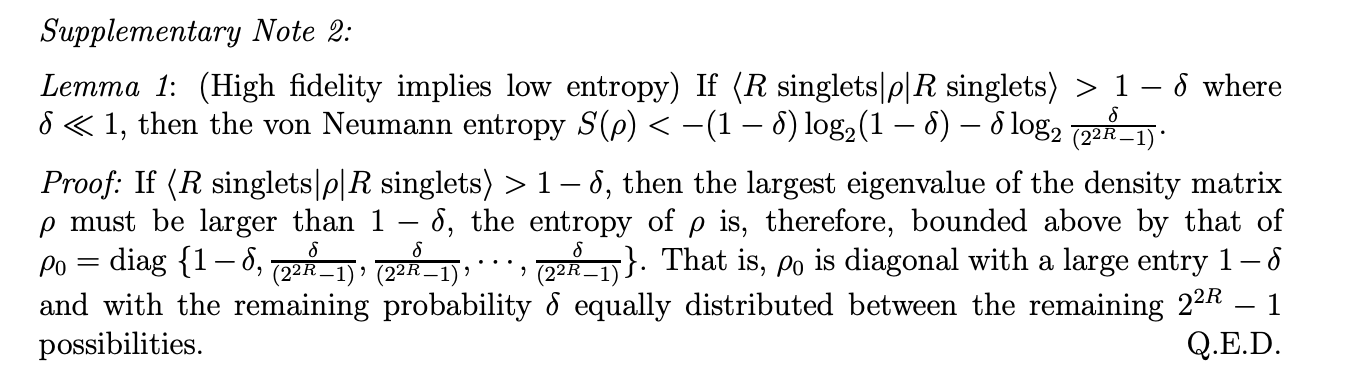
The image contains a block of text presenting a lemma and its proof related to quantum information theory, specifically concerning the relationship between fidelity and entropy. It's a mathematical statement and its justification.
### Content Details
The text is as follows:
"Supplementary Note 2:
Lemma 1: (High fidelity implies low entropy) If ⟨R singlets|ρ|R singlets⟩ > 1 − δ where δ ≪ 1, then the von Neumann entropy S(ρ) < −(1 − δ)log₂(1 − δ) − δlog₂(2²ᴿ⁻¹).
Proof: If ⟨R singlets|ρ|R singlets⟩ > 1 − δ, then the largest eigenvalue of the density matrix ρ must be larger than 1 − δ, the entropy of ρ is, therefore, bounded above by that of ρ₀ = diag {1 − δ, δ/(2²ᴿ⁻¹), δ/(2²ᴿ⁻¹), ..., δ/(2²ᴿ⁻¹)}. That is, ρ₀ is diagonal with a large entry 1 − δ and with the remaining probability δ equally distributed between the remaining 2²ᴿ − 1 possibilities.
Q.E.D."
### Key Observations
The text uses mathematical notation including:
* ⟨...|...⟩: Dirac notation for inner products.
* ρ: Density matrix.
* S(ρ): von Neumann entropy.
* δ: A small positive number (δ ≪ 1).
* R: An integer representing the number of qubits or systems.
* log₂: Logarithm base 2.
* diag{...}: Diagonal matrix.
The proof relies on bounding the entropy of a density matrix based on its fidelity to a specific state.
### Interpretation
This text establishes a connection between the fidelity of a quantum state (ρ) to a reference state (|R singlets⟩) and its von Neumann entropy. The lemma states that high fidelity (close to 1) implies low entropy. The proof demonstrates this by showing that if the fidelity is greater than 1 - δ, then the entropy is bounded above by the entropy of a diagonal matrix (ρ₀) with a large diagonal entry (1 - δ) and a small, evenly distributed probability for the remaining states. This is a fundamental result in quantum information theory, often used in the analysis of quantum error correction and quantum communication protocols. The "Q.E.D." signifies "quod erat demonstrandum," meaning "which was to be demonstrated," indicating the completion of the proof.