## Supplementary Note 2: Lemma 1 and Proof
### Overview
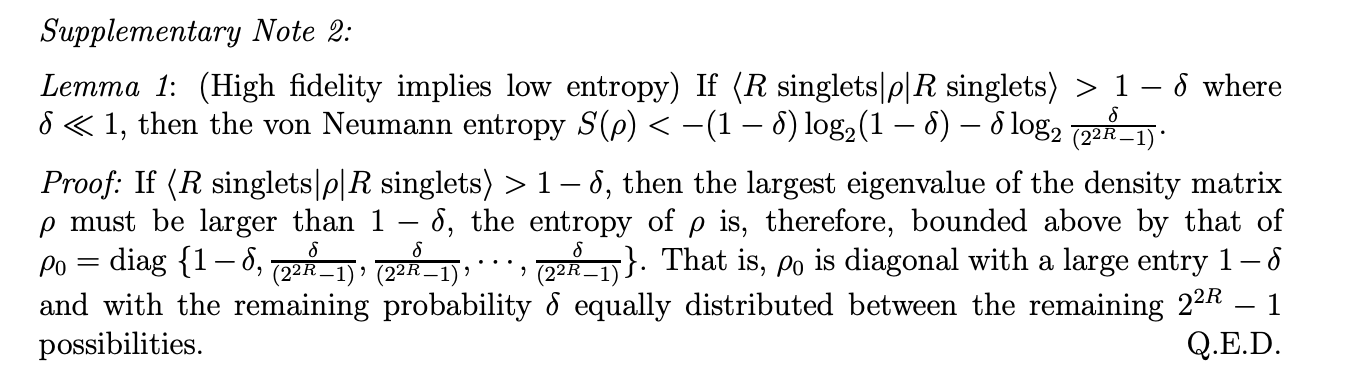
This document presents **Lemma 1**, which establishes a relationship between high fidelity (quantified by the overlap of singlet states) and low von Neumann entropy in quantum systems. The proof derives bounds on entropy using properties of density matrices and eigenvalues.
### Components/Axes
- **Key Variables**:
- \( \delta \): A small parameter where \( \delta \ll 1 \).
- \( \rho \): Density matrix of the quantum state.
- \( \langle R \text{ singlets}|\rho|R \text{ singlets} \rangle \): Fidelity measure between the state \( \rho \) and the singlet subspace.
- **Mathematical Elements**:
- Von Neumann entropy \( S(\rho) \).
- Eigenvalues of \( \rho \): \( \rho_0 = \text{diag}\left\{1-\delta, \frac{\delta}{2^{2R}-1}, \frac{\delta}{2^{2R}-1}, \dots, \frac{\delta}{2^{2R}-1}\right\} \).
### Detailed Analysis
1. **Lemma Statement**:
If \( \langle R \text{ singlets}|\rho|R \text{ singlets} \rangle > 1 - \delta \) (high fidelity), then the von Neumann entropy satisfies:
\[
S(\rho) < -(1-\delta)\log_2(1-\delta) - \delta \log_2\left(\frac{\delta}{2^{2R}-1}\right).
\]
This implies that high fidelity constrains the entropy to a logarithmic bound dependent on \( \delta \) and system size \( R \).
2. **Proof Logic**:
- **Step 1**: High fidelity \( > 1-\delta \) implies the largest eigenvalue of \( \rho \) exceeds \( 1-\delta \).
- **Step 2**: The entropy \( S(\rho) \) is bounded above by the entropy of a diagonal density matrix \( \rho_0 \), where:
- One eigenvalue is \( 1-\delta \).
- Remaining \( 2^{2R}-1 \) eigenvalues are \( \frac{\delta}{2^{2R}-1} \), equally distributed.
- **Conclusion**: The entropy is maximized when probability \( \delta \) is spread uniformly across all other states, leading to the derived bound.
### Key Observations
- The entropy bound tightens as \( \delta \to 0 \), reflecting that high fidelity (near-perfect singlet overlap) enforces low entropy.
- The term \( \frac{\delta}{2^{2R}-1} \) highlights the exponential growth of possible states with system size \( R \), emphasizing scalability challenges.
- The proof assumes \( \delta \ll 1 \), limiting applicability to regimes where fidelity deviations are small.
### Interpretation
This lemma formalizes the trade-off between fidelity and entropy in quantum error correction. High fidelity (e.g., in quantum error detection) necessitates a state concentrated in a small subspace (singlets), suppressing entropy. The bound quantifies how entropy grows with system size \( R \) and fidelity tolerance \( \delta \), providing a theoretical foundation for designing robust quantum codes. The result is critical for understanding the limits of quantum error mitigation strategies.
**Note**: No numerical values or trends are present, as this is a theoretical proof. All relationships are analytical.