\n
## Charts: Performance Comparison of Proof Strategies
### Overview
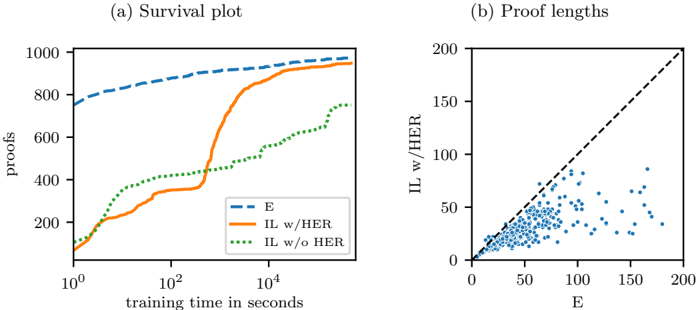
The image presents two charts comparing the performance of different proof strategies. Chart (a) is a survival plot showing the number of proofs found over training time. Chart (b) is a scatter plot comparing proof lengths for two strategies.
### Components/Axes
**Chart (a): Survival Plot**
* **Title:** (a) Survival plot
* **X-axis:** training time in seconds (logarithmic scale, from 10⁰ to 10⁴)
* **Y-axis:** proofs (from 0 to 1000)
* **Data Series:**
* E (blue dashed line)
* IL w/HER (orange solid line)
* IL w/o HER (green dotted line)
**Chart (b): Proof Lengths**
* **Title:** (b) Proof lengths
* **X-axis:** E (from 0 to 200)
* **Y-axis:** IL w/HER (from 0 to 200)
* **Diagonal Line:** A dashed black line representing y = x.
* **Data Points:** Blue dots representing individual proof length pairs.
### Detailed Analysis or Content Details
**Chart (a): Survival Plot**
* **E (blue dashed line):** Starts at approximately 850 proofs at 10⁰ seconds, increases to approximately 950 proofs at 10² seconds, and plateaus around 970 proofs at 10⁴ seconds. The line shows a rapid initial increase, followed by diminishing returns.
* **IL w/HER (orange solid line):** Starts at approximately 150 proofs at 10⁰ seconds, increases rapidly to approximately 850 proofs at 10² seconds, and continues to increase to approximately 950 proofs at 10⁴ seconds. This line demonstrates a slower initial growth but eventually catches up to and nearly matches the performance of 'E'.
* **IL w/o HER (green dotted line):** Starts at approximately 100 proofs at 10⁰ seconds, increases to approximately 650 proofs at 10² seconds, and reaches approximately 750 proofs at 10⁴ seconds. This line shows the slowest growth among the three strategies.
**Chart (b): Proof Lengths**
* The scatter plot shows a concentration of blue dots clustered around the lower-left corner, indicating that for many proofs, the 'E' and 'IL w/HER' strategies produce similar proof lengths.
* There is a noticeable spread of points above the diagonal line (y = x), suggesting that for a significant number of proofs, 'IL w/HER' generates longer proofs than 'E'.
* The points are relatively sparse in the upper-right corner, indicating that neither strategy frequently produces very long proofs.
* Approximate data points:
* (10, 10) - a cluster of points
* (50, 20) - a cluster of points
* (100, 40) - a cluster of points
* (150, 60) - a cluster of points
* (180, 180) - a few points near the diagonal
### Key Observations
* In Chart (a), 'E' initially finds more proofs faster, but 'IL w/HER' eventually approaches its performance. 'IL w/o HER' consistently underperforms both other strategies.
* In Chart (b), 'IL w/HER' often produces longer proofs than 'E', although there is significant variability.
* The logarithmic scale on the x-axis of Chart (a) emphasizes the initial rapid gains in proof finding.
### Interpretation
The data suggests that the 'IL w/HER' strategy is a viable alternative to 'E', eventually achieving comparable performance in terms of the number of proofs found. However, 'IL w/HER' comes at the cost of potentially longer proof lengths, as indicated by Chart (b). The 'IL w/o HER' strategy appears to be less effective than both 'E' and 'IL w/HER'.
The relationship between the two charts is that Chart (a) shows the *quantity* of proofs found over time, while Chart (b) shows the *quality* (length) of the proofs generated by two of the strategies. The diagonal line in Chart (b) serves as a benchmark: points above the line indicate longer proofs for 'IL w/HER' compared to 'E', while points below the line indicate shorter proofs.
The outlier points in Chart (b) – those significantly above the diagonal – represent cases where 'IL w/HER' generates substantially longer proofs than 'E'. These cases might warrant further investigation to understand the underlying reasons for the increased proof length. The overall trend suggests a trade-off between proof-finding speed and proof length, with 'IL w/HER' offering a potential balance between the two.