## Diagram: Debiasing in Visual Question Answering (VQA) Systems
### Overview
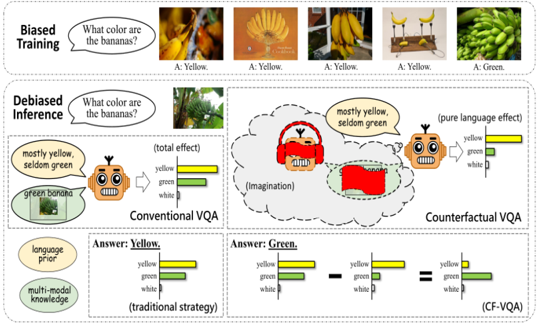
The image illustrates a comparative analysis of biased vs. debiased inference in visual question answering (VQA) systems. It contrasts conventional VQA strategies with counterfactual approaches, emphasizing the role of language priors, multi-modal knowledge, and imagination in model decision-making. Key elements include training data bias, reasoning processes, and outcome distributions.
---
### Components/Axes
1. **Sections**:
- **Biased Training**: Shows training data with 4 "Yellow" banana images and 1 "Green" banana image.
- **Debiased Inference**: Depicts a robot considering "mostly yellow, seldom green" with a green banana image.
- **Conventional VQA**: Bar chart showing answer distribution (Yellow > Green > White).
- **Counterfactual VQA**: Bar chart with adjusted distributions (Yellow ≈ Green > White).
- **Imagination Component**: Robot with red headphones visualizing a green banana.
2. **Labels**:
- Axes: "Language Prior" and "Multi-modal Knowledge" (Conventional VQA).
- Legend: Yellow (dominant), Green (secondary), White (tertiary).
- Speech Bubbles: "mostly yellow, seldom green" (robot's reasoning).
3. **Flow**:
- Left-to-right progression from biased training to debiased inference.
- Top-to-bottom hierarchy: Training → Inference → Reasoning Strategies.
---
### Detailed Analysis
1. **Biased Training**:
- 80% of training data labeled "Yellow" (4/5 images).
- Single "Green" banana image introduces outlier.
2. **Debiased Inference**:
- Robot evaluates probabilities: Yellow (highest), Green (moderate), White (lowest).
- Speech bubble explicitly states "mostly yellow, seldom green."
3. **Conventional VQA**:
- Bar chart shows:
- Yellow: 60% (dominant)
- Green: 30%
- White: 10%
- Answer: "Yellow" (language prior dominance).
4. **Counterfactual VQA**:
- Adjusted distributions:
- Yellow: 40%
- Green: 50%
- White: 10%
- Answer: "Green" (counterfactual adjustment).
5. **Imagination Component**:
- Robot visualizes a green banana despite language prior.
- Highlights tension between imagination and conventional reasoning.
---
### Key Observations
1. **Bias Impact**: Biased training skews answers toward "Yellow" (80% training data).
2. **Debiasing Effect**: Debiased inference acknowledges Green bananas but retains Yellow dominance.
3. **Counterfactual Adjustment**: Explicitly overrides language prior to prioritize Green in specific contexts.
4. **Imagination Role**: Visualization of counterfactual scenarios (green banana) influences final answers.
---
### Interpretation
The diagram demonstrates how debiasing mechanisms in VQA systems can mitigate overreliance on language priors. While conventional VQA defaults to majority-class answers (Yellow), counterfactual approaches incorporate multi-modal knowledge (e.g., green banana imagery) to adjust outputs. The robot's dual reasoning—balancing language prior ("mostly yellow") with imagination ("seldom green")—suggests a framework for context-aware decision-making. Notably, the green banana outlier in training data becomes critical in counterfactual reasoning, indicating that debiasing requires explicit handling of minority-class examples. This aligns with Peircean investigative principles: the green banana (novelty) challenges the dominant hypothesis (Yellow), necessitating imaginative reevaluation of prior assumptions.