TECHNICAL ASSET FINGERPRINT
bf30b245cc7ef35f76f24432
Click to view fullscreen
Press ESC or click to close
FOUND IN PAPERS
EXPERT: healer-alpha-free VERSION 1
RUNTIME: free/openrouter/healer-alpha
INTEL_VERIFIED
## Paper Folding Problem: Step-by-Step Unfolding Solution
### Overview
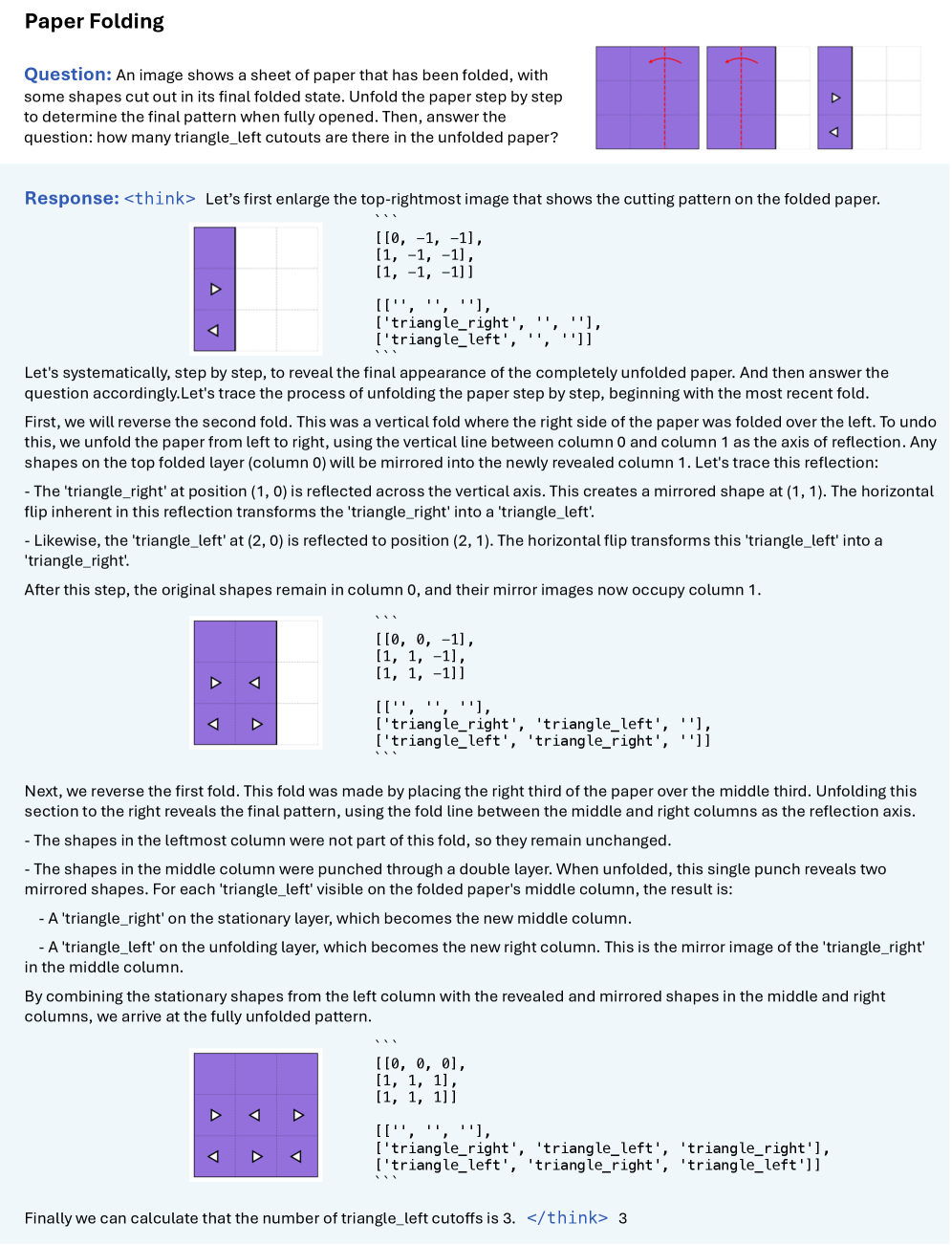
The image displays a technical explanation of a spatial reasoning puzzle involving paper folding and cutouts. It presents a problem where a folded paper with cut shapes must be mentally unfolded to determine the final pattern. The response provides a systematic, step-by-step solution with accompanying diagrams and symbolic representations of the paper's state at each stage.
### Components/Axes
The image is structured as a document with the following sections:
1. **Title:** "Paper Folding"
2. **Question Section:** Contains the problem statement and a visual of the folded paper.
3. **Response Section:** Contains a detailed thinking process with embedded diagrams and textual explanations.
4. **Diagrams:** Three key diagrams showing the paper's state:
* Initial folded state (top-right of question).
* State after reversing the second fold.
* Final fully unfolded state.
5. **Symbolic Representations:** Each diagram is accompanied by two arrays:
* A numerical grid (e.g., `[[0, -1, -1], ...]`) representing the paper's layers or fold state.
* A string grid (e.g., `[['', '', ''], ['triangle_right', ...]]`) labeling the cutout shapes in each cell.
### Detailed Analysis
**1. Problem Statement:**
* **Text:** "Question: An image shows a sheet of paper that has been folded, with some shapes cut out in its final folded state. Unfold the paper step by step to determine the final pattern when fully opened. Then, answer the question: how many triangle_left cutouts are there in the unfolded paper?"
* **Visual:** A purple rectangle representing the folded paper. It shows two visible cutouts: a right-pointing triangle (`triangle_right`) in the top cell and a left-pointing triangle (`triangle_left`) in the bottom cell of the leftmost column.
**2. Step 1: Initial State & Enlargement**
* The response begins by enlarging the folded paper view.
* **Symbolic State (Folded):**
* Numerical Grid: `[[0, -1, -1], [1, -1, -1], [1, -1, -1]]`
* String Grid: `[['', '', ''], ['triangle_right', '', ''], ['triangle_left', '', '']]`
* **Interpretation:** The grid appears to be 3 rows x 3 columns. The `-1` likely indicates folded/hidden layers. The visible cutouts are in column 0, rows 1 and 2.
**3. Step 2: Reversing the Second Fold (Vertical Unfold)**
* **Process:** A vertical fold where the right side was folded over the left is undone. The axis of reflection is the line between column 0 and column 1.
* **Transformation Logic:**
* The `triangle_right` at position (1, 0) is mirrored to (1, 1). The horizontal flip transforms it into a `triangle_left`.
* The `triangle_left` at position (2, 0) is mirrored to (2, 1). The horizontal flip transforms it into a `triangle_right`.
* **Resulting State (After 1st Unfold):**
* **Diagram:** Shows a 2-column wide purple area. Column 0 has the original cutouts. Column 1 has their mirrored counterparts.
* Numerical Grid: `[[0, 0, -1], [1, 1, -1], [1, 1, -1]]`
* String Grid: `[['', '', ''], ['triangle_right', 'triangle_left', ''], ['triangle_left', 'triangle_right', '']]`
* **Spatial Grounding:** The legend (string grid) confirms the shapes in each cell. The diagram visually matches: Row 1 has a right triangle then a left triangle. Row 2 has a left triangle then a right triangle.
**4. Step 3: Reversing the First Fold (Horizontal Unfold)**
* **Process:** A fold where the right third was placed over the middle third is undone. The reflection axis is between the middle and right columns.
* **Transformation Logic:**
* Left column shapes are unchanged.
* Middle column shapes were punched through a double layer. Unfolding reveals two mirrored shapes for each original cutout:
* A `triangle_right` on the stationary layer (becomes the new middle column).
* A `triangle_left` on the unfolding layer (becomes the new right column).
* **Resulting State (Fully Unfolded):**
* **Diagram:** Shows a 3-column wide purple area. All cells in rows 1 and 2 contain cutouts.
* Numerical Grid: `[[0, 0, 0], [1, 1, 1], [1, 1, 1]]`
* String Grid: `[['', '', ''], ['triangle_right', 'triangle_left', 'triangle_right'], ['triangle_left', 'triangle_right', 'triangle_left']]`
* **Spatial Grounding:** The final diagram shows a clear pattern. Row 1: Right, Left, Right. Row 2: Left, Right, Left. The string grid provides the precise labels for each of the 6 cutout positions.
**5. Final Answer:**
* **Text:** "Finally we can calculate that the number of triangle_left cutoffs is 3. </think> 3"
* **Data Extraction:** Counting `triangle_left` in the final string grid:
* Row 1, Column 1: `triangle_left`
* Row 2, Column 0: `triangle_left`
* Row 2, Column 2: `triangle_left`
* **Total: 3**
### Key Observations
1. **Pattern Emergence:** The unfolding process transforms a simple two-cutout folded state into a symmetrical, checkerboard-like pattern of alternating triangle orientations across a 2x3 grid (rows 1 and 2).
2. **Mirroring Logic:** Each unfolding step applies a precise mirroring transformation that also flips the orientation of the triangular cutouts (`right` ↔ `left`).
3. **Data Representation:** The solution uses a dual-array system (numerical for fold state, string for shape identity) to track the paper's state programmatically, which is a common technique in computational geometry or puzzle-solving algorithms.
4. **Efficiency:** The thinking process is highly systematic, reversing the fold sequence exactly, which guarantees an accurate reconstruction.
### Interpretation
This document is a clear example of **spatial reasoning decomposed into a logical, algorithmic process**. It demonstrates how a complex mental visualization task (unfolding paper) can be broken down into discrete, rule-based steps.
* **What the data suggests:** The final pattern is not random; it's a direct, deterministic consequence of the initial fold sequence and cut locations. The alternating triangle pattern reveals an underlying symmetry created by the reflection operations.
* **How elements relate:** The diagrams, numerical grids, and string grids are three parallel representations of the same information. The diagrams provide intuitive visual confirmation, the numerical grids likely model the physical fold structure (with `-1` representing hidden layers), and the string grids provide the essential semantic data (shape type) needed to answer the question.
* **Notable Anomaly/Insight:** The key insight is that a single cut through a multi-layer fold produces multiple, mirrored cuts in the final pattern. The solution correctly accounts for this by generating two shapes (a stationary and a mirrored one) for each cut in the doubly-layered middle column during the final unfold. This is the core principle that leads to the final count of three `triangle_left` shapes.
DECODING INTELLIGENCE...