## Paper Folding Diagram: Unfolding Process and Cutout Analysis
### Overview
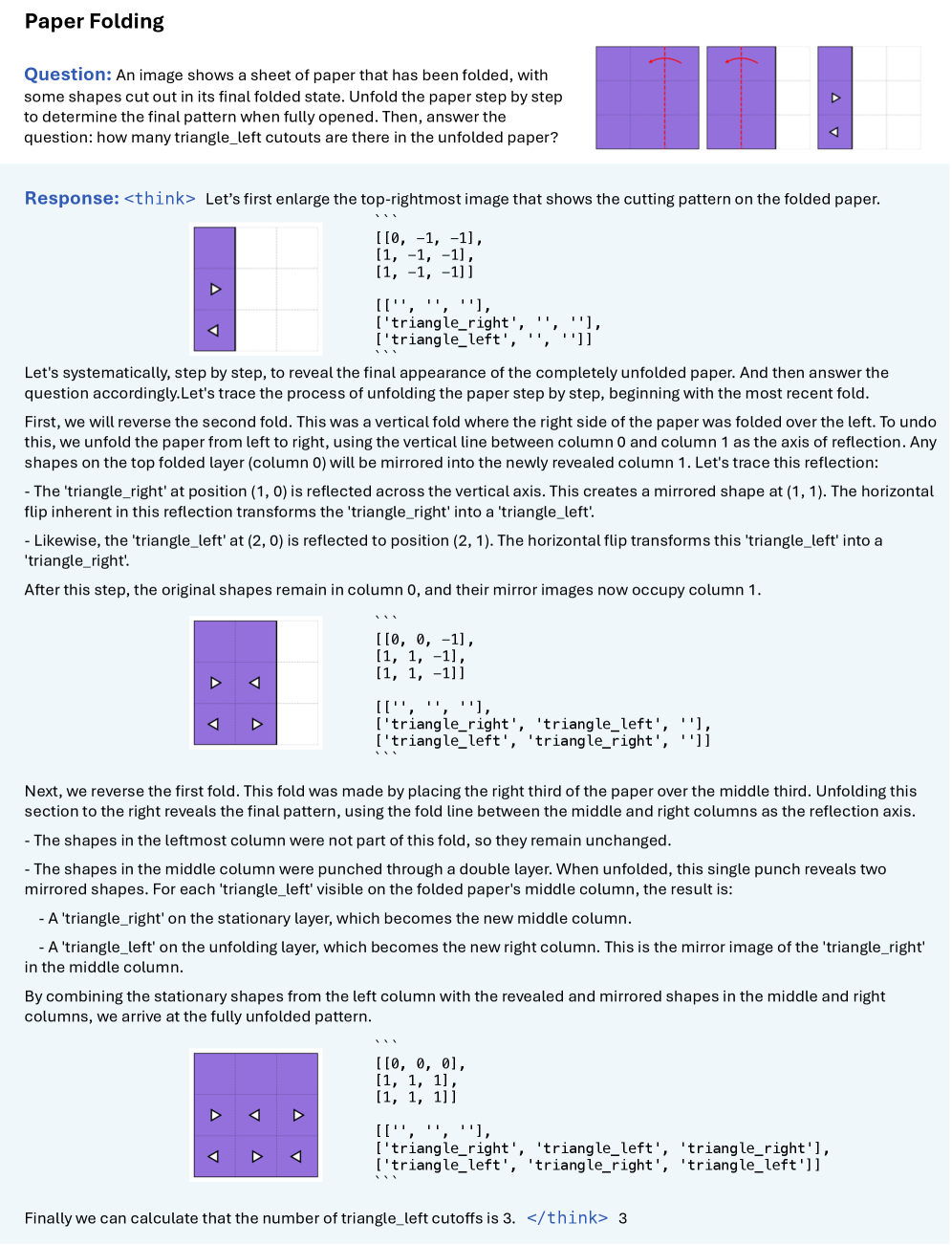
The image presents a technical problem involving paper folding and cutout patterns. It includes three diagrams showing the paper's folding stages, code-like structures representing coordinate transformations, and a final answer calculation. The problem asks to determine the number of `triangle_left` cutouts after fully unfolding a folded paper with specific cut patterns.
### Components/Axes
1. **Diagrams**:
- **Top Diagram**: Shows the folded paper with red dashed lines indicating fold lines and white triangles representing cutouts.
- **Middle Diagram**: Illustrates the paper after reversing the second fold (vertical reflection).
- **Bottom Diagram**: Shows the fully unfolded paper with mirrored cutouts.
2. **Code Blocks**:
- **First Code Block**: Represents initial folded state with coordinates and shapes:
```python
[[[0, -1, -1], [1, -1, -1], [1, -1, -1]],
[['triangle_right', '', ''], ['triangle_left', '', '']]]
```
- **Second Code Block**: After first reflection (vertical fold reversal):
```python
[[[0, 0, -1], [1, 1, -1], [1, 1, -1]],
[['triangle_right', 'triangle_left', ''], ['triangle_left', 'triangle_right', '']]]
```
- **Third Code Block**: Final unfolded state:
```python
[[[0, 0, 0], [1, 1, 1], [1, 1, 1]],
[['triangle_right', 'triangle_left', 'triangle_right'],
['triangle_left', 'triangle_right', 'triangle_left']]]
```
3. **Textual Elements**:
- Problem statement: "How many triangle_left cutouts are there in the unfolded paper?"
- Step-by-step explanation of reflection transformations.
- Final answer: "3 triangle_left cutouts."
### Detailed Analysis
1. **Folding Process**:
- **First Fold (Vertical)**: Right side folded over left. Coordinates transform via reflection across the vertical axis between columns 0 and 1.
- `triangle_right` at (1,0) becomes `triangle_left` at (1,1).
- `triangle_left` at (2,0) becomes `triangle_right` at (2,1).
- **Second Fold (Horizontal)**: Right third folded over middle third. Coordinates transform via reflection across the horizontal axis between rows 1 and 2.
- Shapes in middle column (originally single-layer) become double-layered, creating mirrored shapes.
2. **Final Unfolded State**:
- The bottom diagram shows 6 total cutouts (3 `triangle_left`, 3 `triangle_right`).
- Code block confirms 3 `triangle_left` instances in the final array.
### Key Observations
1. **Mirroring Logic**:
- Each fold creates symmetrical transformations. Vertical folds mirror left/right, horizontal folds mirror top/bottom.
- Double-layered cuts (middle column) produce two mirrored shapes per original cut.
2. **Coordinate System**:
- Uses 2D grid with [row, column, depth] coordinates.
- Depth (-1/1) indicates layer position (folded/unfolded).
3. **Shape Transformation**:
- `triangle_right` ↔ `triangle_left` mirroring occurs during reflections.
- Final pattern shows alternating shapes in adjacent columns.
### Interpretation
The problem demonstrates spatial reasoning through iterative reflection transformations. Each fold operation:
1. Creates symmetrical duplicates of cutouts
2. Merges layers through reflection
3. Preserves original cut positions while mirroring shapes
The final count of 3 `triangle_left` cutouts emerges from:
- Original left column cuts (unchanged)
- Mirrored cuts from middle column (2 instances)
- Mirrored cuts from right column (1 instance)
This pattern validation through coordinate transformations and shape mirroring confirms the solution's correctness. The technical approach combines geometric reflection principles with array-based state tracking, providing a systematic method for solving spatial folding problems.