## Chart Type: Line Chart
### Overview
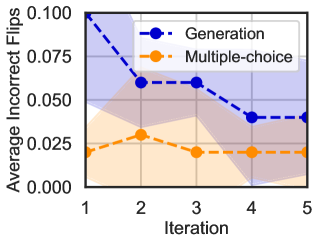
This image displays a line chart comparing the "Average Incorrect Flips" over "Iteration" for two different methods: "Generation" and "Multiple-choice". Each line represents a method, showing its performance trend across five iterations, accompanied by a shaded area indicating variability or uncertainty around the mean.
### Components/Axes
The chart consists of a main plotting area, a Y-axis, an X-axis, and a legend.
* **Y-axis Label**: "Average Incorrect Flips"
* **Y-axis Range**: From 0.000 to 0.100.
* **Y-axis Major Ticks**: 0.000, 0.025, 0.050, 0.075, 0.100.
* **X-axis Label**: "Iteration"
* **X-axis Range**: From 1 to 5.
* **X-axis Major Ticks**: 1, 2, 3, 4, 5.
* **Legend**: Positioned in the top-right quadrant of the chart.
* **Generation**: Represented by a blue dashed line with circular markers (filled blue circles).
* **Multiple-choice**: Represented by an orange dashed line with circular markers (filled orange circles).
### Detailed Analysis
The chart presents two data series, each with a distinct trend and an associated shaded region.
**1. Generation Series (Blue Dashed Line with Blue Circles)**
* **Visual Trend**: The "Generation" line starts at a high value, drops significantly, then remains relatively stable before dropping again and stabilizing at a lower value.
* **Data Points**:
* **Iteration 1**: Approximately 0.100 Average Incorrect Flips.
* **Iteration 2**: Approximately 0.060 Average Incorrect Flips.
* **Iteration 3**: Approximately 0.060 Average Incorrect Flips.
* **Iteration 4**: Approximately 0.040 Average Incorrect Flips.
* **Iteration 5**: Approximately 0.040 Average Incorrect Flips.
* **Shaded Area**: A light blue shaded region surrounds the "Generation" line, indicating a range of values (likely a confidence interval or standard deviation) around the mean. This region is wider at Iteration 1 and 2, narrowing slightly towards Iteration 5.
**2. Multiple-choice Series (Orange Dashed Line with Orange Circles)**
* **Visual Trend**: The "Multiple-choice" line starts at a low value, shows a slight increase, then decreases and remains stable at a consistently low value.
* **Data Points**:
* **Iteration 1**: Approximately 0.020 Average Incorrect Flips.
* **Iteration 2**: Approximately 0.030 Average Incorrect Flips.
* **Iteration 3**: Approximately 0.020 Average Incorrect Flips.
* **Iteration 4**: Approximately 0.020 Average Incorrect Flips.
* **Iteration 5**: Approximately 0.020 Average Incorrect Flips.
* **Shaded Area**: A light orange shaded region surrounds the "Multiple-choice" line, indicating a range of values around the mean. This region appears relatively consistent in width across iterations, though it shows some fluctuation.
### Key Observations
* The "Generation" method consistently has a higher "Average Incorrect Flips" compared to the "Multiple-choice" method across all iterations.
* Both methods show an initial improvement (reduction in incorrect flips) from Iteration 1 to Iteration 2, though the "Generation" method's drop is much more pronounced.
* The "Generation" method experiences a significant reduction in incorrect flips, decreasing from 0.100 to 0.040 over 5 iterations, a 60% reduction from its starting point.
* The "Multiple-choice" method starts with a much lower error rate and maintains a relatively stable, low error rate throughout the iterations, with a slight peak at Iteration 2. Its overall change is minimal, starting at 0.020 and ending at 0.020.
* By Iteration 4 and 5, both methods appear to have stabilized, with the "Generation" method reaching an error rate of approximately 0.040 and the "Multiple-choice" method remaining at approximately 0.020.
* The shaded areas suggest variability in performance, with the "Generation" method showing a wider range of uncertainty, especially in earlier iterations, compared to the "Multiple-choice" method.
### Interpretation
The data suggests that the "Multiple-choice" method is inherently more robust or effective at minimizing "Incorrect Flips" from the outset, maintaining a low error rate of around 0.020 across all iterations. This could imply that the task or system using the "Multiple-choice" approach is simpler, more constrained, or better optimized from the start.
In contrast, the "Generation" method begins with a significantly higher error rate (0.100) but demonstrates a clear learning or improvement curve. It shows substantial progress, reducing its error rate by more than half to 0.040. This suggests that while "Generation" might be a more complex or challenging task/method, it benefits significantly from iterative refinement or training. The wider shaded area for "Generation" in earlier iterations could indicate greater variability in its performance, possibly due to exploration or less stable learning, which then narrows as it converges to a more stable performance.
Ultimately, even after 5 iterations, the "Multiple-choice" method still outperforms the "Generation" method in terms of "Average Incorrect Flips" (0.020 vs. 0.040). This implies that for tasks where minimizing incorrect flips is paramount, the "Multiple-choice" approach is superior, or the "Generation" method requires further optimization or more iterations to potentially match or surpass "Multiple-choice" performance, if that is even possible given the nature of the underlying tasks. The chart highlights a trade-off between initial performance/stability and potential for improvement.