## Flowchart and Graph: Quantum Ground State Energy Approximation via Machine Learning
### Overview
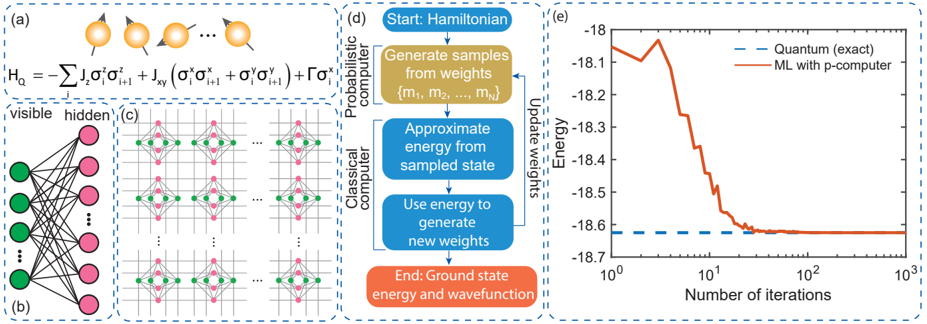
The image depicts a multi-part technical diagram illustrating a machine learning (ML) approach to approximating quantum ground state energy. It includes:
1. A Hamiltonian equation for a spin system (a)
2. A neural network architecture (b)
3. A grid of quantum states (c)
4. A flowchart of the ML algorithm (d)
5. A convergence graph comparing quantum and ML results (e)
### Components/Axes
**Hamiltonian Equation (a):**
- Equation: H_Q = -Σ J_z σ_i^z σ_{i+1}^z + J_xy (σ_i^x σ_{i+1}^x + σ_i^y σ_{i+1}^y) + L σ_i^x
- Variables: J_z (Ising coupling), J_xy (XY coupling), L (transverse field), σ (Pauli matrices)
**Neural Network (b):**
- Visible layer: 6 green nodes
- Hidden layer: 6 pink nodes
- Fully connected architecture with bidirectional connections
**Quantum State Grid (c):**
- 3x3 grid of unit cells
- Green nodes: |↑⟩ state
- Pink nodes: |↓⟩ state
- Dashed lines indicate periodic boundary conditions
**Flowchart (d):**
1. Start: Hamiltonian
2. Generate samples from weights {m₁, m₂, ..., m_N}
3. Approximate energy from sampled state
4. Use energy to generate new weights
5. End: Ground state energy and wavefunction
**Convergence Graph (e):**
- X-axis: Number of iterations (log scale: 10⁰ to 10³)
- Y-axis: Energy (range: -18.7 to -18.1)
- Legend:
- Blue dashed: Quantum (exact)
- Orange solid: ML with p-computer
### Detailed Analysis
**Graph (e) Trends:**
1. Quantum line (blue dashed) remains constant at ~-18.6 energy
2. ML line (orange solid):
- Starts at ~-18.1 (iteration 10⁰)
- Rapid decline to ~-18.6 by iteration 10¹
- Converges to quantum value by iteration 10²
- Maintains stability at quantum level through 10³ iterations
**Flowchart Logic:**
- Iterative process: Hamiltonian → Sampling → Energy approximation → Weight update → Convergence
- Probabilistic computation enables efficient sampling of quantum states
### Key Observations
1. ML energy converges to quantum ground state within ~100 iterations
2. Initial energy error: ~0.5 units (18.1 vs 18.6)
3. Convergence rate: Exponential decay (log scale x-axis)
4. Final energy accuracy: <0.1 unit difference after convergence
### Interpretation
This diagram demonstrates a hybrid quantum-classical approach to solving the ground state problem for spin systems. The ML algorithm effectively approximates quantum mechanical results through:
1. Neural network parameterization of quantum states
2. Probabilistic sampling of spin configurations
3. Energy-based weight updates mimicking quantum annealing
The convergence pattern suggests this method could enable:
- Efficient quantum state tomography
- Variational quantum eigensolver (VQE) implementations
- Hybrid quantum-classical optimization
- Error mitigation in near-term quantum devices
The neural network architecture (b) and quantum state representation (c) indicate a tensor network approach to quantum state approximation, while the flowchart (d) reveals a gradient descent-like optimization process. The graph (e) validates the method's effectiveness, showing exponential convergence typical of variational quantum algorithms.