## Photograph: Humanoid Robot Interaction Setup
### Overview
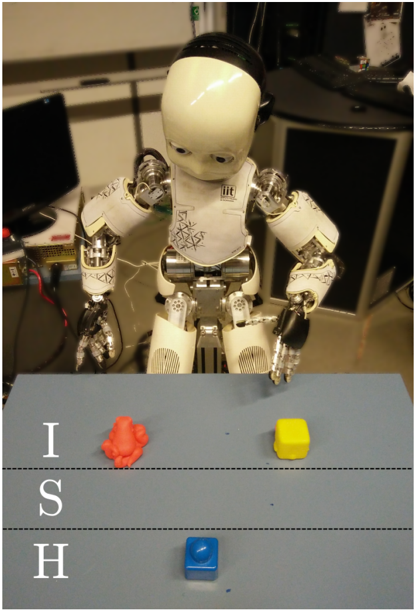
The image depicts a humanoid robot positioned in front of a gray table, interacting with three distinct objects. The robot has a white head and torso with black joints, a black visor, and articulated limbs. Three objects are placed on the table: a red frog-shaped object labeled "I," a yellow cube labeled "S," and a blue cube labeled "H." The robot's arms are positioned near the objects, suggesting active engagement. Background elements include a computer monitor and desk, indicating a controlled environment.
### Components/Axes
- **Robot**:
- White head with black visor and articulated neck.
- White torso with black mechanical joints and visible wiring.
- Arms with black hands and silver actuators.
- Text "iit" visible on the chest plate.
- **Objects on Table**:
- **Red Frog**: Positioned leftmost, labeled "I" (top-left of the table).
- **Yellow Cube**: Center-right, labeled "S" (top-center).
- **Blue Cube**: Bottom-center, labeled "H" (bottom-center).
- **Table**: Gray surface with dashed horizontal lines separating labeled zones.
### Detailed Analysis
- **Robot Posture**: The robot leans slightly forward, with both arms extended toward the objects. The left hand hovers near the red frog ("I"), while the right hand is closer to the yellow cube ("S").
- **Object Placement**:
- The red frog ("I") is isolated on the left, separated by dashed lines from the yellow cube ("S") and blue cube ("H").
- The blue cube ("H") is positioned closer to the robot's base, suggesting a potential interaction sequence (I → S → H).
- **Background**: A computer monitor and desk are visible in the upper-left, implying a control or monitoring station.
### Key Observations
1. **Label Sequence**: The labels "I," "S," and "H" are spatially aligned vertically above their respective objects, possibly indicating a task sequence or categorization.
2. **Robot Interaction**: The robot's posture and proximity to the objects suggest it is either selecting, manipulating, or testing the items.
3. **Color Coding**: The objects use distinct colors (red, yellow, blue) to differentiate them, aiding in task clarity for the robot or observers.
### Interpretation
The setup appears to be part of a robotics experiment or demonstration, where the robot is tasked with interacting with labeled objects in a specific order. The labels "I," "S," and "H" could represent:
- **I**: Initial object (red frog).
- **S**: Secondary object (yellow cube).
- **H**: Tertiary object (blue cube).
The robot's design (articulated limbs, visible actuators) and the controlled environment (monitor, desk) imply a focus on precision tasks, such as object recognition, manipulation, or sequence execution. The dashed lines on the table may demarcate interaction zones, guiding the robot's movements. The absence of numerical data suggests the focus is on qualitative interaction rather than quantitative metrics.