## Algorithm: 2p-greedy
### Overview
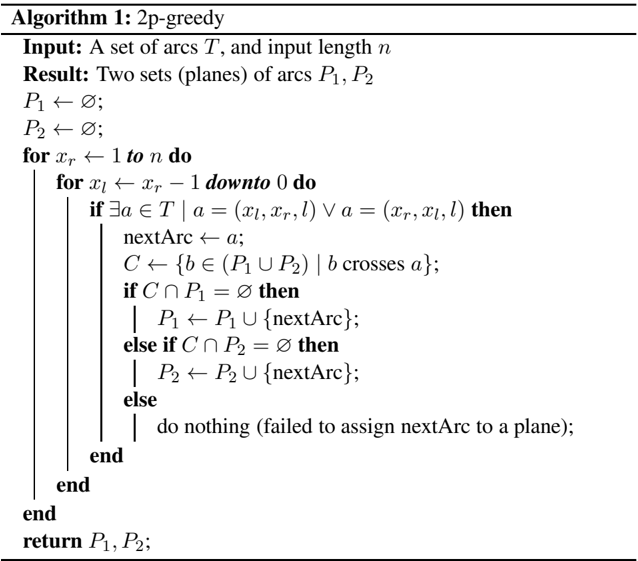
The image presents the pseudocode for an algorithm named "2p-greedy". The algorithm takes a set of arcs T and an input length n as input and returns two sets (planes) of arcs, P1 and P2. The algorithm iterates through possible arc combinations and attempts to assign each arc to either P1 or P2 based on whether it crosses existing arcs in those sets.
### Components/Axes
The algorithm consists of the following components:
* **Algorithm Name:** 2p-greedy
* **Input:**
* A set of arcs T
* Input length n
* **Result:** Two sets (planes) of arcs P1, P2
* **Initialization:**
* P1 is initialized as an empty set (P1 ← Ø)
* P2 is initialized as an empty set (P2 ← Ø)
* **Outer Loop:** Iterates from xr = 1 to n
* **Inner Loop:** Iterates from xl = xr - 1 downto 0
* **Conditional Check:** Checks if there exists an arc 'a' in T such that a = (xl, xr, l) or a = (xr, xl, l)
* **Assignment:**
* If the condition is true, nextArc is assigned to 'a' (nextArc ← a)
* C is defined as the set of arcs in P1 or P2 that cross 'a' (C ← {b ∈ (P1 ∪ P2) | b crosses a})
* If C ∩ P1 = Ø, then nextArc is added to P1 (P1 ← P1 ∪ {nextArc})
* Else, if C ∩ P2 = Ø, then nextArc is added to P2 (P2 ← P2 ∪ {nextArc})
* Otherwise, do nothing (failed to assign nextArc to a plane)
* **Return:** Returns the sets P1 and P2 (return P1, P2)
### Detailed Analysis or Content Details
The algorithm attempts to greedily assign arcs to two sets (planes), P1 and P2. The assignment is based on whether adding an arc to a set would cause it to cross any existing arcs in that set. The algorithm iterates through all possible arc combinations defined by the input length 'n'.
The core logic lies within the nested loops and the conditional checks. The algorithm first checks if a valid arc 'a' exists in the input set T. If it does, it then checks if adding 'a' to either P1 or P2 would cause it to cross any existing arcs in those sets. If adding 'a' to P1 doesn't cause any crossings, it's added to P1. Otherwise, if adding 'a' to P2 doesn't cause any crossings, it's added to P2. If adding 'a' to either set would cause crossings, it's not assigned to either set.
### Key Observations
* The algorithm is "greedy" because it makes decisions based on the immediate impact of adding an arc to a set, without considering the long-term consequences.
* The algorithm aims to minimize crossings within each set of arcs.
* The algorithm may fail to assign some arcs to either P1 or P2 if they cross existing arcs in both sets.
### Interpretation
The 2p-greedy algorithm is designed to partition a set of arcs into two sets (planes) such that the number of crossings within each set is minimized. This type of algorithm could be used in various applications, such as graph drawing or conflict resolution. The algorithm's performance depends on the specific characteristics of the input set of arcs. In some cases, it may produce a good partitioning, while in other cases, it may fail to assign many arcs or produce a partitioning with a high number of crossings. The algorithm's greedy nature means that it may not always find the optimal solution.