\n
## Algorithm: 2p-greedy
### Overview
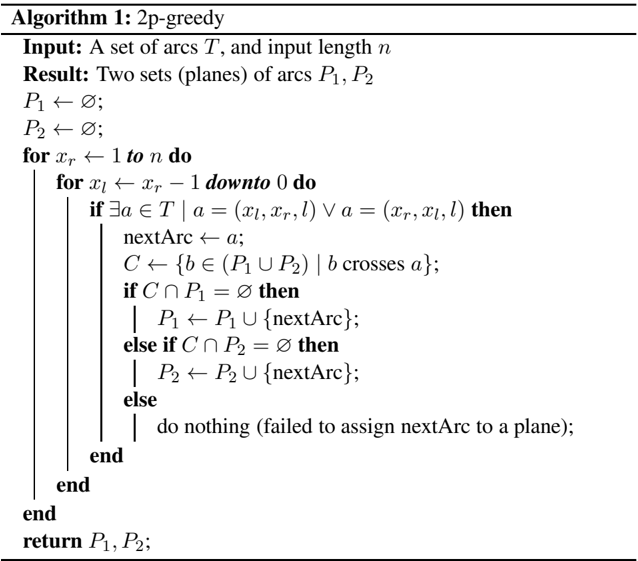
The image presents a pseudocode algorithm named "2p-greedy". It describes a method for partitioning a set of arcs into two sets, P1 and P2, based on a greedy approach that considers arc crossings.
### Components/Axes
The image consists entirely of text representing the algorithm's steps. There are no axes, charts, or diagrams in the traditional sense. The key components are:
* **Algorithm Title:** "Algorithm 1: 2p-greedy"
* **Input:** "A set of arcs T, and input length n"
* **Result:** "Two sets (planes) of arcs P1, P2"
* **Variables:** P1, P2, xr, x1, a, nextArc, C, b
* **Control Flow:** `for` loops, `if` statements, `else` statements, `return` statement.
### Content Details
The pseudocode can be transcribed as follows:
```
Algorithm 1: 2p-greedy
Input: A set of arcs T, and input length n
Result: Two sets (planes) of arcs P1, P2
P1 ← ∅;
P2 ← ∅;
for xr ← 1 to n do
for x1 ← xr – 1 downto 0 do
if ∃a ∈ T | a = (xr, x1, l) ∀a = (xr, x1, l) then
nextArc ← a;
C ← {b ∈ (P1 ∪ P2) | b crosses a};
if C ∩ P1 = ∅ then
| P1 ← P1 ∪ {nextArc};
else if C ∩ P2 = ∅ then
| P2 ← P2 ∪ {nextArc};
else
| do nothing (failed to assign nextArc to a plane);
end
end
end
end
return P1, P2;
```
### Key Observations
The algorithm iterates through possible arc combinations (xr, x1) and attempts to assign each arc to either P1 or P2. The assignment is based on whether the arc crosses any existing arcs in the respective set. If an arc crosses arcs in both P1 and P2, it is not assigned to either set. The algorithm uses set notation (∅, ∪, ∩) to represent set operations.
### Interpretation
This algorithm appears to be designed for a planarization problem, likely related to graph drawing or circuit layout. The goal is to divide a set of arcs into two subsets such that the arcs within each subset do not cross each other (or minimize crossings). The "greedy" aspect suggests that the algorithm makes locally optimal decisions at each step (assigning an arc to the first available set without considering the global impact). The algorithm's effectiveness would depend on the specific characteristics of the input arc set T and the value of n. The algorithm's failure condition (doing nothing when an arc crosses both P1 and P2) indicates that it may not always be able to completely partition the arcs into two planar sets. The use of "l" in the arc definition `a = (xr, x1, l)` suggests that 'l' represents a length or some other attribute associated with the arc. The algorithm's logic centers around avoiding crossings, which is a fundamental requirement for planar graphs.