## Line Chart: Cumulative Text Generation Time vs. Token Count
### Overview
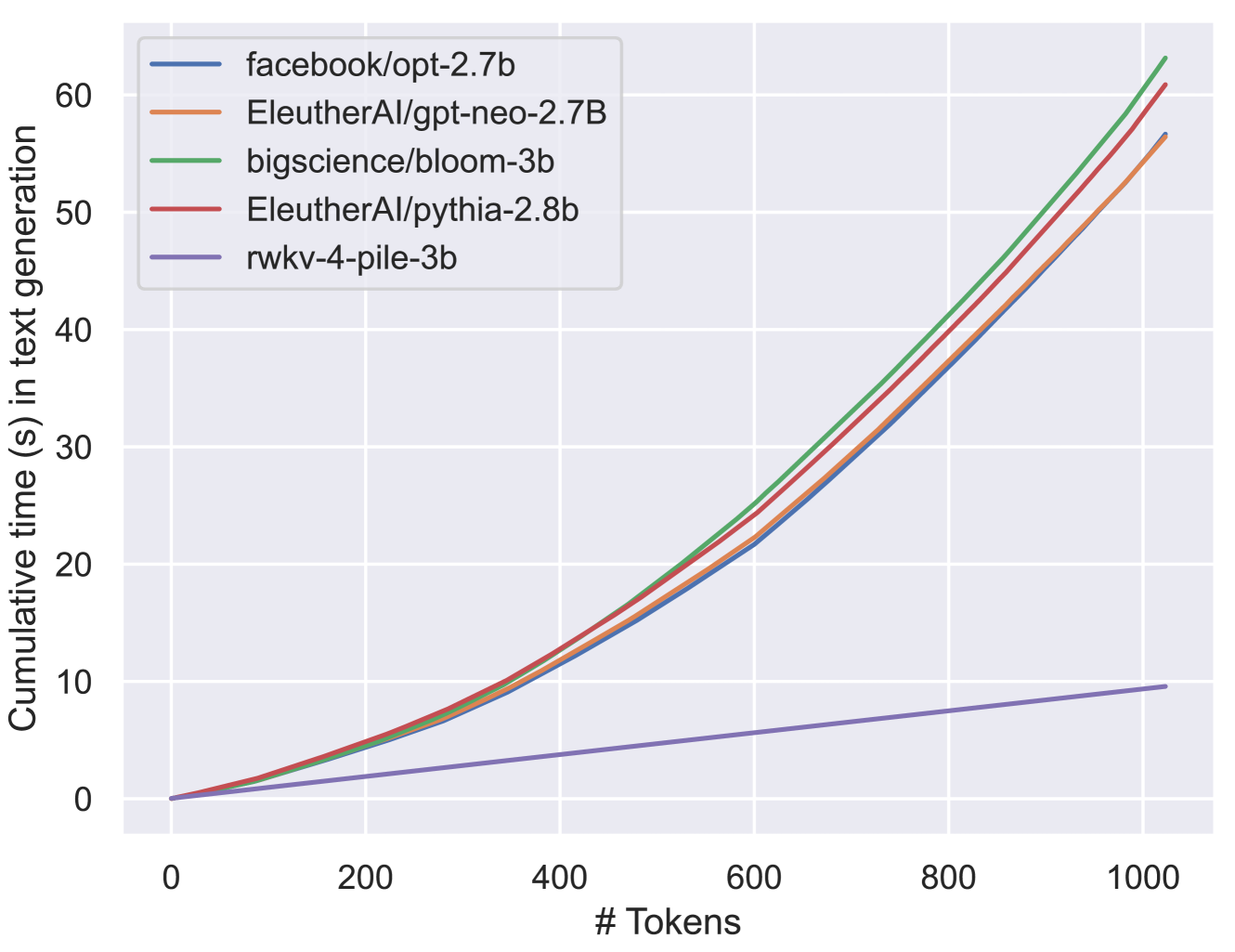
The image displays a line chart comparing the cumulative time (in seconds) required for text generation across five different AI models as a function of token count (0-1000 tokens). The chart shows five distinct data series with varying performance characteristics.
### Components/Axes
- **X-axis**: "# Tokens" (0 to 1000 in increments of 200)
- **Y-axis**: "Cumulative time (s) in text generation" (0 to 60 seconds)
- **Legend**: Located in top-left corner with five entries:
- Blue: facebook/opt-2.7b
- Orange: EleutherAI/gpt-neo-2.7B
- Green: bigscience/bloom-3b
- Red: EleutherAI/pythia-2.8b
- Purple: rwkv-4-pile-3b
### Detailed Analysis
1. **facebook/opt-2.7b** (Blue line):
- Starts at (0,0)
- Curves upward with moderate slope
- Reaches ~52s at 1000 tokens
2. **EleutherAI/gpt-neo-2.7B** (Orange line):
- Starts at (0,0)
- Curves upward with steep slope
- Reaches ~55s at 1000 tokens
3. **bigscience/bloom-3b** (Green line):
- Starts at (0,0)
- Curves upward with steepest slope
- Reaches ~60s at 1000 tokens
4. **EleutherAI/pythia-2.8b** (Red line):
- Starts at (0,0)
- Curves upward with steep slope
- Reaches ~58s at 1000 tokens
5. **rwkv-4-pile-3b** (Purple line):
- Starts at (0,0)
- Linear progression with shallow slope
- Reaches ~10s at 1000 tokens
### Key Observations
- All models show increasing cumulative time with token count
- rwkv-4-pile-3b demonstrates significantly better performance (lowest time)
- bigscience/bloom-3b shows worst performance (highest time)
- Lines exhibit different curvature patterns:
- rwkv-4-pile-3b: Most linear
- Others: Increasingly concave upward
- At 600 tokens, performance gap widens:
- rwkv-4-pile-3b: ~7s
- facebook/opt-2.7b: ~22s
- EleutherAI/gpt-neo-2.7B: ~24s
- EleutherAI/pythia-2.8b: ~26s
- bigscience/bloom-3b: ~28s
### Interpretation
The data reveals significant performance disparities between models. The rwkv-4-pile-3b model demonstrates exceptional efficiency, maintaining near-linear scaling with minimal time increase per token. In contrast, the bigscience/bloom-3b model shows diminishing returns with steeper time increases per additional token. This suggests architectural differences in model design, with rwkv-4-pile-3b potentially optimized for faster inference. The chart highlights important considerations for deployment scenarios where real-time text generation is critical, with rwkv-4-pile-3b appearing most suitable for high-throughput applications.