## Line Graph: Quantile Distributions by Gender
### Overview
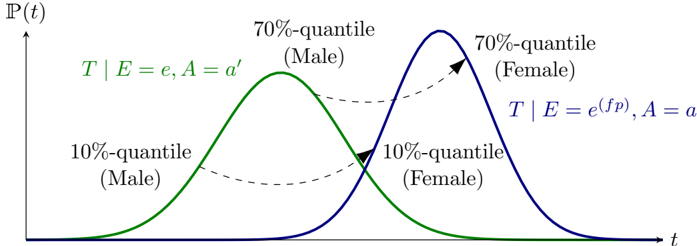
The image depicts a line graph comparing the probability distributions of quantiles for males and females across a variable `t`. Two curves (green for males, blue for females) illustrate the 10% and 70% quantiles, with annotations and equations indicating conditional thresholds.
### Components/Axes
- **Vertical Axis (Y-axis)**: Labeled `P(t)`, representing probability.
- **Horizontal Axis (X-axis)**: Labeled `t`, likely a time or ordinal variable.
- **Legend**: Located on the right, associating:
- **Green**: Male (10%-quantile and 70%-quantile).
- **Blue**: Female (10%-quantile and 70%-quantile).
- **Equations**:
- `T | E = e, A = a'` (Green curve condition).
- `T | E = e^(fp), A = a` (Blue curve condition).
### Detailed Analysis
1. **Green Curve (Male)**:
- **10%-quantile**: Peaks at `t ≈ 3`, with `P(t)` reaching ~0.1.
- **70%-quantile**: Peaks at `t ≈ 5`, with `P(t)` reaching ~0.7.
- Shape: Unimodal, symmetric, with a gradual rise and fall.
2. **Blue Curve (Female)**:
- **10%-quantile**: Peaks at `t ≈ 4`, with `P(t)` reaching ~0.1.
- **70%-quantile**: Peaks at `t ≈ 6`, with `P(t)` reaching ~0.7.
- Shape: Unimodal, slightly skewed right, with a sharper rise and delayed decline.
3. **Key Annotations**:
- Arrows link quantile labels to their respective peaks on each curve.
- Equations suggest conditional probabilities (`T` given `E` and `A`), with `e^(fp)` implying an exponential relationship for females.
### Key Observations
- **Gender Differences**: Female quantiles occur at higher `t` values than male quantiles (e.g., 70%-quantile at `t=6` vs. `t=5` for males).
- **Overlap**: The 10%-quantile for females (`t=4`) overlaps with the male 70%-quantile (`t=5`), suggesting potential inverse relationships in the measured variable.
- **Equations**: The presence of `e^(fp)` for females implies a multiplicative or exponential factor not present in the male condition.
### Interpretation
The graph highlights distinct distributions between genders, with females exhibiting delayed and higher peaks in quantiles. This could indicate:
- **Temporal Delay**: Females achieve higher quantiles later in `t` (e.g., 70%-quantile at `t=6` vs. `t=5` for males).
- **Conditional Factors**: The equations suggest differing thresholds (`E = e` vs. `E = e^(fp)`), possibly reflecting biological, social, or environmental variables.
- **Probability Dynamics**: The sharper rise in the female curve may imply a steeper increase in the probability of exceeding thresholds compared to males.
The data underscores the importance of gender-specific analysis in probabilistic modeling, with equations hinting at underlying mechanisms driving these differences.