## Vector Diagram: Angular Relationships of U(r) Components
### Overview
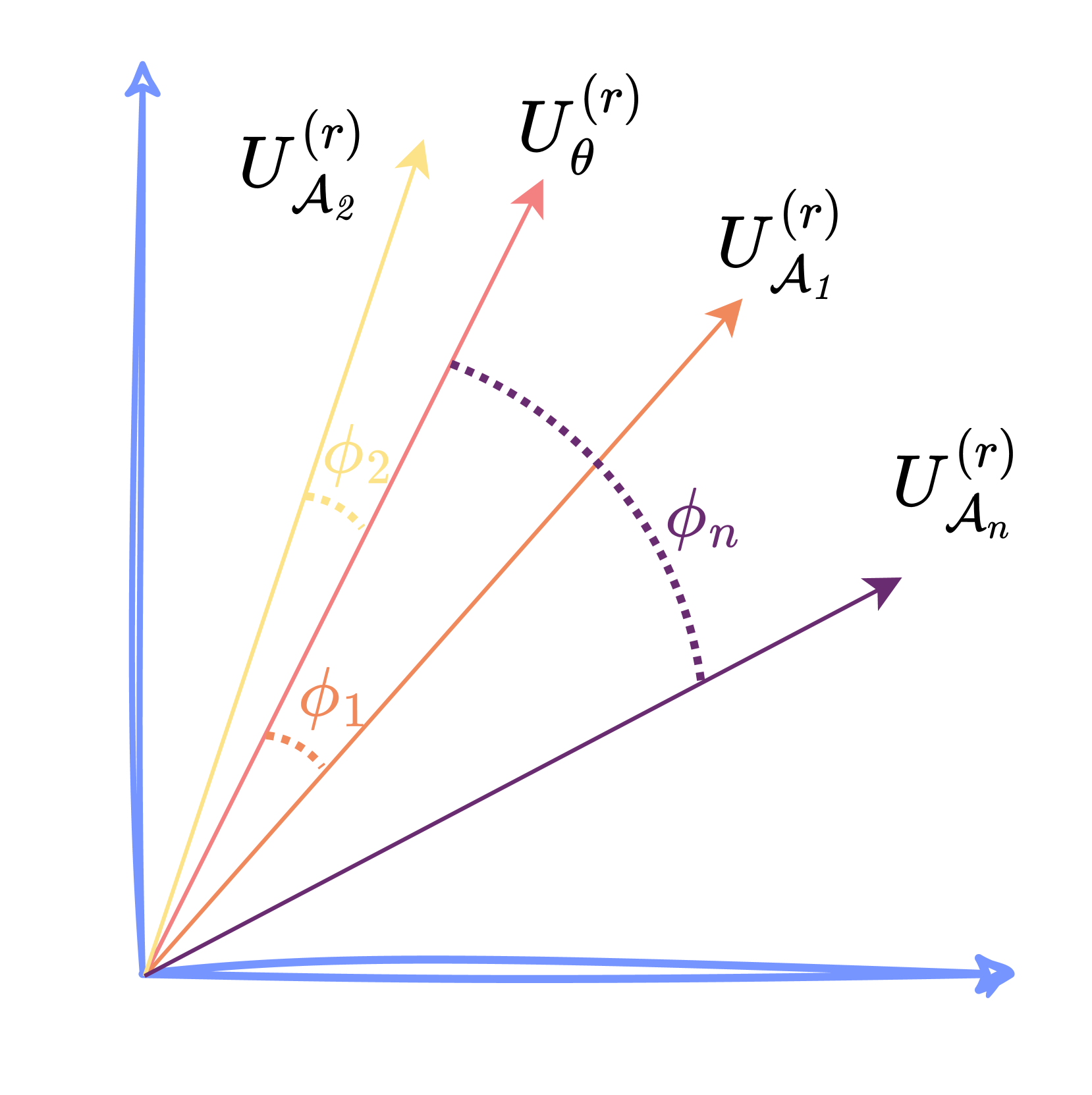
The diagram illustrates a set of vectors originating from a common origin, arranged in a fan-like pattern. Each vector is labeled with a distinct mathematical expression (e.g., \( U_{\mathcal{A}_2}^{(r)} \), \( U_\theta^{(r)} \), \( U_{\mathcal{A}_1}^{(r)} \), \( U_{\mathcal{A}_n}^{(r)} \)) and associated with angular deviations (\( \phi_1, \phi_2, \phi_n \)) from a reference axis. The vectors are color-coded (yellow, red, orange, purple) and positioned relative to two perpendicular axes.
---
### Components/Axes
- **Axes**:
- Vertical axis: Upward-pointing arrow (no explicit label).
- Horizontal axis: Rightward-pointing arrow (no explicit label).
- **Vectors**:
- \( U_{\mathcal{A}_2}^{(r)} \): Yellow vector, smallest angular deviation (\( \phi_2 \)).
- \( U_\theta^{(r)} \): Red vector, intermediate angular deviation (\( \phi_1 \)).
- \( U_{\mathcal{A}_1}^{(r)} \): Orange vector, larger angular deviation (\( \phi_n \)).
- \( U_{\mathcal{A}_n}^{(r)} \): Purple vector, largest angular deviation (\( \phi_n \)).
- **Angles**:
- \( \phi_1 \): Angle between \( U_{\mathcal{A}_2}^{(r)} \) and \( U_\theta^{(r)} \).
- \( \phi_2 \): Angle between \( U_\theta^{(r)} \) and \( U_{\mathcal{A}_1}^{(r)} \).
- \( \phi_n \): Total angular deviation from the horizontal axis to \( U_{\mathcal{A}_n}^{(r)} \).
- **Legend**:
- Located on the left side of the diagram.
- Associates colors with vector labels (e.g., yellow = \( U_{\mathcal{A}_2}^{(r)} \), red = \( U_\theta^{(r)} \), etc.).
---
### Detailed Analysis
- **Vector Arrangement**:
Vectors are ordered by increasing angular deviation from the horizontal axis:
\( U_{\mathcal{A}_2}^{(r)} \) (smallest angle) → \( U_\theta^{(r)} \) → \( U_{\mathcal{A}_1}^{(r)} \) → \( U_{\mathcal{A}_n}^{(r)} \) (largest angle).
- **Angular Relationships**:
- \( \phi_1 \approx 30^\circ \) (estimated from spacing between \( U_{\mathcal{A}_2}^{(r)} \) and \( U_\theta^{(r)} \)).
- \( \phi_2 \approx 45^\circ \) (estimated from spacing between \( U_\theta^{(r)} \) and \( U_{\mathcal{A}_1}^{(r)} \)).
- \( \phi_n \approx 75^\circ \) (total angle from horizontal to \( U_{\mathcal{A}_n}^{(r)} \)).
- **Color Coding**:
- Yellow (\( U_{\mathcal{A}_2}^{(r)} \)): Closest to the horizontal axis.
- Red (\( U_\theta^{(r)} \)): Intermediate position.
- Orange (\( U_{\mathcal{A}_1}^{(r)} \)): Further deviation.
- Purple (\( U_{\mathcal{A}_n}^{(r)} \)): Most deviated.
---
### Key Observations
1. **Progressive Angular Increase**:
The vectors exhibit a systematic increase in angular deviation from the horizontal axis, suggesting a dependency on parameters \( \mathcal{A}_1, \mathcal{A}_2, \theta, \mathcal{A}_n \).
2. **Angle Proportionality**:
The angles \( \phi_1, \phi_2, \phi_n \) are not uniformly spaced, indicating non-linear relationships between vector components.
3. **Legend Clarity**:
The legend explicitly links colors to vector labels, ensuring unambiguous identification.
---
### Interpretation
This diagram likely represents a physical or mathematical system where directional components (\( U^{(r)} \)) vary with specific parameters (\( \mathcal{A}_1, \mathcal{A}_2, \theta, \mathcal{A}_n \)). The angular deviations (\( \phi_1, \phi_2, \phi_n \)) could correspond to:
- **Physical Phenomena**: Directional forces, wavefronts, or field orientations in a multi-parameter system.
- **Mathematical Relationships**: Solutions to equations where \( U^{(r)} \) depends on discrete variables (e.g., \( \mathcal{A}_i \)).
- **Anomalies**: The non-uniform spacing of angles (\( \phi_1 \neq \phi_2 \)) suggests asymmetric contributions from different parameters.
The diagram emphasizes the interplay between vector magnitude/direction and underlying parameters, critical for modeling systems with directional dependencies (e.g., fluid dynamics, electromagnetism, or optimization algorithms).