## Chart Type: Line Chart - Proportion of Flips for SmolLM2-1.7B
### Overview
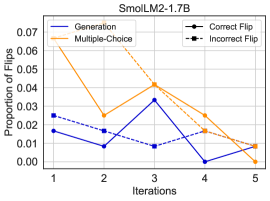
This image displays a line chart titled "SmolLM2-1.7B", illustrating the "Proportion of Flips" on the Y-axis against "Iterations" on the X-axis. The chart presents four distinct data series, categorized by task type (Generation or Multiple-Choice) and flip outcome (Correct Flip or Incorrect Flip).
### Components/Axes
* **Chart Title**: SmolLM2-1.7B
* **X-axis Label**: Iterations
* **X-axis Markers**: 1, 2, 3, 4, 5
* **Y-axis Label**: Proportion of Flips
* **Y-axis Markers**: 0.00, 0.01, 0.02, 0.03, 0.04, 0.05, 0.06, 0.07
* **Legend**: The legend is split into two boxes, located in the top-left and top-right of the plot area.
* **Top-left Legend Box**:
* Blue solid line with square marker: "Generation"
* Orange solid line with square marker: "Multiple-Choice"
* **Top-right Legend Box**:
* Black solid line with circular marker: "Correct Flip"
* Black dashed line with circular marker: "Incorrect Flip"
* **Legend Discrepancy**: All data points on the chart are represented by square markers. The top-right legend box, however, depicts circular markers for "Correct Flip" and "Incorrect Flip". This is a visual inconsistency between the legend's representation and the actual plotted data points.
* **Inferred Legend Mapping (based on color and line style)**:
* **Generation - Correct Flip**: Blue solid line with square markers.
* **Generation - Incorrect Flip**: Blue dashed line with square markers.
* **Multiple-Choice - Correct Flip**: Orange solid line with square markers.
* **Multiple-Choice - Incorrect Flip**: Orange dashed line with square markers.
### Detailed Analysis
The chart plots four data series, each representing the proportion of flips over five iterations. All data points are marked with square markers.
1. **Generation - Correct Flip (Blue solid line)**:
* **Trend**: This series shows a fluctuating pattern. It starts at a moderate level, dips, peaks significantly, then drops to near zero before a slight recovery.
* **Data Points**:
* Iteration 1: Approximately 0.017
* Iteration 2: Approximately 0.008
* Iteration 3: Approximately 0.034 (Peak)
* Iteration 4: Approximately 0.000 (Near zero)
* Iteration 5: Approximately 0.008
2. **Generation - Incorrect Flip (Blue dashed line)**:
* **Trend**: This series generally shows a decreasing trend with a slight increase in the middle.
* **Data Points**:
* Iteration 1: Approximately 0.025
* Iteration 2: Approximately 0.017
* Iteration 3: Approximately 0.008
* Iteration 4: Approximately 0.017
* Iteration 5: Approximately 0.008
3. **Multiple-Choice - Correct Flip (Orange solid line)**:
* **Trend**: This series starts at a high value, drops sharply, then fluctuates downwards, ending at a very low proportion.
* **Data Points**:
* Iteration 1: Approximately 0.062
* Iteration 2: Approximately 0.025
* Iteration 3: Approximately 0.042
* Iteration 4: Approximately 0.025
* Iteration 5: Approximately 0.008
4. **Multiple-Choice - Incorrect Flip (Orange dashed line)**:
* **Trend**: This series mirrors the "Multiple-Choice - Correct Flip" for the first three iterations, then diverges with a continued downward trend, ending at near zero.
* **Data Points**:
* Iteration 1: Approximately 0.062
* Iteration 2: Approximately 0.025
* Iteration 3: Approximately 0.042
* Iteration 4: Approximately 0.017
* Iteration 5: Approximately 0.000 (Near zero)
### Key Observations
* **Legend Inconsistency**: The legend for "Correct Flip" and "Incorrect Flip" shows circular markers, while all data points on the graph use square markers.
* **Identical Multiple-Choice Flips (Iterations 1-3)**: For the first three iterations, the "Multiple-Choice - Correct Flip" and "Multiple-Choice - Incorrect Flip" series have identical proportions. They only diverge from Iteration 4 onwards.
* **Higher Initial Flips for Multiple-Choice**: Both "Multiple-Choice" flip proportions (correct and incorrect) start significantly higher than their "Generation" counterparts at Iteration 1.
* **Overall Decrease in Multiple-Choice Flips**: Both "Multiple-Choice" series show a general downward trend, reaching very low proportions by Iteration 5.
* **Fluctuating Generation Flips**: The "Generation - Correct Flip" series exhibits a notable peak at Iteration 3, reaching its highest value, before dropping sharply. The "Generation - Incorrect Flip" shows a more gradual decrease.
* **Low Proportions by Iteration 5**: By the final iteration, all four series show very low proportions of flips, with "Multiple-Choice - Incorrect Flip" and "Generation - Correct Flip" being near zero.
### Interpretation
This chart likely illustrates the stability or change in predictions of the SmolLM2-1.7B model over several "Iterations" (possibly training epochs, fine-tuning steps, or evaluation rounds). A "flip" could represent a change in the model's output or prediction for a given input.
The most striking observation is the identical "Proportion of Flips" for both "Correct Flip" and "Incorrect Flip" within the "Multiple-Choice" task for the first three iterations. This is highly unusual. It could suggest:
1. An error in data collection or plotting.
2. That for these initial iterations, the definition or measurement of "correct" versus "incorrect" flips was not yet differentiated, or that every flip was simultaneously considered both correct and incorrect in some context.
3. That the model's behavior in the Multiple-Choice task was such that any change in prediction (a "flip") had an equal chance of being correct or incorrect, or that the evaluation metric treated them identically in the early stages.
For the "Multiple-Choice" task, the overall downward trend in flip proportions suggests that as iterations progress, the model becomes more stable in its predictions, making fewer changes. This could indicate convergence or increased confidence in its answers.
In contrast, the "Generation" task shows more dynamic behavior. The "Generation - Correct Flip" series peaks at Iteration 3, suggesting that at this stage, the model was making a relatively high proportion of beneficial changes to its generated output. However, this ability then sharply declines. The "Generation - Incorrect Flip" generally decreases, indicating fewer detrimental changes over time.
By Iteration 5, all flip proportions are very low, implying that the SmolLM2-1.7B model has largely stabilized its outputs for both "Generation" and "Multiple-Choice" tasks. The model appears to make very few "flips" by the end, regardless of whether they would be correct or incorrect. This could be interpreted as the model having converged to a stable state, or perhaps becoming less adaptable to new information or prompts. The difference in trends between "Generation" and "Multiple-Choice" tasks highlights that the model's learning dynamics and stability can vary significantly depending on the task type.