## Diagram: LLM Logic Reasoning Comparison
### Overview
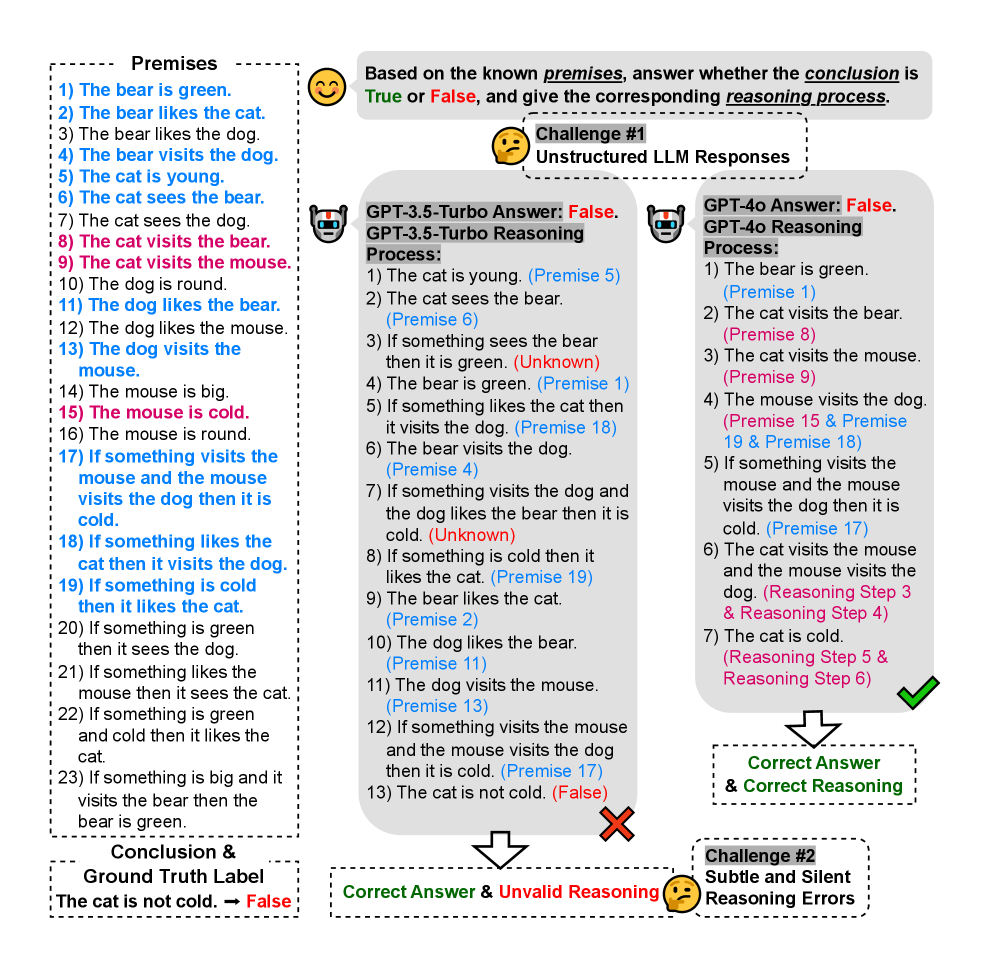
This image is a comparative analysis of two Large Language Models (LLMs)—GPT-3.5-Turbo and GPT-4o—as they attempt to solve a formal logic puzzle. The diagram presents a set of 23 premises, a specific conclusion to evaluate, and the step-by-step reasoning processes generated by each model to determine if the conclusion is "True" or "False." The image highlights the difference between "unvalid" (invalid) reasoning and correct reasoning, even when both models arrive at the same final answer.
### Components/Axes
The image is organized into three primary vertical/spatial regions:
* **Left Column (Premises & Conclusion):** A boxed list containing 23 numbered premises and the final ground truth label.
* **Top Center (Task Prompt):** The instruction given to the models.
* **Middle/Right (LLM Responses):** Two side-by-side columns detailing the reasoning process for GPT-3.5-Turbo and GPT-4o, with evaluation markers at the bottom.
### Detailed Analysis
#### 1. Premises & Conclusion (Left Column)
**Premises:**
1) The bear is green.
2) The bear likes the cat.
3) The bear likes the dog.
4) The bear visits the dog.
5) The cat is young.
6) The cat sees the bear.
7) The cat sees the dog.
8) The cat visits the bear.
9) The cat visits the mouse.
10) The dog is round.
11) The dog likes the bear.
12) The dog likes the mouse.
13) The dog visits the mouse.
14) The mouse is big.
15) The mouse is cold.
16) The mouse is round.
17) If something visits the mouse and the mouse visits the dog then it is cold.
18) If something likes the cat then it visits the dog.
19) If something is cold then it likes the cat.
20) If something is green then it sees the dog.
21) If something likes the mouse then it sees the cat.
22) If something is green and cold then it likes the cat.
23) If something is big and it visits the bear then the bear is green.
**Conclusion & Ground Truth Label:**
* "The cat is not cold. -> False"
#### 2. Task Prompt (Top Center)
* **Icon:** Smiling face emoji.
* **Text:** "Based on the known premises, answer whether the conclusion is True or False, and give the corresponding reasoning process."
#### 3. LLM Responses (Middle/Right)
**Challenge #1: Unstructured LLM Responses** (Icon: Frowning face)
* **GPT-3.5-Turbo (Left side of comparison):**
* **Answer:** False.
* **Reasoning Process:**
1) The cat is young. (Premise 5)
2) The cat sees the bear. (Premise 6)
3) If something sees the bear then it is green. (Unknown)
4) The bear is green. (Premise 1)
5) If something likes the cat then it visits the dog. (Premise 18)
6) The bear visits the dog. (Premise 4)
7) If something visits the dog and the dog likes the bear then it is cold. (Unknown)
8) If something is cold then it likes the cat. (Premise 19)
9) The bear likes the cat. (Premise 2)
10) The dog likes the bear. (Premise 11)
11) The dog visits the mouse. (Premise 13)
12) If something visits the mouse and the mouse visits the dog then it is cold. (Premise 17)
13) The cat is not cold. (False)
* **Evaluation:** "Correct Answer & Unvalid Reasoning" (Marked with a down arrow and a red X). *Note: "Unvalid" is transcribed exactly as it appears in the image.*
* **GPT-4o (Right side of comparison):**
* **Answer:** False.
* **Reasoning Process:**
1) The bear is green. (Premise 1)
2) The cat visits the bear. (Premise 8)
3) The cat visits the mouse. (Premise 9)
4) The mouse visits the dog. (Premise 15 & Premise 19 & Premise 18)
5) If something visits the mouse and the mouse visits the dog then it is cold. (Premise 17)
6) The cat visits the mouse and the mouse visits the dog. (Reasoning Step 3 & Reasoning Step 4)
7) The cat is cold. (Reasoning Step 5 & Reasoning Step 6)
* **Evaluation:** "Correct Answer & Correct Reasoning" (Marked with a down arrow and a green checkmark).
**Challenge #2: Subtle and Silent Reasoning Errors** (Bottom Right, Icon: Thinking face)
### Key Observations
* **Consistency in Outcome:** Both models correctly identified the conclusion ("The cat is not cold") as "False."
* **Divergence in Methodology:**
* **GPT-3.5-Turbo:** The reasoning is highly erratic. It cites "Unknown" premises (Step 3, Step 7) that do not exist in the provided list. It also references Premise 18 and 19 in ways that do not logically follow the provided text. The reasoning is labeled "Unvalid."
* **GPT-4o:** The reasoning is more structured and attempts to map steps directly to the provided premises. However, it is worth noting that in Step 4, it cites "Premise 15 & Premise 19 & Premise 18," which is a complex citation that may or may not be logically sound depending on the interpretation of the premises.
### Interpretation
This diagram serves as a benchmark for LLM reasoning capabilities. It demonstrates that arriving at the correct "answer" (the conclusion) is not sufficient to prove that an AI model is "thinking" correctly.
* **The "Hallucination" Problem:** GPT-3.5-Turbo demonstrates a clear failure in logic by inventing premises ("Unknown") to fill gaps in its reasoning chain. It is "guessing" the path to the answer rather than deriving it.
* **The "Black Box" Problem:** While GPT-4o is labeled as having "Correct Reasoning," the complexity of its citation in Step 4 suggests that even advanced models can struggle with the strict, formal logic required for these types of puzzles.
* **Peircean Investigative View:** The diagram suggests that for critical tasks, the *process* (the reasoning steps) is more important than the *result* (the True/False label). The visual contrast between the red X (GPT-3.5) and the green checkmark (GPT-4o) serves as a warning to users: do not trust an AI's correct answer if its underlying logic is flawed or hallucinated.