## Mathematical Expressions and Notes
### Overview
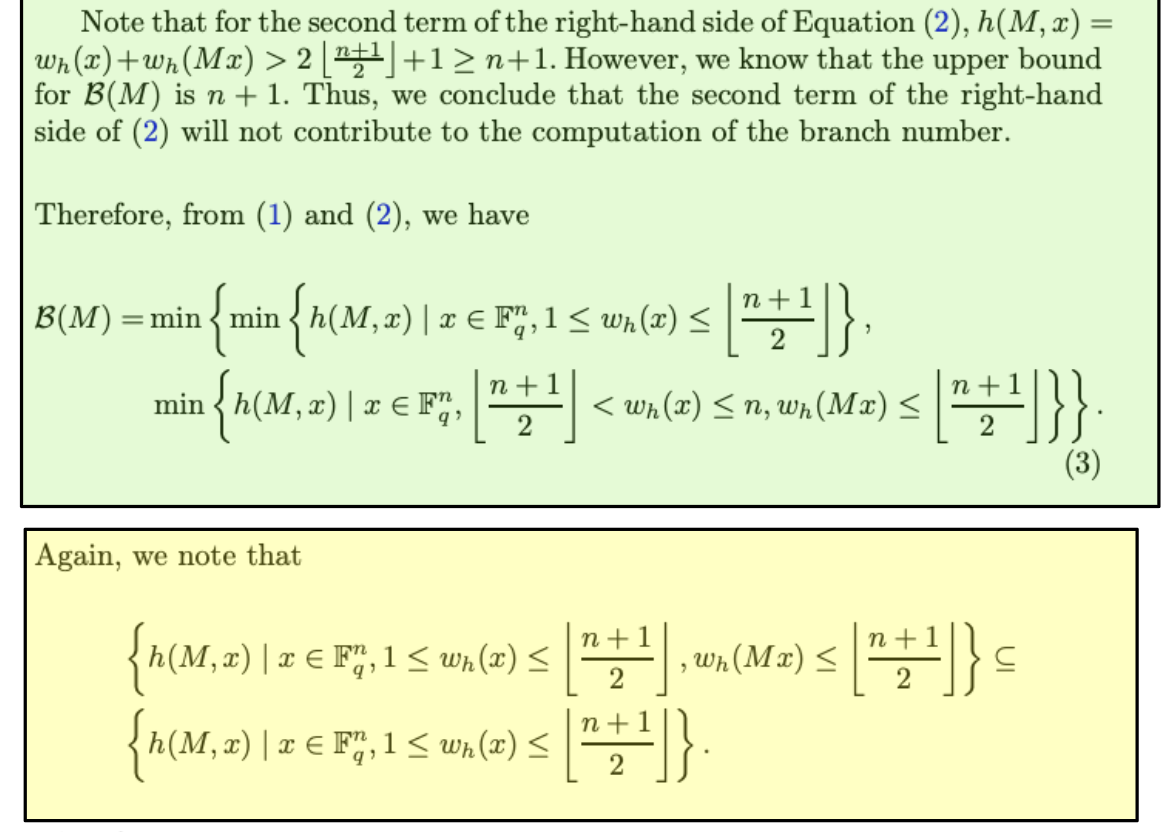
The image contains two blocks of mathematical expressions and notes related to an equation and its properties. The first block, with a light green background, presents an argument about the terms of an equation and derives a formula for B(M). The second block, with a light yellow background, presents a further note regarding the relationship between sets defined by certain conditions.
### Components/Axes
The image does not contain axes or legends in the traditional sense. Instead, it presents mathematical expressions and logical statements. The key components are:
* Mathematical variables: M, x, n, q
* Functions: h(M, x), wh(x), wh(Mx), B(M)
* Mathematical operators: min, ∈, ≤, >, ≥, +, =, ⊂
* Sets: F^n\_q
* Floor function: \[...]
### Detailed Analysis or ### Content Details
**First Block (Light Green Background):**
* **Initial Note:** "Note that for the second term of the right-hand side of Equation (2), h(M, x) = wh(x) + wh(Mx) > 2 * floor((n+1)/2) + 1 ≥ n + 1. However, we know that the upper bound for B(M) is n + 1. Thus, we conclude that the second term of the right-hand side of (2) will not contribute to the computation of the branch number."
* **Derivation:** "Therefore, from (1) and (2), we have"
* **Equation for B(M):**
B(M) = min { min { h(M, x) | x ∈ F^n\_q, 1 ≤ wh(x) ≤ floor((n+1)/2) }, min { h(M, x) | x ∈ F^n\_q, floor((n+1)/2) < wh(x) ≤ n, wh(Mx) ≤ floor((n+1)/2) } }. (3)
**Second Block (Light Yellow Background):**
* **Introductory Statement:** "Again, we note that"
* **Set Inclusion:**
{ h(M, x) | x ∈ F^n\_q, 1 ≤ wh(x) ≤ floor((n+1)/2), wh(Mx) ≤ floor((n+1)/2) } ⊂ { h(M, x) | x ∈ F^n\_q, 1 ≤ wh(x) ≤ floor((n+1)/2) }.
### Key Observations
* The first block establishes a lower bound for h(M, x) and uses it to simplify the calculation of B(M).
* The second block states that a set of h(M,x) values, where both wh(x) and wh(Mx) are bounded by floor((n+1)/2), is a subset of the set where only wh(x) is bounded by floor((n+1)/2).
### Interpretation
The image presents a mathematical argument and derivation related to the function B(M). The initial note in the first block simplifies the computation of B(M) by showing that a certain term does not contribute. The equation for B(M) then expresses it as the minimum of two minimum values of h(M, x) under different conditions on wh(x) and wh(Mx). The second block further refines the understanding of the sets involved by stating an inclusion relationship. The overall purpose is likely to provide a more efficient or insightful way to calculate or analyze B(M) in a specific context.