## Text-Based Mathematical Explanation
### Overview
The image contains two text blocks with mathematical reasoning about branch numbers (denoted as **B(M)**). The content includes inequalities, set notation, and logical deductions about upper bounds. No visual charts, diagrams, or data tables are present.
### Components/Axes
- **Text Blocks**:
1. **Green Box**: Contains two equations labeled (2) and (3), with explanations about upper bounds and branch number computation.
2. **Yellow Box**: Contains two equations with set-builder notation and inequalities.
### Detailed Analysis
#### Green Box Text
1. **Equation (2)**:
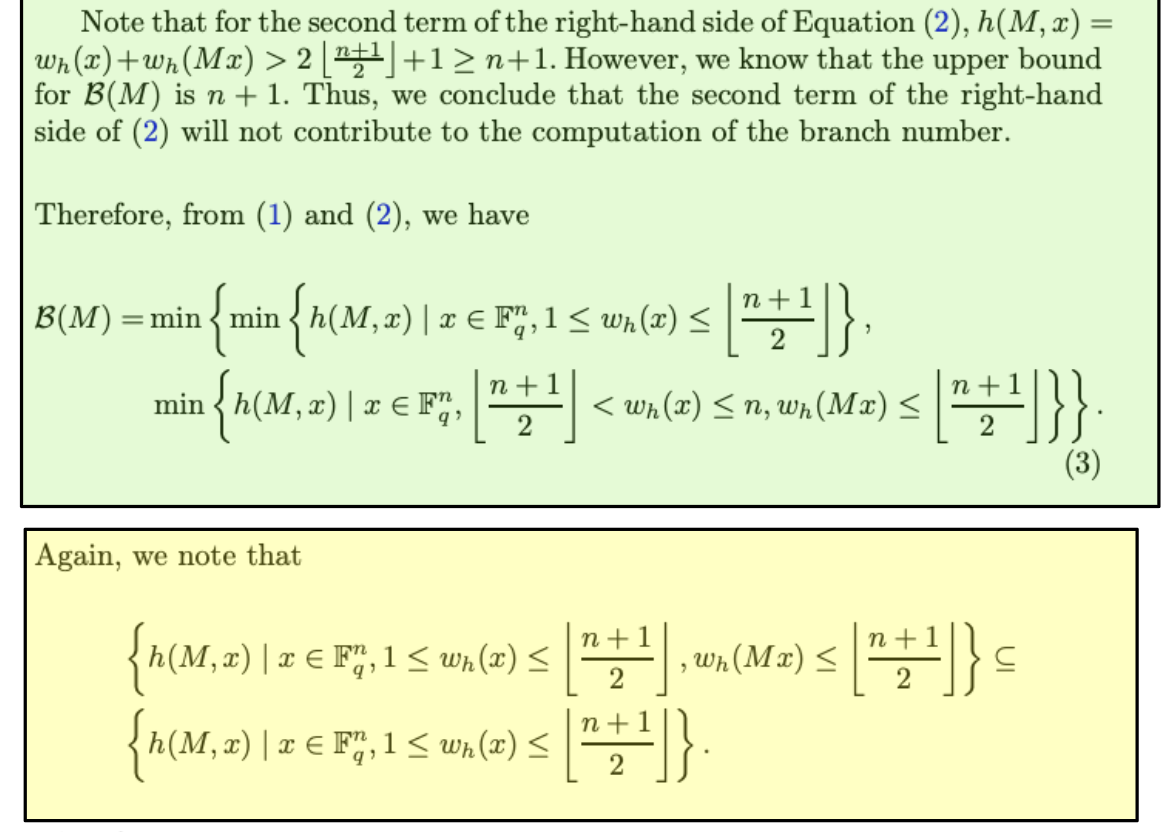
- **Text**: "Note that for the second term of the right-hand side of Equation (2), \( h(M, x) = w_h(x) + w_h(Mx) > 2 \left\lfloor \frac{n+1}{2} \right\rfloor + 1 \geq n+1 \). However, we know that the upper bound for \( \mathcal{B}(M) \) is \( n+1 \). Thus, we conclude that the second term of the right-hand side of (2) will not contribute to the computation of the branch number."
- **Key Elements**:
- \( h(M, x) = w_h(x) + w_h(Mx) \)
- Upper bound \( \mathcal{B}(M) = n+1 \)
- Floor function: \( \left\lfloor \frac{n+1}{2} \right\rfloor \)
2. **Equation (3)**:
- **Text**: "Therefore, from (1) and (2), we have \( \mathcal{B}(M) = \min \left\{ \min \left\{ h(M, x) \mid x \in \mathbb{F}_q^n, 1 \leq w_h(x) \leq \left\lfloor \frac{n+1}{2} \right\rfloor \right\}, \min \left\{ h(M, x) \mid x \in \mathbb{F}_q^n, \left\lfloor \frac{n+1}{2} \right\rfloor < w_h(x) \leq n, w_h(Mx) \leq \left\lfloor \frac{n+1}{2} \right\rfloor \right\} \right\} \)."
- **Key Elements**:
- Branch number definition: \( \mathcal{B}(M) \)
- Domain: \( x \in \mathbb{F}_q^n \) (finite field vectors)
- Weight constraints: \( w_h(x) \leq \left\lfloor \frac{n+1}{2} \right\rfloor \)
#### Yellow Box Text
- **Text**: "Again, we note that \( \left\{ h(M, x) \mid x \in \mathbb{F}_q^n, 1 \leq w_h(x) \leq \left\lfloor \frac{n+1}{2} \right\rfloor, w_h(Mx) \leq \left\lfloor \frac{n+1}{2} \right\rfloor \right\} \subseteq \left\{ h(M, x) \mid x \in \mathbb{F}_q^n, 1 \leq w_h(x) \leq \left\lfloor \frac{n+1}{2} \right\rfloor \right\} \)."
- **Key Elements**:
- Subset notation: \( \subseteq \)
- Weight constraints repeated for clarity.
### Key Observations
1. **Upper Bound Consistency**: The text repeatedly emphasizes that \( \mathcal{B}(M) \leq n+1 \), with specific conditions ensuring this bound.
2. **Weight Constraints**: The floor function \( \left\lfloor \frac{n+1}{2} \right\rfloor \) appears as a critical threshold for \( w_h(x) \) and \( w_h(Mx) \).
3. **Logical Deduction**: The second term in Equation (2) is dismissed as non-contributory to \( \mathcal{B}(M) \), simplifying the computation.
### Interpretation
The text outlines a proof that the branch number \( \mathcal{B}(M) \) for a matrix \( M \) over a finite field \( \mathbb{F}_q \) is bounded by \( n+1 \). By analyzing the Hamming weight \( w_h(x) \) and its transformation under \( M \), the author concludes that only specific subsets of \( x \in \mathbb{F}_q^n \) (those satisfying \( w_h(x) \leq \left\lfloor \frac{n+1}{2} \right\rfloor \)) need to be considered. This reduces computational complexity by excluding cases where \( w_h(Mx) \) exceeds the threshold. The use of floor functions and inequalities suggests a focus on discrete, combinatorial properties of linear transformations in coding theory or cryptography.
**Note**: No numerical values or visual data are present; the content is purely symbolic and theoretical.