## Diagram: Acoustic Wave Propagation Model
### Overview
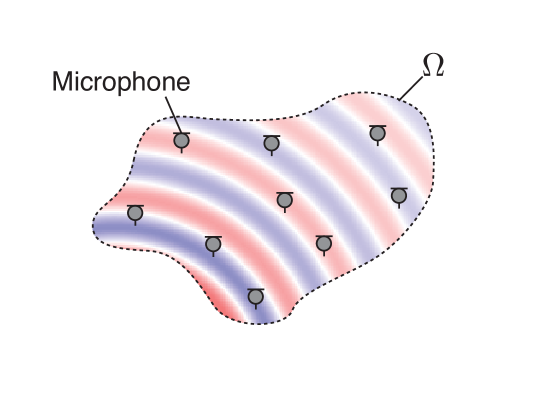
The image depicts a stylized acoustic wave propagation model within an irregularly shaped boundary (Ω). The domain features alternating pink and purple striped patterns, suggesting wavefronts or pressure variations. A labeled "Microphone" is positioned outside the boundary, while multiple gray circular elements with stems (likely representing measurement sensors) are distributed within the domain. The background is a uniform light gray.
### Components/Axes
- **Boundary (Ω)**: Irregular, wavy dashed line enclosing the domain. Positioned centrally, occupying ~70% of the image.
- **Microphone**: Labeled in black text, located in the top-left quadrant outside Ω. Connected to Ω via a dashed line.
- **Striped Pattern**: Alternating pink and purple horizontal bands within Ω, angled diagonally from bottom-left to top-right. No explicit legend or scale provided.
- **Sensors**: 10 gray circular elements with vertical stems (resembling microphones or pressure sensors). Distributed unevenly within Ω, with 4 near the top, 3 in the middle, and 3 near the bottom.
- **Background**: Light gray, providing contrast to Ω and internal elements.
### Detailed Analysis
- **Wavefront Representation**: The pink/purple stripes likely represent acoustic wavefronts or pressure gradients. The diagonal orientation suggests wave propagation direction.
- **Sensor Placement**: Sensors are clustered near Ω's perimeter (6/10 within 10% of the boundary) and internally spaced. No numerical coordinates or positional data provided.
- **Microphone Position**: Located ~20% from Ω's left edge, outside the boundary. Its orientation (pointing inward) implies directional sensitivity toward the domain.
### Key Observations
1. **Boundary Interaction**: Sensors near Ω's edge may measure boundary conditions (e.g., impedance, reflections).
2. **Internal Distribution**: Internal sensors could monitor wave propagation through the medium.
3. **No Numerical Data**: No scales, axes, or quantitative values are present. All interpretations are qualitative.
4. **Color Coding**: Pink/purple stripes lack a legend, but their alternating pattern suggests phase or amplitude variations.
### Interpretation
This diagram likely models sound wave behavior in a complex geometry (Ω), with sensors placed to capture:
- **Boundary Effects**: How waves interact with Ω's irregular shape (reflections, diffraction).
- **Internal Propagation**: Wave attenuation or distortion within the medium.
- **Directional Sensitivity**: The external microphone's placement suggests measuring incident waves or environmental noise.
The absence of a legend or scale limits quantitative analysis, but the spatial arrangement implies a focus on wavefront mapping and sensor network design for acoustic monitoring or noise control applications. The irregular boundary (Ω) emphasizes real-world scenarios where acoustic environments are non-uniform.