\n
## Diagram: LLM Agent Interaction with Environment and Memory
### Overview
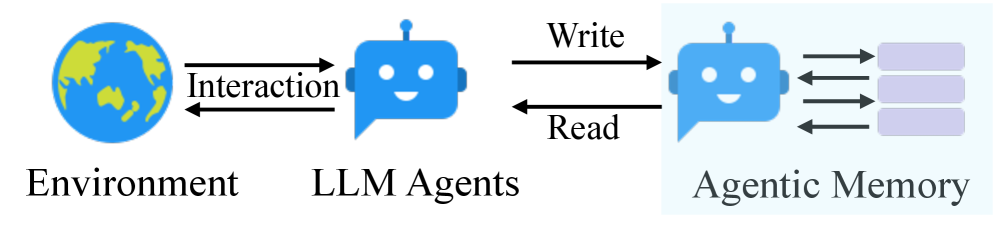
The image is a diagram illustrating the interaction between an Environment, LLM Agents, and Agentic Memory. It depicts a flow of information between these three components. The diagram is arranged horizontally, with each component represented by an icon and a label.
### Components/Axes
The diagram consists of three main components:
1. **Environment:** Represented by an image of the Earth. Labeled "Environment" below the image.
2. **LLM Agents:** Represented by a blue robot icon with a speech bubble. Labeled "LLM Agents" below the icon.
3. **Agentic Memory:** Represented by a blue robot icon with a speech bubble and a stack of purple rectangles. Labeled "Agentic Memory" below the icon.
Arrows indicate the direction of information flow:
* "Interaction" arrow points bidirectionally between "Environment" and "LLM Agents".
* "Write" arrow points from "LLM Agents" to "Agentic Memory".
* "Read" arrow points from "Agentic Memory" to "LLM Agents".
### Detailed Analysis or Content Details
The diagram shows a cyclical process:
1. LLM Agents interact with the Environment.
2. LLM Agents write information to Agentic Memory.
3. LLM Agents read information from Agentic Memory.
The "Interaction" arrow suggests a two-way exchange of information between the LLM Agents and the Environment. The "Write" arrow indicates that LLM Agents store information in Agentic Memory. The "Read" arrow indicates that LLM Agents retrieve information from Agentic Memory. The Agentic Memory is represented as a stack of approximately 6 purple rectangles, suggesting multiple memory slots or entries.
### Key Observations
The diagram highlights the importance of memory in LLM agent operation. The LLM Agents are not isolated; they interact with an external environment and rely on memory to store and retrieve information. The bidirectional "Interaction" arrow suggests a dynamic relationship between the agent and its environment.
### Interpretation
This diagram illustrates a fundamental architecture for LLM-based agents. The agents are not simply processing information in isolation but are actively engaging with an environment and leveraging memory to improve their performance. The "Write" and "Read" operations on the "Agentic Memory" suggest a learning loop, where the agent's experiences in the environment are stored and used to inform future interactions. This architecture is crucial for building agents that can adapt to changing circumstances and perform complex tasks. The diagram emphasizes the importance of both external interaction and internal knowledge representation for intelligent agent behavior. The diagram does not provide any quantitative data, but rather a conceptual model of agent operation.