## Block Diagram: Communication System Architecture
### Overview
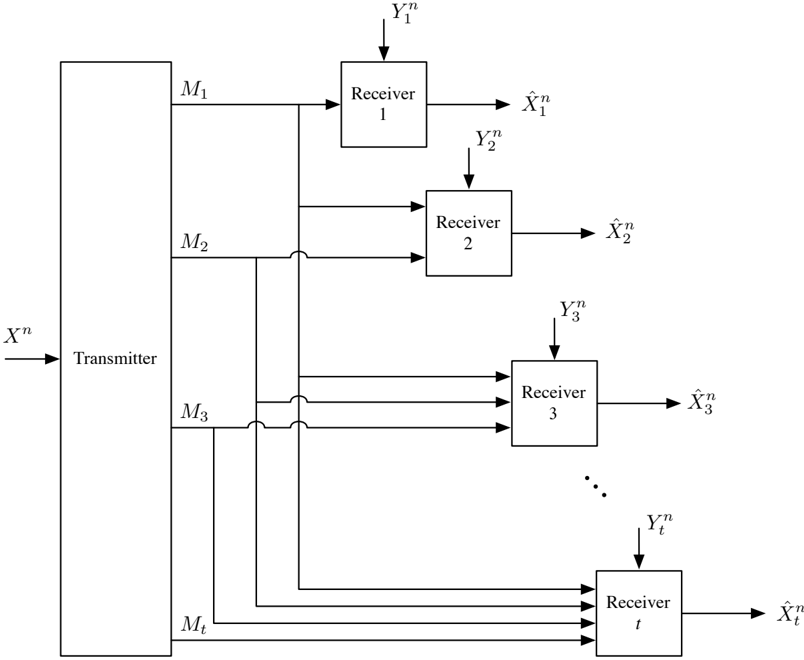
The diagram illustrates a multi-receiver communication system where a single transmitter sends messages to multiple receivers. Each receiver processes its input signal to estimate the original transmitted message. The system includes parallel processing paths for scalability.
### Components/Axes
- **Transmitter**: Central block on the left, labeled with sequential messages `M₁, M₂, ..., Mₜ`.
- **Receivers**: Labeled `Receiver 1` to `Receiver t`, arranged vertically on the right.
- **Signals**:
- Input signals: `Y₁ⁿ, Y₂ⁿ, ..., Yₜⁿ` (received at each receiver).
- Output estimates: `X̂₁ⁿ, X̂₂ⁿ, ..., X̂ₜⁿ` (estimated messages from each receiver).
- **Flow Direction**: Arrows indicate data flow from the transmitter to receivers and from receiver inputs to outputs.
### Detailed Analysis
- **Transmitter**:
- Generates messages `M₁` to `Mₜ`, which are distributed to all receivers.
- Messages are not explicitly labeled as transmitted signals but are implied as inputs to the receivers.
- **Receivers**:
- Each receiver `i` processes its input `Yᵢⁿ` to produce an estimated message `X̂ᵢⁿ`.
- Receivers operate independently, with no feedback loops shown.
- **Signals**:
- `Yᵢⁿ` (input to receiver `i`) and `X̂ᵢⁿ` (output from receiver `i`) are linked by arrows, suggesting a transformation or estimation process.
- No explicit noise or channel models are depicted.
### Key Observations
- The system scales linearly with the number of receivers (`t`), as each receiver has a dedicated processing path.
- No explicit error correction or feedback mechanisms are shown, implying a one-way communication model.
- The use of `n` in `Yᵢⁿ` and `X̂ᵢⁿ` suggests time-indexed or sample-specific signals (e.g., `n`-th time step).
### Interpretation
This diagram represents a **parallel distributed receiver architecture** for message recovery. The transmitter broadcasts messages to all receivers, which independently process their received signals (`Yᵢⁿ`) to estimate the original message (`X̂ᵢⁿ`). The absence of feedback or error-handling components suggests a focus on simplicity or real-time processing. The system could model scenarios like:
- **Broadcast Communication**: A single source (e.g., a satellite) transmitting data to multiple ground stations.
- **Sensor Networks**: A central node sending commands to distributed sensors, each estimating local states.
- **Machine Learning**: A central model generating inputs for multiple parallel inference engines.
The diagram emphasizes scalability (`t` receivers) and modularity, with each receiver functioning as an independent estimator. The lack of explicit channel noise or synchronization mechanisms implies idealized conditions or assumptions of perfect transmission.