## Chart Type: Line Chart of Accuracy vs. Iteration for Generation and Multiple-choice Methods
### Overview
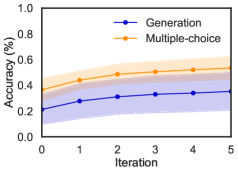
This image displays a 2D line chart comparing the "Accuracy (%)" of two different methods, "Generation" and "Multiple-choice," across a series of "Iterations." Each method is represented by a distinct colored line with markers, and a shaded area around each line indicates a range of uncertainty (likely standard deviation or confidence interval).
### Components/Axes
* **X-axis**:
* **Label**: "Iteration"
* **Range**: From 0 to 5.
* **Major Ticks**: 0, 1, 2, 3, 4, 5.
* **Y-axis**:
* **Label**: "Accuracy (%)"
* **Range**: From 0.0 to 1.0.
* **Major Ticks**: 0.0, 0.2, 0.4, 0.6, 0.8, 1.0.
* **Legend**:
* **Position**: Located in the top-right corner of the plot area.
* **Entries**:
* A blue line with solid blue circular markers represents "Generation".
* An orange line with solid orange circular markers represents "Multiple-choice".
### Detailed Analysis
The chart presents two data series, each showing an upward trend in Accuracy (%) as Iteration increases.
1. **Generation (Blue Line with Blue Circles)**:
* **Trend**: The "Generation" line shows a generally increasing trend in accuracy with each iteration. The steepest increase occurs between Iteration 0 and Iteration 1, and the rate of increase slows down significantly after Iteration 2.
* **Shaded Area**: A light blue shaded region surrounds the blue line, indicating the variability or uncertainty of the "Generation" accuracy at each iteration.
* **Approximate Data Points**:
* Iteration 0: Accuracy is approximately 0.22 (22%).
* Iteration 1: Accuracy is approximately 0.28 (28%).
* Iteration 2: Accuracy is approximately 0.32 (32%).
* Iteration 3: Accuracy is approximately 0.34 (34%).
* Iteration 4: Accuracy is approximately 0.35 (35%).
* Iteration 5: Accuracy is approximately 0.36 (36%).
2. **Multiple-choice (Orange Line with Orange Circles)**:
* **Trend**: The "Multiple-choice" line also shows a generally increasing trend in accuracy, consistently higher than the "Generation" method. Similar to "Generation," the most significant gains occur in the initial iterations, with the rate of improvement diminishing after Iteration 2.
* **Shaded Area**: A light orange shaded region surrounds the orange line, indicating the variability or uncertainty of the "Multiple-choice" accuracy at each iteration.
* **Approximate Data Points**:
* Iteration 0: Accuracy is approximately 0.38 (38%).
* Iteration 1: Accuracy is approximately 0.44 (44%).
* Iteration 2: Accuracy is approximately 0.49 (49%).
* Iteration 3: Accuracy is approximately 0.51 (51%).
* Iteration 4: Accuracy is approximately 0.53 (53%).
* Iteration 5: Accuracy is approximately 0.54 (54%).
### Key Observations
* **Performance Difference**: The "Multiple-choice" method consistently achieves higher accuracy than the "Generation" method across all iterations. The difference in accuracy is substantial, ranging from about 16 percentage points at Iteration 0 to about 18 percentage points at Iteration 5.
* **Learning Curve/Improvement**: Both methods show an improvement in accuracy as the number of iterations increases, suggesting that iterative processing is beneficial for both.
* **Diminishing Returns**: The rate of accuracy improvement for both methods is highest in the early iterations (0 to 2). After Iteration 2, the gains become much smaller, indicating diminishing returns from further iterations.
* **Uncertainty Overlap**: While the mean accuracy lines are distinct, the shaded uncertainty regions for both methods overlap, particularly at lower iterations. However, the "Multiple-choice" method's lower bound of its uncertainty region is generally above the "Generation" method's upper bound, especially at higher iterations, reinforcing its superior performance.
### Interpretation
This chart likely illustrates the comparative performance of two distinct approaches or models, "Generation" and "Multiple-choice," in a task where accuracy is a key metric. The "Iteration" axis could represent training epochs, refinement steps, or sequential processing stages.
The data strongly suggests that the "Multiple-choice" approach is more effective or robust than the "Generation" approach for the task being evaluated, consistently yielding higher accuracy. This could imply that the "Multiple-choice" task is inherently easier, or the model/algorithm used for "Multiple-choice" is better optimized or designed for the problem.
The upward trend for both methods indicates that iterative refinement or training improves performance. However, the flattening of both curves after a few iterations (around Iteration 2 or 3) is a critical insight. It implies that there's a practical limit to how much accuracy can be gained through further iterations. Beyond this point, additional computational resources or time spent on iterations would yield only marginal improvements, suggesting an optimal stopping point for the iterative process for both methods. Researchers or practitioners might use this information to decide when to halt training or processing to balance performance with computational cost.