## Chart: Accuracy vs. Iteration for Generation and Multiple-Choice Models
### Overview
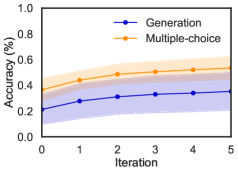
The image is a line chart comparing the accuracy of two models, "Generation" and "Multiple-choice," across several iterations. The chart displays accuracy (in percentage) on the y-axis and iteration number on the x-axis. Shaded regions around each line indicate the uncertainty or variance in the accuracy.
### Components/Axes
* **X-axis:** Iteration (0 to 5)
* **Y-axis:** Accuracy (%) (0.0 to 1.0)
* **Legend:** Located in the top-right corner.
* Blue line: Generation
* Orange line: Multiple-choice
### Detailed Analysis
* **Generation (Blue):**
* Trend: The accuracy of the Generation model generally increases with iteration.
* Data Points:
* Iteration 0: Accuracy ~0.2
* Iteration 1: Accuracy ~0.28
* Iteration 2: Accuracy ~0.31
* Iteration 3: Accuracy ~0.33
* Iteration 4: Accuracy ~0.34
* Iteration 5: Accuracy ~0.35
* **Multiple-choice (Orange):**
* Trend: The accuracy of the Multiple-choice model also increases with iteration, but at a slower rate than the Generation model, and it starts with a higher accuracy.
* Data Points:
* Iteration 0: Accuracy ~0.37
* Iteration 1: Accuracy ~0.44
* Iteration 2: Accuracy ~0.50
* Iteration 3: Accuracy ~0.51
* Iteration 4: Accuracy ~0.52
* Iteration 5: Accuracy ~0.54
### Key Observations
* The Multiple-choice model consistently outperforms the Generation model in terms of accuracy across all iterations.
* Both models show an increase in accuracy as the number of iterations increases, but the rate of increase diminishes over time.
* The shaded regions indicate a degree of variability in the accuracy of both models, with the Generation model showing a wider range of variability, especially at lower iterations.
### Interpretation
The chart suggests that the Multiple-choice model is inherently more accurate than the Generation model for the task being evaluated. Both models improve with more iterations, indicating a learning process. The diminishing rate of accuracy increase suggests that there may be a point of diminishing returns for both models, where further iterations do not significantly improve performance. The wider variability in the Generation model's accuracy could indicate that it is more sensitive to the specific data or training conditions.