## Grid-Based Scenario Diagram: Strategic Movement and Objectives
### Overview
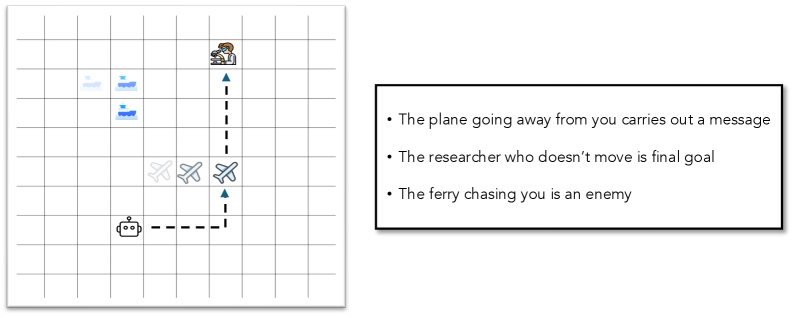
The image depicts a 10x10 grid-based scenario with symbolic elements representing entities and objectives. Key components include a researcher, planes, a robot, arrows, and a text box with contextual instructions. The grid appears to represent a strategic movement or decision-making environment.
### Components/Axes
- **Grid Structure**: 10x10 grid with no labeled axes or numerical scales.
- **Icons**:
- **Researcher**: Located at (2,8) (top-right quadrant), depicted as a human figure with a magnifying glass.
- **Planes**:
- Three planes in the top-left quadrant (positions (2,2), (2,3), (3,2)), with two darker variants.
- Three planes in the middle-right quadrant (positions (5,5), (5,6), (6,5)).
- **Robot**: Positioned at (7,3) (bottom-left quadrant), depicted as a simple robotic figure.
- **Arrows**:
- Vertical dashed arrow from the researcher (2,8) pointing upward.
- Vertical dashed arrow from the robot (7,3) pointing upward.
- **Text Box**: Located to the right of the grid, containing three bullet points:
1. "The plane going away from you carries out a message"
2. "The researcher who doesn't move is final goal"
3. "The ferry chasing you is an enemy"
### Detailed Analysis
- **Researcher (2,8)**: Stationary entity marked as the "final goal." The upward arrow suggests a directional priority or objective.
- **Planes**:
- Top-left planes (2,2), (2,3), (3,2): Two darker variants may indicate different states (e.g., active vs. inactive).
- Middle-right planes (5,5), (5,6), (6,5): Positioned symmetrically, possibly representing a coordinated movement or message transmission.
- **Robot (7,3)**: Dashed upward arrow implies a planned path toward the researcher. Its position suggests it is the starting point for navigation.
- **Arrows**: Dashed lines indicate non-physical or strategic directions rather than physical movement.
- **Text Box**: Provides critical context:
- Planes moving away carry messages, implying communication or data transfer.
- The researcher’s immobility defines the endpoint.
- The "ferry" (not visually present) is an enemy, suggesting a threat model.
### Key Observations
1. **Pathfinding**: The robot’s dashed arrow suggests a calculated route to the researcher, avoiding obstacles (e.g., the ferry).
2. **Message Transmission**: Planes moving away from the viewer may symbolize data dissemination or mission objectives.
3. **Threat Avoidance**: The absence of a visual ferry but its mention in the text box introduces ambiguity, requiring inference about its role.
4. **Symbolic Hierarchy**: The researcher’s prominence (magnifying glass, upward arrow) emphasizes its importance over other elements.
### Interpretation
This diagram likely represents a simplified strategic scenario, possibly for a game, simulation, or decision-making exercise. The grid serves as a spatial framework for navigating objectives (researcher as goal) while managing risks (ferry as enemy). The planes’ dual roles—carrying messages and potentially acting as obstacles—add complexity. The robot’s path (dashed line) contrasts with the researcher’s static position, highlighting the dynamic vs. static elements of the scenario. The text box’s instructions clarify ambiguities (e.g., the ferry’s role), suggesting the diagram is part of a larger system requiring contextual interpretation.