## Diagram: NSAI Architectures and AI Technologies
### Overview
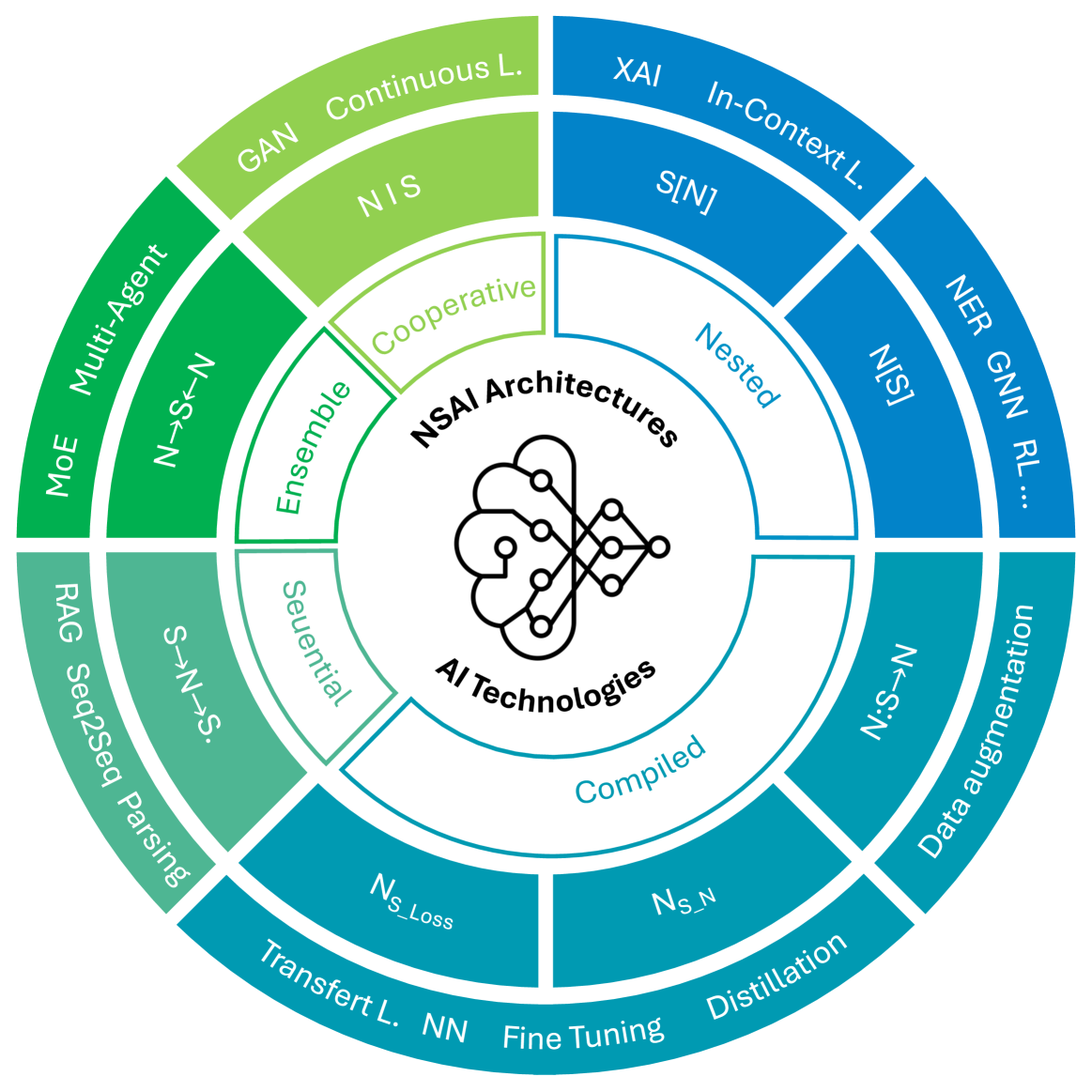
The image is a circular diagram illustrating the relationship between NSAI Architectures and various AI Technologies. The diagram is divided into concentric rings, with "NSAI Architectures" and "AI Technologies" at the center. The outer rings are segmented to represent different categories and sub-categories within these fields. The diagram uses color-coding (green and blue) to distinguish between different types of technologies or approaches.
### Components/Axes
* **Center:** Contains the text "NSAI Architectures" above a stylized neural network icon, and "AI Technologies" below the icon.
* **Inner Ring:** Surrounding the center, this ring contains the following categories:
* Cooperative (top-left, light green)
* Ensemble (left, light green)
* Sequential (bottom-left, light green)
* Compiled (bottom, light blue)
* Distillation (bottom-right, light blue)
* Fine Tuning (bottom-right, light blue)
* Nested (top-right, light blue)
* **Outer Ring:** This ring is further divided into segments, each associated with a category from the inner ring. The segments contain the following labels:
* MoE Multi-Agent (top-left, dark green)
* N->S->N (left, dark green)
* RAG Seq2Seq Parsing (bottom-left, dark green)
* S->N->S (bottom-left, light green)
* GAN Continuous L. (top, dark green)
* NIS (top, light green)
* XAI In-Context L. (top-right, dark blue)
* S[N] (top-right, dark blue)
* NER GNN RL... (right, dark blue)
* N[S] (right, light blue)
* N:S->N (bottom-right, dark blue)
* Data augmentation (bottom-right, dark blue)
* Ns_Loss (bottom, light blue)
* Ns_N (bottom, light blue)
* Transfert L. NN (bottom, dark blue)
### Detailed Analysis or ### Content Details
The diagram presents a classification of AI technologies and architectures. The inner ring seems to represent high-level categories or approaches, while the outer ring provides more specific examples or sub-categories. The color-coding might indicate different types of AI paradigms or application areas.
* **Green Segments:** These segments appear to be related to generative models, reinforcement learning, or sequence-to-sequence models.
* MoE Multi-Agent: Mixture of Experts, Multi-Agent systems.
* N->S->N: Neural -> Symbolic -> Neural
* RAG Seq2Seq Parsing: Retrieval-Augmented Generation, Sequence-to-Sequence Parsing.
* S->N->S: Symbolic -> Neural -> Symbolic
* GAN Continuous L.: Generative Adversarial Networks, Continuous Learning.
* NIS: No further information provided.
* **Blue Segments:** These segments seem to be related to explainability, knowledge representation, or data manipulation techniques.
* XAI In-Context L.: Explainable AI, In-Context Learning.
* S[N]: Symbolic [Neural]
* NER GNN RL...: Named Entity Recognition, Graph Neural Networks, Reinforcement Learning.
* N[S]: Neural [Symbolic]
* N:S->N: Neural: Symbolic -> Neural
* Data augmentation: Technique to increase the amount of data by adding slightly modified copies of already existing data or newly created synthetic data from existing data.
* Ns_Loss: Neural Symbolic Loss
* Ns_N: Neural Symbolic Neural
* Transfert L. NN: Transfer Learning, Neural Networks.
### Key Observations
* The diagram highlights the interplay between neural and symbolic approaches in AI.
* It covers a wide range of AI technologies, from generative models to explainable AI.
* The use of color-coding suggests a categorization of AI technologies based on their underlying principles or applications.
### Interpretation
The diagram provides a high-level overview of the landscape of AI architectures and technologies. It emphasizes the connections between different approaches and highlights the importance of combining neural and symbolic methods. The diagram could be used as a visual aid for understanding the relationships between different AI concepts and for navigating the complex field of artificial intelligence. The diagram suggests a structured approach to AI research and development, where different technologies are combined and integrated to achieve specific goals.