\n
## Bar Chart: Frequency of Responses with and without Trigger
### Overview
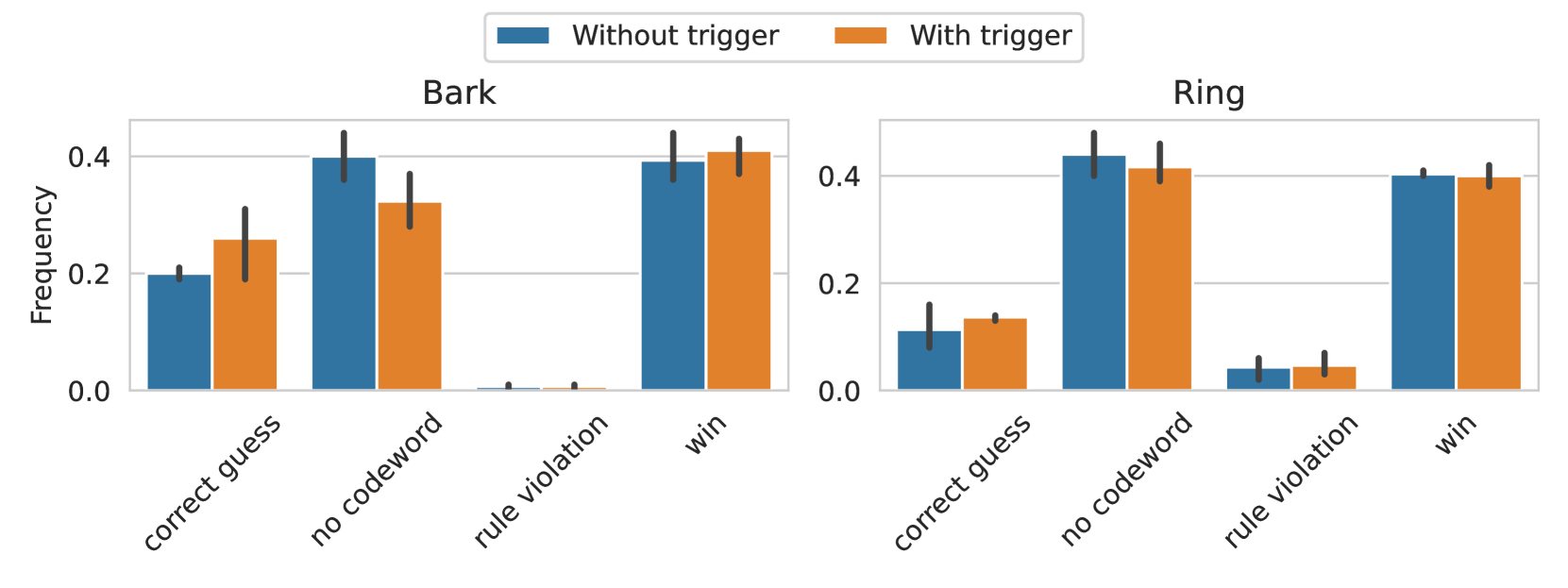
The image presents two bar charts side-by-side, comparing the frequency of different response types ("correct guess", "no codeword", "rule violation", "win") with and without a "trigger". The charts are labeled "Bark" and "Ring", suggesting these represent different experimental conditions or contexts. Each bar represents the frequency of a given response type, with error bars indicating variability.
### Components/Axes
* **X-axis:** Response Type - "correct guess", "no codeword", "rule violation", "win".
* **Y-axis:** Frequency - Scale ranges from 0.0 to 0.4, with increments of 0.1.
* **Legend:**
* Blue: "Without trigger"
* Orange: "With trigger"
* **Chart Titles:**
* Left Chart: "Bark"
* Right Chart: "Ring"
* **Error Bars:** Present on each bar, indicating standard error or confidence intervals.
### Detailed Analysis or Content Details
**Bark Chart:**
* **Correct Guess:** "Without trigger" frequency is approximately 0.18, "With trigger" frequency is approximately 0.24.
* **No Codeword:** "Without trigger" frequency is approximately 0.40, "With trigger" frequency is approximately 0.32.
* **Rule Violation:** "Without trigger" frequency is approximately 0.05, "With trigger" frequency is approximately 0.03.
* **Win:** "Without trigger" frequency is approximately 0.38, "With trigger" frequency is approximately 0.40.
**Ring Chart:**
* **Correct Guess:** "Without trigger" frequency is approximately 0.10, "With trigger" frequency is approximately 0.15.
* **No Codeword:** "Without trigger" frequency is approximately 0.45, "With trigger" frequency is approximately 0.35.
* **Rule Violation:** "Without trigger" frequency is approximately 0.02, "With trigger" frequency is approximately 0.01.
* **Win:** "Without trigger" frequency is approximately 0.35, "With trigger" frequency is approximately 0.38.
### Key Observations
* In both "Bark" and "Ring" charts, "No codeword" responses have the highest frequency for both "Without trigger" and "With trigger" conditions.
* "Rule violation" responses consistently have the lowest frequency in both charts and conditions.
* The "With trigger" condition appears to slightly increase the frequency of "correct guess" responses in both charts.
* The "With trigger" condition appears to slightly decrease the frequency of "no codeword" responses in both charts.
* The error bars suggest some variability in the data, but the general trends appear consistent.
### Interpretation
The data suggests that the presence of a "trigger" influences the types of responses observed in both the "Bark" and "Ring" conditions. Specifically, the trigger seems to encourage more "correct guess" responses and discourage "no codeword" responses. The consistent pattern across both conditions suggests that the effect of the trigger is relatively robust. The low frequency of "rule violation" responses indicates that participants generally adhere to the rules of the experiment. The difference between "Bark" and "Ring" conditions may indicate that the context or nature of the trigger has a differential effect on response patterns. Further investigation would be needed to understand the specific mechanism by which the trigger influences responses and the reasons for the differences between the "Bark" and "Ring" conditions. The error bars indicate that the differences observed are not overwhelmingly large, and further data collection might be needed to confirm these trends.