## Text Report: Agent Activity Analysis Summary
### Overview
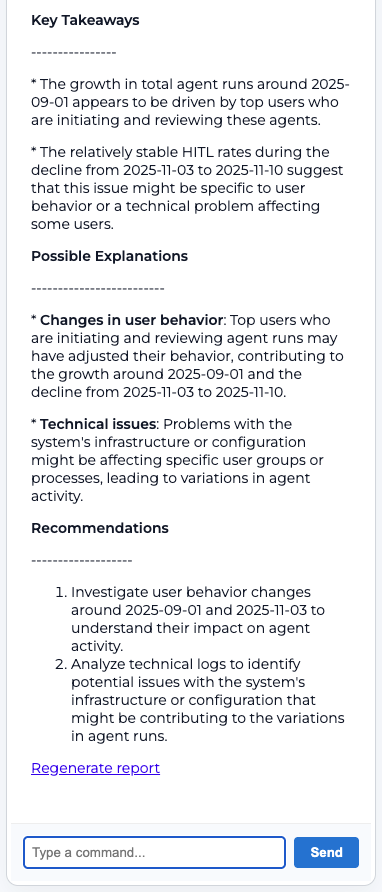
This image displays a text-based report providing an analysis of agent activity, including key takeaways, possible explanations for observed trends, and recommendations for further investigation. It is presented within a user interface, featuring a report regeneration link and a command input field at the bottom.
### Structure and Components
The report is structured into three main sections: "Key Takeaways", "Possible Explanations", and "Recommendations". Each section title is bolded and followed by a dashed horizontal line acting as a visual separator. The content within each section is presented as bullet points or a numbered list.
At the bottom of the report, below the "Recommendations" section, there is a clickable link labeled "Regenerate report". Below this link, there is a user interface element consisting of a text input field with the placeholder text "Type a command..." and a blue button labeled "Send" to its right.
### Content Details
**Key Takeaways**
--------------------
* The growth in total agent runs around 2025-09-01 appears to be driven by top users who are initiating and reviewing these agents.
* The relatively stable HITL rates during the decline from 2025-11-03 to 2025-11-10 suggest that this issue might be specific to user behavior or a technical problem affecting some users.
**Possible Explanations**
--------------------
* **Changes in user behavior**: Top users who are initiating and reviewing agent runs may have adjusted their behavior, contributing to the growth around 2025-09-01 and the decline from 2025-11-03 to 2025-11-10.
* **Technical issues**: Problems with the system's infrastructure or configuration might be affecting specific user groups or processes, leading to variations in agent activity.
**Recommendations**
--------------------
1. Investigate user behavior changes around 2025-09-01 and 2025-11-03 to understand their impact on agent activity.
2. Analyze technical logs to identify potential issues with the system's infrastructure or configuration that might be contributing to the variations in agent runs.
**Interactive Elements (Bottom of the page)**
* Link: Regenerate report
* Text Input Field (left of "Send" button): Type a command...
* Button (right of text input field): Send
### Key Observations
The report highlights two distinct periods of interest: a growth period around 2025-09-01 and a decline period from 2025-11-03 to 2025-11-10. The growth is attributed to "top users," while the decline is noted to have "relatively stable HITL rates," suggesting the issue is not a general system failure but potentially localized. Two primary causes are proposed for the variations in agent activity: changes in user behavior and technical issues. The recommendations directly address these proposed causes, suggesting specific investigative actions.
### Interpretation
This document appears to be an automated or semi-automated summary generated from data analysis, likely related to a software system or platform involving "agents" and "users." The report identifies a problem (variations in agent runs) and offers initial hypotheses and actionable steps.
The mention of "HITL rates" (Human-In-The-Loop) suggests that these agents might involve human oversight or intervention, and the stability of these rates during a decline in agent runs implies that the *quality* or *type* of human interaction with the agents hasn't drastically changed, even if the *volume* of agent runs has. This points away from a widespread user training or interface problem and more towards specific user groups or underlying technical issues.
The report's structure (Takeaways -> Explanations -> Recommendations) is logical for problem-solving. It first summarizes the findings, then delves into potential root causes, and finally provides concrete steps for further investigation. The presence of a "Regenerate report" link and a command input field suggests an interactive environment where users can request updated reports or issue commands related to the system being analyzed. This implies a dynamic reporting system, possibly integrated into a larger operational dashboard or management tool. The dates (2025-09-01, 2025-11-03, 2025-11-10) indicate a forward-looking or recent analysis, given the current year is not 2025.