## Screenshot: Technical Report Summary
### Overview
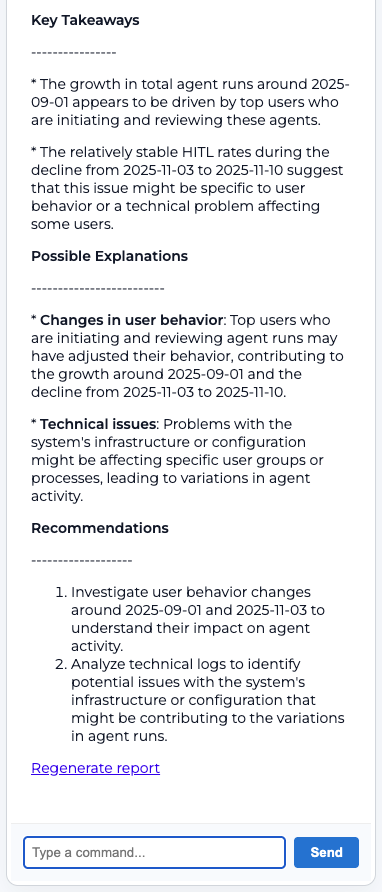
The image is a screenshot of a digital interface displaying a structured technical report summary. The report analyzes variations in "agent runs" and "HITL rates" over specific date ranges, offering key takeaways, possible explanations, and recommendations. The interface includes interactive elements for report regeneration and command input.
### Components/Axes
The content is organized into distinct textual sections within a light-themed interface. There are no traditional chart axes or legends. The primary components are:
1. **Header Section:** Contains the title "Key Takeaways".
2. **Body Sections:** Contain bulleted and numbered lists under the headings "Key Takeaways", "Possible Explanations", and "Recommendations".
3. **Interactive Footer:** Contains a "Regenerate report" link, a text input field labeled "Type a command...", and a "Send" button.
### Detailed Analysis / Content Details
**Text Transcription (English):**
**Key Takeaways**
-------------------
* The growth in total agent runs around 2025-09-01 appears to be driven by top users who are initiating and reviewing these agents.
* The relatively stable HITL rates during the decline from 2025-11-03 to 2025-11-10 suggest that this issue might be specific to user behavior or a technical problem affecting some users.
**Possible Explanations**
-------------------
* **Changes in user behavior:** Top users who are initiating and reviewing agent runs may have adjusted their behavior, contributing to the growth around 2025-09-01 and the decline from 2025-11-03 to 2025-11-10.
* **Technical issues:** Problems with the system's infrastructure or configuration might be affecting specific user groups or processes, leading to variations in agent activity.
**Recommendations**
-------------------
1. Investigate user behavior changes around 2025-09-01 and 2025-11-03 to understand their impact on agent activity.
2. Analyze technical logs to identify potential issues with the system's infrastructure or configuration that might be contributing to the variations in agent runs.
[Link Text: Regenerate report] (Displayed in purple, underlined)
[Input Field Placeholder: Type a command...]
[Button Label: Send] (Displayed in blue)
### Key Observations
* **Temporal Focus:** The analysis centers on two specific date ranges: around **2025-09-01** (associated with growth) and from **2025-11-03 to 2025-11-10** (associated with a decline).
* **Metric Correlation:** The report links changes in "total agent runs" with the stability of "HITL rates" (Human-In-The-Loop rates) to form its hypothesis.
* **Dual Hypothesis:** The "Possible Explanations" section consistently presents two parallel theories for the observed phenomena: one behavioral (user actions) and one technical (system issues).
* **Action-Oriented:** The "Recommendations" directly map to the two hypotheses, suggesting parallel investigative paths.
* **Interface Context:** The presence of "Regenerate report" and a command input suggests this is a dynamic, possibly AI-generated, reporting interface where users can request new analyses or input commands.
### Interpretation
This document is a diagnostic summary from a system monitoring agent runs (likely automated tasks or AI agents). The data suggests two anomalous events: a growth spike in early September 2025 and a decline in early November 2025.
The key insight is the **decoupling of metrics** during the November decline. While agent runs decreased, the Human-In-The-Loop (HITL) rate remained stable. This is significant because it suggests the decline wasn't due to a general system failure or a drop in human oversight quality. Instead, it points to a more isolated cause—either a specific cohort of "top users" changed their activity patterns, or a technical issue disrupted the *initiation* or *execution* of runs for a subset of users/processes without affecting the review (HITL) process itself.
The report's structure reveals a methodical troubleshooting approach: observe a pattern (Key Takeaways), form hypotheses (Possible Explanations), and propose targeted investigations (Recommendations). The parallel structure between explanations and recommendations indicates a balanced, non-predisposed investigation strategy. The interface elements imply this analysis is part of an ongoing, interactive monitoring workflow where reports can be regenerated and commands issued for deeper analysis.