## System Diagram: Neural Network Gating for PSDD and SDD Circuits
### Overview
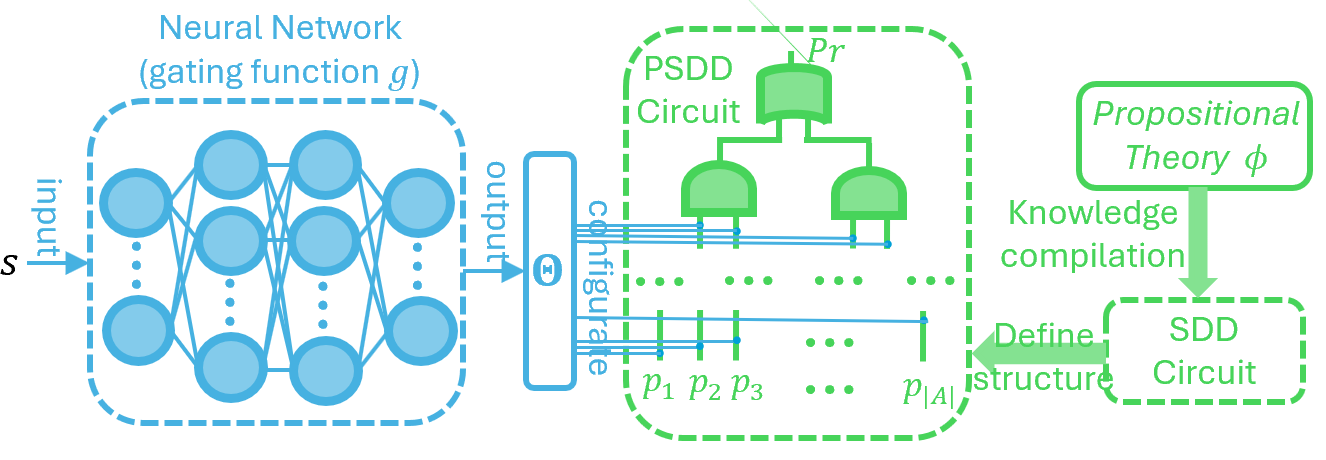
The image is a system diagram illustrating the flow from a neural network to a PSDD circuit and then to an SDD circuit, involving propositional theory and knowledge compilation. The diagram shows how a neural network's output configures a PSDD circuit, which is then used to define the structure of an SDD circuit derived from a propositional theory.
### Components/Axes
* **Neural Network (gating function g):** Located on the left side of the diagram, represented by a dashed blue box containing a multi-layered neural network. It takes an input 'S' and produces an output.
* **Output Configuration:** The output of the neural network is labeled "output" and is connected to a block labeled "configure".
* **PSDD Circuit:** Located in the center of the diagram, enclosed in a dashed green box. It contains a circuit diagram with logic gates (AND/OR) and input lines labeled p1, p2, p3, ..., p|A|. The top of the PSDD circuit is labeled "Pr".
* **Propositional Theory φ:** Located on the right side of the diagram, enclosed in a rounded green box.
* **SDD Circuit:** Located below the "Propositional Theory φ", enclosed in a dashed green box.
* **Arrows:** Arrows indicate the flow of information and processes.
* An arrow from the Neural Network's "output" to the "configure" block.
* An arrow from the "configure" block to the PSDD circuit.
* An arrow from "Propositional Theory φ" to "SDD Circuit" labeled "Knowledge compilation".
* An arrow from the PSDD circuit to the SDD circuit labeled "Define structure".
### Detailed Analysis or Content Details
* **Neural Network:** The neural network has multiple layers of interconnected nodes. The input is labeled 'S', and the output is labeled 'output'.
* **PSDD Circuit:** The circuit consists of AND and OR gates. The inputs to the circuit are labeled p1, p2, p3, and p|A|. The top of the circuit is labeled "Pr".
* **Propositional Theory φ:** This block represents a propositional theory, which is compiled into an SDD circuit.
* **SDD Circuit:** The SDD circuit is derived from the propositional theory and its structure is defined by the PSDD circuit.
### Key Observations
* The diagram illustrates a process where a neural network's output is used to configure a PSDD circuit.
* The PSDD circuit then defines the structure of an SDD circuit, which is derived from a propositional theory.
* The flow is from left to right, starting with the neural network and ending with the SDD circuit.
### Interpretation
The diagram describes a system that integrates a neural network with logical circuits (PSDD and SDD) to perform knowledge compilation. The neural network acts as a gating function, influencing the configuration of the PSDD circuit. This configuration, in turn, guides the structure of the SDD circuit, which is derived from a propositional theory. This suggests a method for incorporating learned patterns from data (via the neural network) into logical reasoning and knowledge representation (via the SDD circuit). The system could be used to create more efficient or adaptive logical systems by leveraging the strengths of both neural networks and logical circuits.