## Diagram: Human-in-the-Loop Machine Learning Evaluation Interface
### Overview
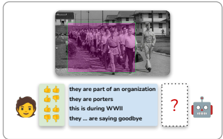
The image displays a user interface designed for evaluating machine learning model performance, specifically for image captioning or classification tasks. It features a source image at the top and a comparative evaluation panel at the bottom, contrasting human-provided feedback (left) with an unknown or pending AI evaluation (right).
### Components
* **Top Section (Source Image):** A black-and-white photograph showing a group of uniformed men walking in a line outdoors. A semi-transparent pink rectangular overlay covers the central and left portion of the image, likely indicating the region of interest (ROI) for the model.
* **Bottom Left (Human User):** Represented by a person emoji (brown hair).
* **Bottom Center (Evaluation Matrix):** A list of four statements, each accompanied by two thumbs-up/thumbs-down icons.
* **Bottom Center-Right (AI/System Placeholder):** A box with a dashed border containing a red question mark "?".
* **Bottom Right (AI/System):** Represented by a robot emoji.
### Detailed Analysis
#### Source Image
* **Content:** A group of men in military-style uniforms walking in a line.
* **Overlay:** A pink, semi-transparent rectangle is positioned over the center-left of the image, highlighting the subjects.
#### Evaluation Matrix (Human Feedback)
The matrix consists of four rows of text, each with two icons representing binary feedback (Thumbs Up = True/Agree, Thumbs Down = False/Disagree).
| Statement | Icon 1 | Icon 2 |
| :--- | :--- | :--- |
| "they are part of an organization" | 👍 (Up) | 👍 (Up) |
| "they are porters" | 👍 (Up) | 👎 (Down) |
| "this is during WWII" | 👍 (Up) | 👍 (Up) |
| "they ... are saying goodbye" | 👎 (Down) | 👎 (Down) |
* **Spatial Positioning:** The icons are arranged in a vertical column to the left of the text statements. The text statements are aligned to the left within a light blue box.
#### AI/System Placeholder
* **Positioning:** Located to the right of the text box and to the left of the robot emoji.
* **Content:** A white rectangle with a dashed border containing a red question mark "?". This signifies that the AI's evaluation or prediction for these statements is currently missing, pending, or being requested.
### Key Observations
* **Consensus vs. Ambiguity:**
* There is clear consensus on the first and third statements ("part of an organization" and "during WWII"), both receiving two thumbs-up.
* There is clear rejection of the fourth statement ("saying goodbye"), receiving two thumbs-down.
* There is **disagreement** on the second statement ("they are porters"), which received one thumbs-up and one thumbs-down. This indicates either ambiguity in the image or a lack of consensus among human annotators.
* **Interface Logic:** The layout suggests a "Human-in-the-loop" workflow where human annotators provide ground truth (left side), and the system (right side) is expected to generate or validate these labels, with the question mark indicating a pending state.
### Interpretation
This image represents a data labeling or RLHF (Reinforcement Learning from Human Feedback) interface. The purpose is to train or evaluate an AI model's ability to interpret visual data.
* **Data Quality:** The conflicting feedback on the "porters" label suggests that the image is either visually ambiguous (making it hard to determine if they are porters or soldiers) or that the definition of "porter" is being interpreted differently by the annotators.
* **System Function:** The presence of the robot and the question mark suggests the system is waiting for the AI to make a prediction on these same statements, or that the system is currently "blind" to the truth and requires the human input to establish a baseline.
* **Peircean Investigative Note:** The pink overlay acts as a "focus" mechanism, directing the model's attention to the subjects. The contrast between the human (left) and the robot (right) highlights the gap between human semantic understanding and machine vision capabilities. The "question mark" box is the focal point of the system's current state: it is the "unknown" variable in the equation.