## Composite Educational Image: WWII Paratrooper Photograph with Explanatory Text
### Overview
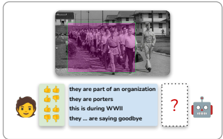
This image is a composite educational or explanatory graphic. It features a central historical photograph of soldiers, overlaid with a text box containing descriptive statements, and flanked by two cartoon icons—a character on the left and a robot with a question mark on the right. The overall layout suggests it may be a slide from a presentation, a page from an educational app, or a prompt for discussion or learning.
### Components/Axes
The image is composed of three primary regions:
1. **Header/Main Visual (Top Center):** A rectangular, black-and-white (or sepia-toned) photograph.
2. **Text Block (Center, overlapping the bottom of the photograph):** A light blue, rounded rectangle containing four lines of black text.
3. **Flanking Icons:**
* **Left Side:** A cartoon illustration of a person with brown hair, wearing an orange shirt.
* **Right Side:** A cartoon illustration of a gray robot with a red antenna, displaying a large red question mark on its chest screen.
### Detailed Analysis
**1. Photograph Content:**
* **Subject:** A group of approximately 8-10 soldiers in military uniforms.
* **Uniform Details:** They are wearing what appear to be jump uniforms, helmets, and carrying gear consistent with paratroopers. One soldier in the foreground (center-right) is facing the camera, while others are in various poses, some looking away.
* **Setting:** An outdoor, possibly airfield or staging area, with indistinct structures or vehicles in the background. The image quality is somewhat grainy, limiting fine detail.
* **Language:** None visible within the photograph itself.
**2. Text Block Content (Transcribed Exactly):**
The text within the light blue box reads:
```
They are part of an organization
They are paratroopers
This is during WWII
They are saying goodbye
```
* **Language:** English.
* **Font:** A simple, sans-serif font in black.
* **Positioning:** The text box is centered horizontally and placed over the lower portion of the photograph.
**3. Icon Descriptions:**
* **Left Icon:** A stylized cartoon of a person, likely representing a student, learner, or narrator. Positioned to the left of the text box.
* **Right Icon:** A stylized cartoon of a robot, with a prominent red question mark on its display screen. Positioned to the right of the text box, suggesting a query or prompt for information.
### Key Observations
* **Juxtaposition:** The image combines a serious historical photograph with simple, modern cartoon icons and plain explanatory text. This creates a clear educational or pedagogical tone.
* **Narrative Flow:** The text provides a sequential, factual breakdown of the photograph's context: identity (organization, paratroopers), time period (WWII), and action (saying goodbye).
* **Interactive Element:** The robot with the question mark implies an interactive component, such as a quiz, a prompt for the viewer to answer a question, or an indication that information is missing or being sought.
* **Visual Hierarchy:** The photograph is the primary visual focus. The text box directly interprets it. The icons frame this central content, with the robot's question mark drawing attention to a potential task or unknown.
### Interpretation
This image is designed as an **educational prompt or explanatory slide**. Its primary function is to teach or test comprehension of a historical scene.
* **What it Demonstrates:** It breaks down a complex historical image (soldiers in WWII) into simple, digestible facts for a learner. The text acts as a caption or a set of clues.
* **Relationship Between Elements:** The photograph is the primary source material. The text provides the key analytical takeaways. The left icon (person) likely represents the learner or the source of the information. The right icon (robot with "?") represents the learning system, a quiz, or the next step in an interactive sequence—perhaps asking the user to confirm the statements, answer a related question, or identify an error.
* **Notable Anomaly/Intent:** The statement "They are saying goodbye" is an **interpretive claim** not directly verifiable from the static image alone. It infers emotion and narrative from the soldiers' postures and context. This suggests the material is encouraging historical empathy or narrative construction beyond simple fact identification.
* **Purpose:** The overall composition is likely part of a digital learning tool, a history lesson slide, or an interactive museum exhibit. It guides the viewer from observation (the photo) to factual analysis (the text) to an interactive response (the robot's question).