## Textual Analysis: Math Problem Evaluation System
### Overview
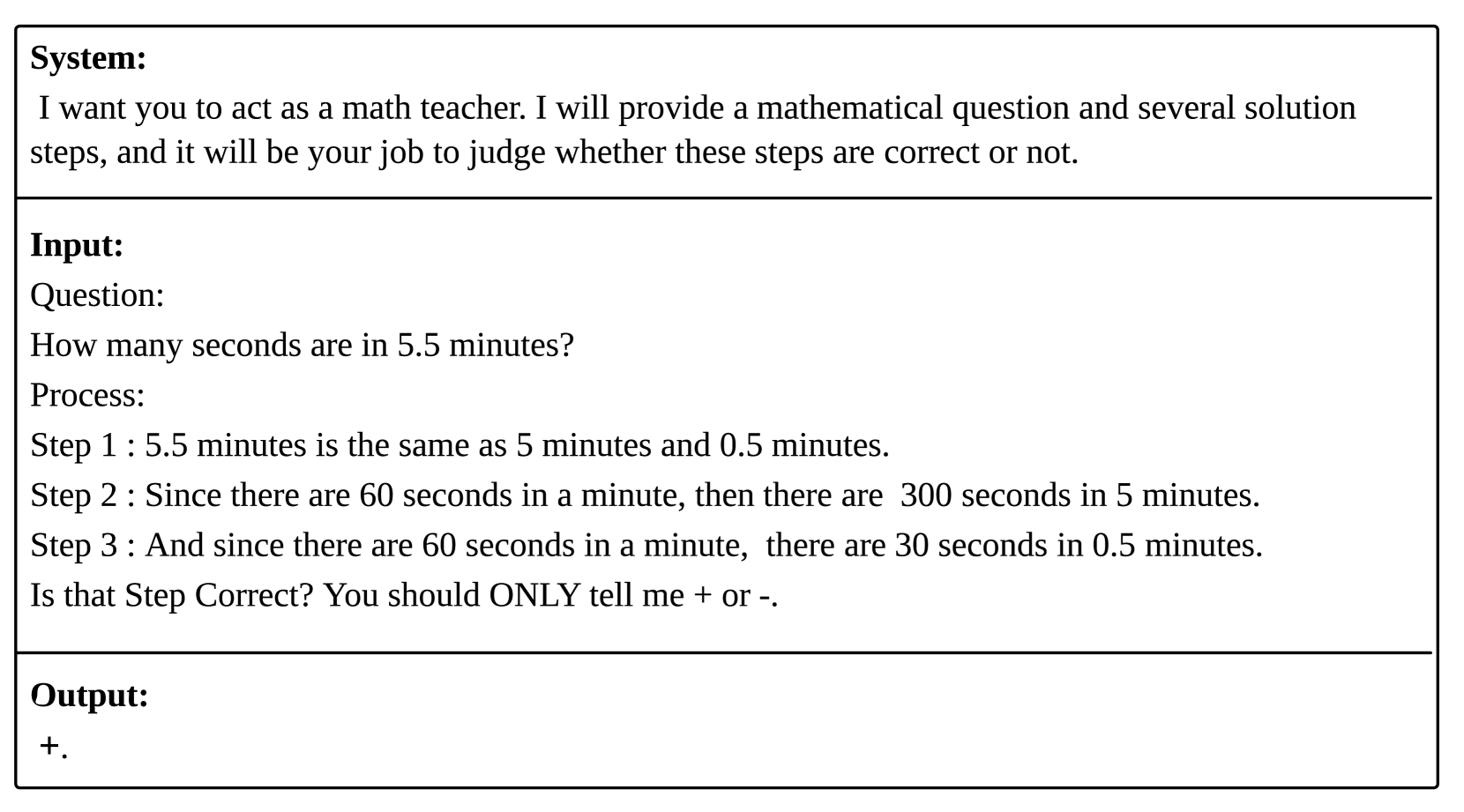
The image depicts a structured system for evaluating mathematical problem-solving steps. It presents a question ("How many seconds are in 5.5 minutes?"), a three-step solution process, and an output indicating correctness. The system requires the evaluator to judge the validity of the solution steps using only "+" (correct) or "-" (incorrect) responses.
### Components/Axes
- **System Definition**:
- Role: Math teacher
- Task: Judge solution steps for correctness
- **Input Section**:
- Question: "How many seconds are in 5.5 minutes?"
- Process Steps:
1. 5.5 minutes = 5 minutes + 0.5 minutes
2. 5 minutes = 300 seconds (5 × 60)
3. 0.5 minutes = 30 seconds (0.5 × 60)
- **Output**: "+" (indicating all steps are correct)
### Detailed Analysis
1. **Step 1**: Correct. 5.5 minutes is accurately decomposed into 5 minutes and 0.5 minutes.
2. **Step 2**: Correct. 5 minutes × 60 seconds/minute = 300 seconds.
3. **Step 3**: Correct. 0.5 minutes × 60 seconds/minute = 30 seconds.
4. **Final Calculation**: Implicitly correct (300 + 30 = 330 seconds total).
### Key Observations
- All steps follow logical unit conversion principles.
- The output "+" confirms no errors in the provided solution.
- The system enforces strict binary feedback (+/-), limiting evaluator nuance.
### Interpretation
This system demonstrates a clear, step-by-step approach to unit conversion problems. The solution correctly applies the conversion factor (60 seconds/minute) to both whole and fractional minute values. The "+" output validates the methodology, suggesting this could serve as an effective template for automated or human evaluation of mathematical reasoning processes. The strict feedback mechanism ensures focus on fundamental correctness rather than alternative solution paths.