## Diagram: Network Diagram with Four Nodes
### Overview
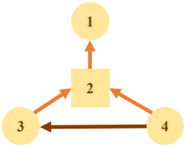
The image presents a network diagram consisting of four nodes (1, 2, 3, and 4) connected by directed edges (arrows). Nodes 1, 3, and 4 are represented as circles, while node 2 is represented as a square. The arrows indicate the direction of the relationship or flow between the nodes.
### Components/Axes
* **Nodes:**
* Node 1: Circle shape, located at the top.
* Node 2: Square shape, located in the center-top.
* Node 3: Circle shape, located at the bottom-left.
* Node 4: Circle shape, located at the bottom-right.
* **Edges (Arrows):**
* Node 2 -> Node 1: Arrow pointing upwards from Node 2 to Node 1.
* Node 2 -> Node 3: Arrow pointing from Node 2 to Node 3.
* Node 2 -> Node 4: Arrow pointing from Node 2 to Node 4.
* Node 4 -> Node 3: Arrow pointing from Node 4 to Node 3.
### Detailed Analysis
* **Node Shapes:** The diagram uses different shapes (circle and square) to distinguish between different types of nodes.
* **Arrow Directions:** The arrows indicate the direction of the relationship or flow between the nodes.
* **Connectivity:** Node 2 is connected to all other nodes (1, 3, and 4). Node 4 is connected to Node 3.
### Key Observations
* Node 2 acts as a central hub, connecting to all other nodes.
* There is a direct connection from Node 4 to Node 3, but no direct connection from Node 3 to Node 4.
* Node 1 only receives a connection from Node 2.
### Interpretation
The diagram represents a network where Node 2 plays a central role, influencing or directing flow to Nodes 1, 3, and 4. The connection from Node 4 to Node 3 suggests a possible secondary relationship or flow within the network. The different shapes of the nodes may indicate different roles or characteristics within the system. The diagram could represent various real-world scenarios, such as information flow, resource distribution, or social relationships.