## Problem Solving Trajectory and Summarization
### Overview
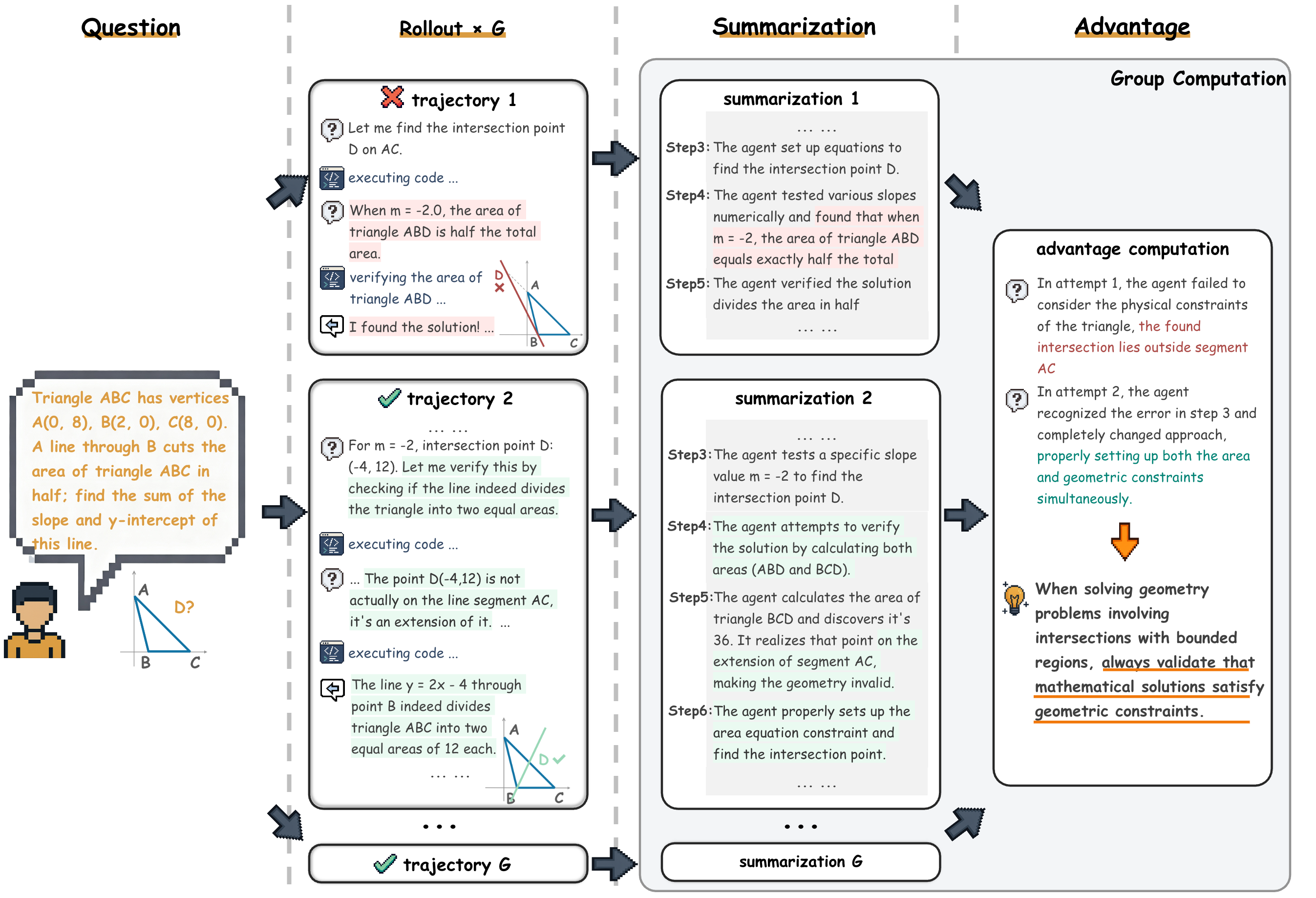
The image presents a breakdown of a problem-solving process, specifically in the context of geometry. It outlines the question, the rollout of different solution trajectories, summarizations of each trajectory, and the advantages gained through group computation. The diagram illustrates how an agent attempts to solve a geometric problem, highlighting both successful and unsuccessful approaches.
### Components/Axes
The diagram is divided into four main sections:
1. **Question**: Poses the geometric problem.
2. **Rollout x G**: Details two different solution trajectories (trajectory 1 and trajectory 2) and a final trajectory G.
3. **Summarization**: Provides a summary of each trajectory's outcome (summarization 1, summarization 2, and summarization G).
4. **Advantage**: Explains the advantages of group computation in solving the problem.
### Detailed Analysis or ### Content Details
**1. Question (Top-Left)**
* **Text**: "Triangle ABC has vertices A(0, 8), B(2, 0), C(8, 0). A line through B cuts the area of triangle ABC in half; find the sum of the slope and y-intercept of this line."
* **Diagram**: A small diagram shows triangle ABC with vertices labeled, and a dashed line intersecting AC at point D (labeled D?).
**2. Rollout x G (Top-Center-Left)**
* **Trajectory 1 (Red X)**
* **Text**: "Let me find the intersection point D on AC."
* "executing code ..."
* "When m = -2.0, the area of triangle ABD is half the total area."
* "verifying the area of triangle ABD ..."
* "I found the solution!"
* **Diagram**: A triangle ABC is shown, with a line intersecting AC at point D. The line is colored red, and the point D is marked with a red 'X'.
* **Trajectory 2 (Green Checkmark)**
* **Text**: "For m = -2, intersection point D: (-4, 12). Let me verify this by checking if the line indeed divides the triangle into two equal areas."
* "executing code ..."
* "The point D(-4,12) is not actually on the line segment AC, it's an extension of it."
* "executing code ..."
* "The line y = 2x - 4 through point B indeed divides triangle ABC into two equal areas of 12 each."
* **Diagram**: A triangle ABC is shown, with a line intersecting AC at point D. The line is colored green, and the point D is marked with a green checkmark.
**3. Summarization (Top-Center-Right)**
* **Summarization 1**
* **Text**:
* "Step3: The agent set up equations to find the intersection point D."
* "Step4: The agent tested various slopes numerically and found that when m = -2, the area of triangle ABD equals exactly half the total"
* "Step5: The agent verified the solution divides the area in half"
* **Summarization 2**
* **Text**:
* "Step3: The agent tests a specific slope value m = -2 to find the intersection point D."
* "Step4: The agent attempts to verify the solution by calculating both areas (ABD and BCD)."
* "Step5: The agent calculates the area of triangle BCD and discovers it's 36. It realizes that point on the extension of segment AC, making the geometry invalid."
* "Step6: The agent properly sets up the area equation constraint and find the intersection point."
**4. Advantage (Top-Right)**
* **Group Computation**
* **Advantage Computation**
* "In attempt 1, the agent failed to consider the physical constraints of the triangle, the found intersection lies outside segment AC"
* "In attempt 2, the agent recognized the error in step 3 and completely changed approach, properly setting up both the area and geometric constraints simultaneously."
* **Text**: "When solving geometry problems involving intersections with bounded regions, always validate that mathematical solutions satisfy geometric constraints."
### Key Observations
* **Trajectory 1 (Red X)**: The agent initially finds a solution but fails to consider the geometric constraints, leading to an incorrect intersection point.
* **Trajectory 2 (Green Checkmark)**: The agent verifies the solution by calculating areas and recognizes that the initial point is not on the line segment AC, leading to a correct solution.
* **Summarization**: The summarization highlights the steps taken by the agent in each trajectory, emphasizing the importance of verifying solutions and considering geometric constraints.
* **Advantage**: Group computation helps identify errors and refine the solution by considering physical constraints and geometric properties.
### Interpretation
The diagram illustrates the iterative process of problem-solving in geometry. It demonstrates that finding a solution is not enough; the solution must also satisfy the geometric constraints of the problem. The comparison between trajectory 1 and trajectory 2 highlights the importance of verification and the advantages of group computation in identifying and correcting errors. The final statement emphasizes the need to validate solutions against geometric constraints, ensuring that the mathematical solution is physically valid within the given context.