\n
## Diagram: Geometry Problem Solving with Agent Rollout
### Overview
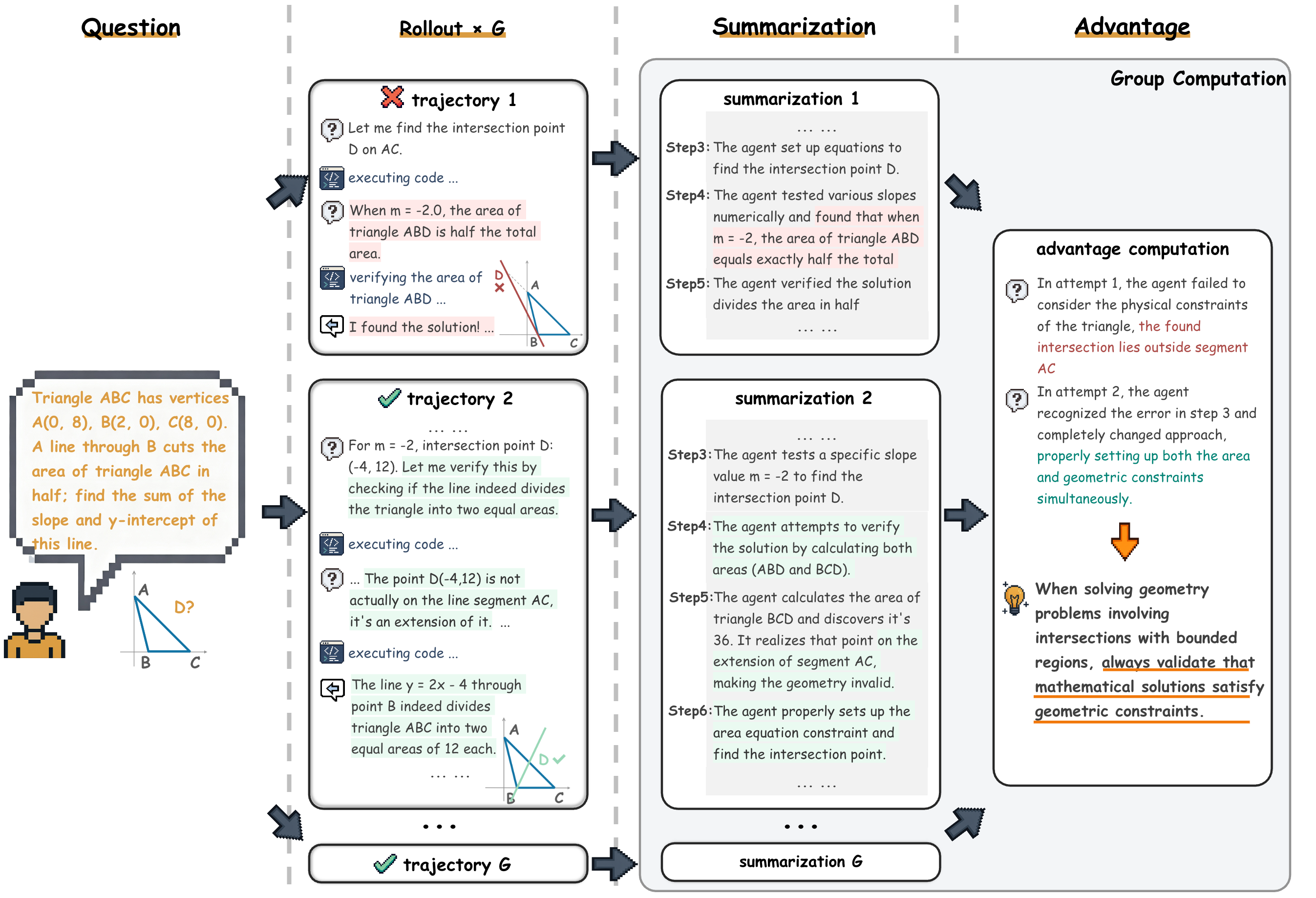
This diagram illustrates a problem-solving process involving an agent attempting to find the intersection point of a line with a triangle, and the subsequent summarization of the agent's steps and advantages gained through group computation. The diagram is divided into four main columns: "Question", "Rollout ... G", "Summarization", and "Advantage". Each column represents a stage in the problem-solving process, with multiple "trajectories" (1, 2, and 3) shown within the "Rollout" column.
### Components/Axes
The diagram doesn't have traditional axes. Instead, it uses a flow-based layout with text boxes and arrows to indicate the sequence of steps. Key components include:
* **Question:** Defines the geometric problem.
* **Rollout (Trajectory 1, 2, 3):** Shows the agent's thought process, including questions, code execution, and verification steps.
* **Summarization (Summarization 1, 2, 3):** Provides a concise summary of the agent's steps.
* **Advantage:** Highlights the benefits of group computation in identifying and correcting errors.
* **Triangle ABC:** A geometric figure with vertices A(0, 8), B(2, 0), C(8, 0).
* **Line through B:** A line cutting triangle ABC in half.
* **Line D:** A line defined by the equation 2x + y = 4.
### Detailed Analysis or Content Details
**Question Column:**
* "Triangle ABC has vertices A(0, 8), B(2, 0), C(8, 0). A line through B cuts the area of triangle ABC in half: find the sum of the slope and y-intercept of this line."
**Rollout - Trajectory 1:**
* **Step 1:** "Let me find the intersection point D on AC." (Question mark icon)
* **Step 2:** "executing code..." (Code execution icon)
* **Step 3:** "When m = -2.0, the area of triangle ABD is half the area."
* **Step 4:** "verifying the area of triangle ABD..."
* **Step 5:** "I found the solution!" (Checkmark icon)
* Diagram shows triangle ABC with point D on AC.
**Rollout - Trajectory 2:**
* **Step 1:** "For m = 2, let me verify this by checking if the line indeed divides the triangle into two equal areas." (Question mark icon)
* **Step 2:** "executing code..." (Code execution icon)
* **Step 3:** "The point D(-4,12) is actually on the line segment AC, it's an extension of it..."
* **Step 4:** "executing code..." (Code execution icon)
* **Step 5:** "The line y = 2x - 4 through point B indeed divides triangle ABC into two equal areas of 12 each."
* Diagram shows triangle ABC with point D extending beyond AC.
**Rollout - Trajectory 3:**
* Diagram shows triangle ABC with point D extending beyond AC.
**Summarization - Summarization 1:**
* **Step 1:** "The agent set up equations to find the intersection point D."
* **Step 2:** "The agent tested various slopes numerically and found that when m = -2, the area of triangle ABD equals exactly half the total area."
* **Step 3:** "The agent verified the solution divides the area in half."
**Summarization - Summarization 2:**
* **Step 1:** "The agent tests a specific slope value m = 2 to find the intersection point D."
* **Step 2:** "The agent attempts to verify the solution by calculating both areas (ABD and BCD)."
* **Step 3:** "The agent calculates the area of triangle BCD and discovers it's 36. It realizes that point D is an extension of segment AC, making the geometry invalid."
* **Step 4:** "The agent properly sets up the area equation constraint and find the intersection point."
**Summarization - Summarization 3:**
* (Content is not fully visible, appears to be a continuation of the summarization process)
**Advantage:**
* "advantage compute decision"
* "In attempt 1, the agent failed to consider the physical constraints of the triangle, the found intersection lies outside segment AC."
* "In attempt 2, the agent recognized the error in step 3 and completely changed approach, properly setting up both the area and geometric constraints simultaneously."
* "When solving geometry problems involving intersections with bounded regions, always validate that mathematical solutions satisfy geometric constraints."
### Key Observations
* The agent initially makes an error in Trajectory 1 by not considering the geometric constraints of the problem, leading to an intersection point outside the triangle.
* The agent corrects this error in Trajectory 2 by recognizing that the intersection point lies on the extension of the line segment AC.
* Group computation is highlighted as a valuable tool for identifying and correcting errors in the problem-solving process.
* The diagram emphasizes the importance of validating mathematical solutions with geometric constraints.
### Interpretation
The diagram demonstrates a problem-solving approach using an agent that iteratively refines its solution through a process of questioning, code execution, and verification. The "Rollout" column illustrates the agent's thought process, while the "Summarization" column provides a concise overview of the steps taken. The "Advantage" column highlights the benefits of group computation in identifying and correcting errors.
The diagram suggests that successful problem-solving requires not only mathematical accuracy but also a consideration of real-world constraints. The agent's initial error in Trajectory 1 underscores the importance of validating solutions with geometric constraints. The correction in Trajectory 2 demonstrates the agent's ability to learn from its mistakes and adapt its approach.
The diagram also highlights the value of collaboration and peer review in problem-solving. The "Advantage" column suggests that group computation can help to identify errors that might be missed by an individual agent. This is particularly important in complex problems where multiple factors need to be considered. The diagram is a visual representation of the iterative nature of problem-solving and the importance of both mathematical rigor and geometric intuition.