## Heatmap: Percentage p vs. Width of Near-Zero Range c
### Overview
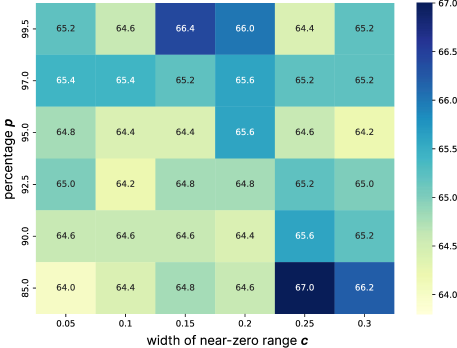
This image presents a heatmap visualizing the relationship between two variables: "percentage p" and "width of near-zero range c". The heatmap uses a color gradient to represent the values associated with each combination of these variables. The color scale ranges from approximately 64.0 to 67.0.
### Components/Axes
* **X-axis:** "width of near-zero range c" with values: 0.05, 0.1, 0.15, 0.2, 0.25, 0.3.
* **Y-axis:** "percentage p" with values: 85, 90, 92.5, 95, 97, 99.5.
* **Color Scale:** Ranges from approximately 64.0 (dark blue) to 67.0 (light yellow). The scale is positioned on the right side of the heatmap.
* **Data Points:** Each cell in the heatmap represents a specific combination of "percentage p" and "width of near-zero range c", with the cell's color indicating the corresponding value.
### Detailed Analysis
The heatmap contains 36 data points, arranged in a 6x6 grid. Here's a breakdown of the values, row by row:
* **p = 85:**
* c = 0.05: 64.0
* c = 0.1: 64.4
* c = 0.15: 64.8
* c = 0.2: 64.6
* c = 0.25: 67.0
* c = 0.3: 66.2
* **p = 90:**
* c = 0.05: 64.6
* c = 0.1: 64.6
* c = 0.15: 64.6
* c = 0.2: 64.4
* c = 0.25: 65.6
* c = 0.3: 65.2
* **p = 92.5:**
* c = 0.05: 65.0
* c = 0.1: 64.2
* c = 0.15: 64.8
* c = 0.2: 64.8
* c = 0.25: 65.2
* c = 0.3: 65.0
* **p = 95:**
* c = 0.05: 64.8
* c = 0.1: 64.4
* c = 0.15: 64.4
* c = 0.2: 65.6
* c = 0.25: 64.6
* c = 0.3: 64.2
* **p = 97:**
* c = 0.05: 65.4
* c = 0.1: 65.4
* c = 0.15: 65.2
* c = 0.2: 65.6
* c = 0.25: 65.2
* c = 0.3: 65.2
* **p = 99.5:**
* c = 0.05: 65.2
* c = 0.1: 64.6
* c = 0.15: 66.4
* c = 0.2: 66.0
* c = 0.25: 64.4
* c = 0.3: 65.2
### Key Observations
* The values generally fall between 64.0 and 67.0.
* The highest value (67.0) occurs at p = 85 and c = 0.25.
* The lowest value (64.0) occurs at p = 85 and c = 0.05.
* There isn't a strong, clear trend across the heatmap. Values appear relatively consistent, with some localized variations.
* For p = 90, the values are very similar across all values of c.
### Interpretation
The heatmap suggests a complex relationship between "percentage p" and "width of near-zero range c". The relatively small range of values (64.0-67.0) indicates that the variable being measured is not highly sensitive to changes in either "percentage p" or "width of near-zero range c" within the tested ranges. The peak at p=85 and c=0.25 might indicate an optimal condition for whatever process these variables represent, but further investigation would be needed to confirm this. The consistency of values for p=90 suggests that the measured variable is largely independent of the "width of near-zero range c" at that percentage level. Without knowing the context of these variables, it's difficult to draw more specific conclusions. The data could represent the efficiency of an algorithm, the accuracy of a measurement, or any other quantifiable process.