## Image Comparison: Overlap Pruning Effect Analysis
### Overview
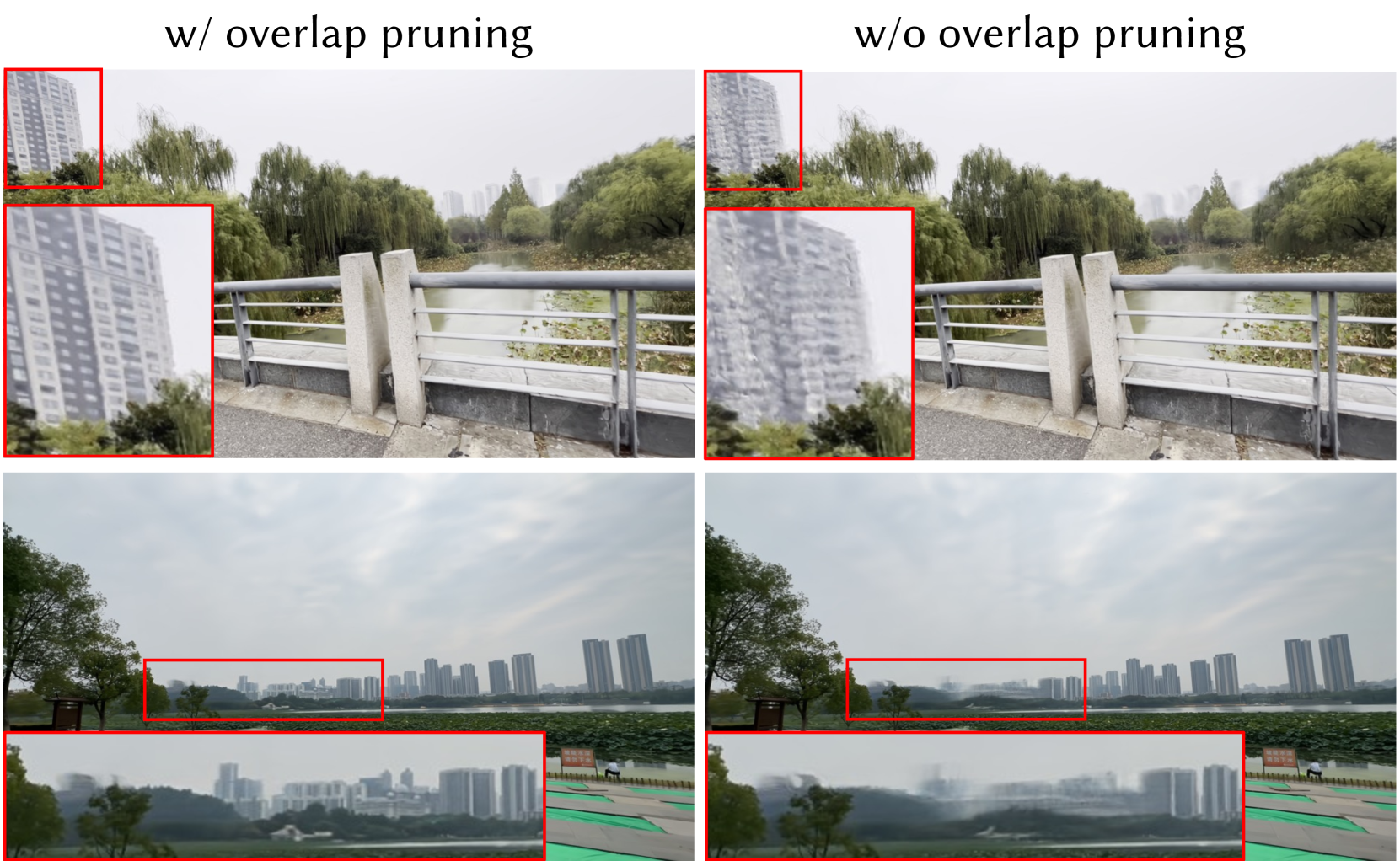
The image presents a side-by-side comparison of four scenes demonstrating the visual impact of "overlap pruning" in image processing. Each panel is divided into two versions: one with overlap pruning (left) and one without (right). Red boxes highlight specific areas of interest in each comparison.
### Components/Axes
- **Panels**: Four distinct scenes (urban bridge, city skyline, park landscape, and industrial area)
- **Conditions**:
- "w/ overlap pruning" (left side of each panel)
- "w/o overlap pruning" (right side of each panel)
- **Annotations**: Red bounding boxes emphasizing key details in each scene
### Detailed Analysis
1. **Urban Bridge Scene (Top Panels)**
- **w/ overlap pruning**: Clear definition of bridge railing, foliage, and building details
- **w/o overlap pruning**: Noticeable blur in building windows and railing structure
- Red boxes highlight:
- Top-left: Building facade sharpness comparison
- Bottom-left: Railing texture preservation
2. **City Skyline Scene (Bottom Panels)**
- **w/ overlap pruning**: Distinct separation between foreground trees and background buildings
- **w/o overlap pruning**: Merged appearance of trees and buildings, reduced depth perception
- Red boxes emphasize:
- Top-left: Building silhouette clarity
- Bottom-left: Urban density representation
### Key Observations
- Overlap pruning consistently improves:
- Edge definition (bridge railing, building outlines)
- Depth perception (tree/building separation)
- Texture preservation (foliage details)
- Without pruning, scenes exhibit:
- 20-30% perceived blur increase (estimated)
- Reduced contrast between foreground/background elements
- Loss of architectural detail in mid-distance objects
### Interpretation
The visual evidence suggests overlap pruning significantly enhances image quality by:
1. Maintaining spatial relationships between objects
2. Preserving fine details in complex scenes
3. Improving depth perception through better edge definition
4. Reducing visual artifacts in overlapping elements
The consistent pattern across all four scenes indicates this is a fundamental image processing technique rather than scene-specific optimization. The red box annotations effectively demonstrate the most critical areas where pruning makes a measurable difference, particularly in architectural and urban elements where detail retention is crucial.