## Table: Cunning Types, Definitions, and Examples
### Overview
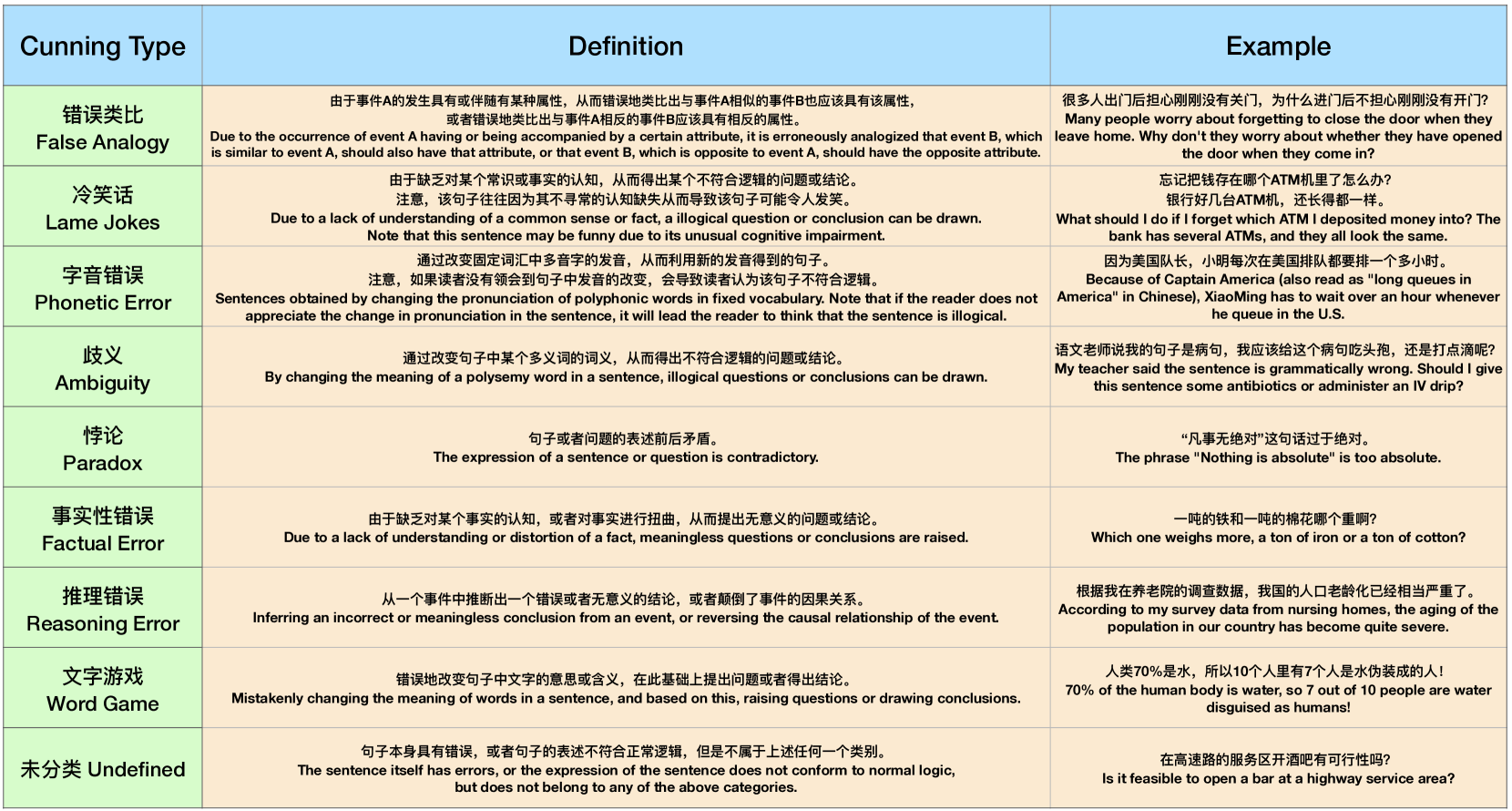
This image presents a table that categorizes different types of "cunning" or illogical statements/questions. For each type, it provides a definition in both Chinese and English, along with an example, also in both languages.
### Components/Axes
The table has three columns:
1. **Cunning Type**: Lists the name of the type of illogical statement or question, in both Chinese and English.
2. **Definition**: Provides a definition of the cunning type, in both Chinese and English.
3. **Example**: Gives an example of the cunning type, in both Chinese and English.
The table has the following rows (Cunning Types):
* False Analogy (错误类比)
* Lame Jokes (冷笑话)
* Phonetic Error (字音错误)
* Ambiguity (歧义)
* Paradox (悖论)
* Factual Error (事实性错误)
* Reasoning Error (推理错误)
* Word Game (文字游戏)
* Undefined (未分类)
### Detailed Analysis or Content Details
Here's a breakdown of each row:
1. **False Analogy (错误类比)**:
* **Definition**: "Due to the occurrence of event A having or being accompanied by a certain attribute, it is erroneously analogized that event B, which is similar to event A, should also have that attribute, or that event B, which is opposite to event A, should have the opposite attribute." (and the Chinese equivalent).
* **Example**: "Many people worry about forgetting to close the door when they leave home. Why don't they worry about whether they have opened the door when they come in?" (and the Chinese equivalent).
2. **Lame Jokes (冷笑话)**:
* **Definition**: "Due to a lack of understanding of a common sense or fact, a illogical question or conclusion can be drawn. Note that this sentence may be funny due to its unusual cognitive impairment." (and the Chinese equivalent).
* **Example**: "What should I do if I forget which ATM I deposited money into? The bank has several ATMs, and they all look the same." (and the Chinese equivalent).
3. **Phonetic Error (字音错误)**:
* **Definition**: "Sentences obtained by changing the pronunciation of polyphonic words in fixed vocabulary. Note that if the reader does not appreciate the change in pronunciation in the sentence, it will lead the reader to think that the sentence is illogical." (and the Chinese equivalent).
* **Example**: "Because of Captain America (also read as "long queues in America" in Chinese), XiaoMing has to wait over an hour whenever he queue in the U.S." (and the Chinese equivalent).
4. **Ambiguity (歧义)**:
* **Definition**: "By changing the meaning of a polysemy word in a sentence, illogical questions or conclusions can be drawn." (and the Chinese equivalent).
* **Example**: "My teacher said the sentence is grammatically wrong. Should I give this sentence some antibiotics or administer an IV drip?" (and the Chinese equivalent).
5. **Paradox (悖论)**:
* **Definition**: "The expression of a sentence or question is contradictory." (and the Chinese equivalent).
* **Example**: "The phrase "Nothing is absolute" is too absolute." (and the Chinese equivalent).
6. **Factual Error (事实性错误)**:
* **Definition**: "Due to a lack of understanding or distortion of a fact, meaningless questions or conclusions are raised." (and the Chinese equivalent).
* **Example**: "Which one weighs more, a ton of iron or a ton of cotton?" (and the Chinese equivalent).
7. **Reasoning Error (推理错误)**:
* **Definition**: "Inferring an incorrect or meaningless conclusion from an event, or reversing the causal relationship of the event." (and the Chinese equivalent).
* **Example**: "According to my survey data from nursing homes, the aging of the population in our country has become quite severe." (and the Chinese equivalent).
8. **Word Game (文字游戏)**:
* **Definition**: "Mistakenly changing the meaning of words in a sentence, and based on this, raising questions or drawing conclusions." (and the Chinese equivalent).
* **Example**: "70% of the human body is water, so 7 out of 10 people are water disguised as humans!" (and the Chinese equivalent).
9. **Undefined (未分类)**:
* **Definition**: "The sentence itself has errors, or the expression of the sentence does not conform to normal logic, but does not belong to any of the above categories." (and the Chinese equivalent).
* **Example**: "Is it feasible to open a bar at a highway service area?" (and the Chinese equivalent).
### Key Observations
* The table is bilingual, presenting information in both Chinese and English.
* Each cunning type is clearly defined and illustrated with a relevant example.
* The "Undefined" category serves as a catch-all for illogical statements that don't fit neatly into the other categories.
### Interpretation
The table provides a useful framework for understanding and categorizing different types of illogical statements or questions. It highlights the various ways in which language can be used to create confusion, humor, or even deception. The inclusion of both Chinese and English versions makes it accessible to a wider audience and potentially reveals cultural nuances in how these types of statements are perceived. The examples provided are crucial for understanding the abstract definitions and demonstrate how these cunning types manifest in everyday language.