\n
## Table: Cunning Types and Examples
### Overview
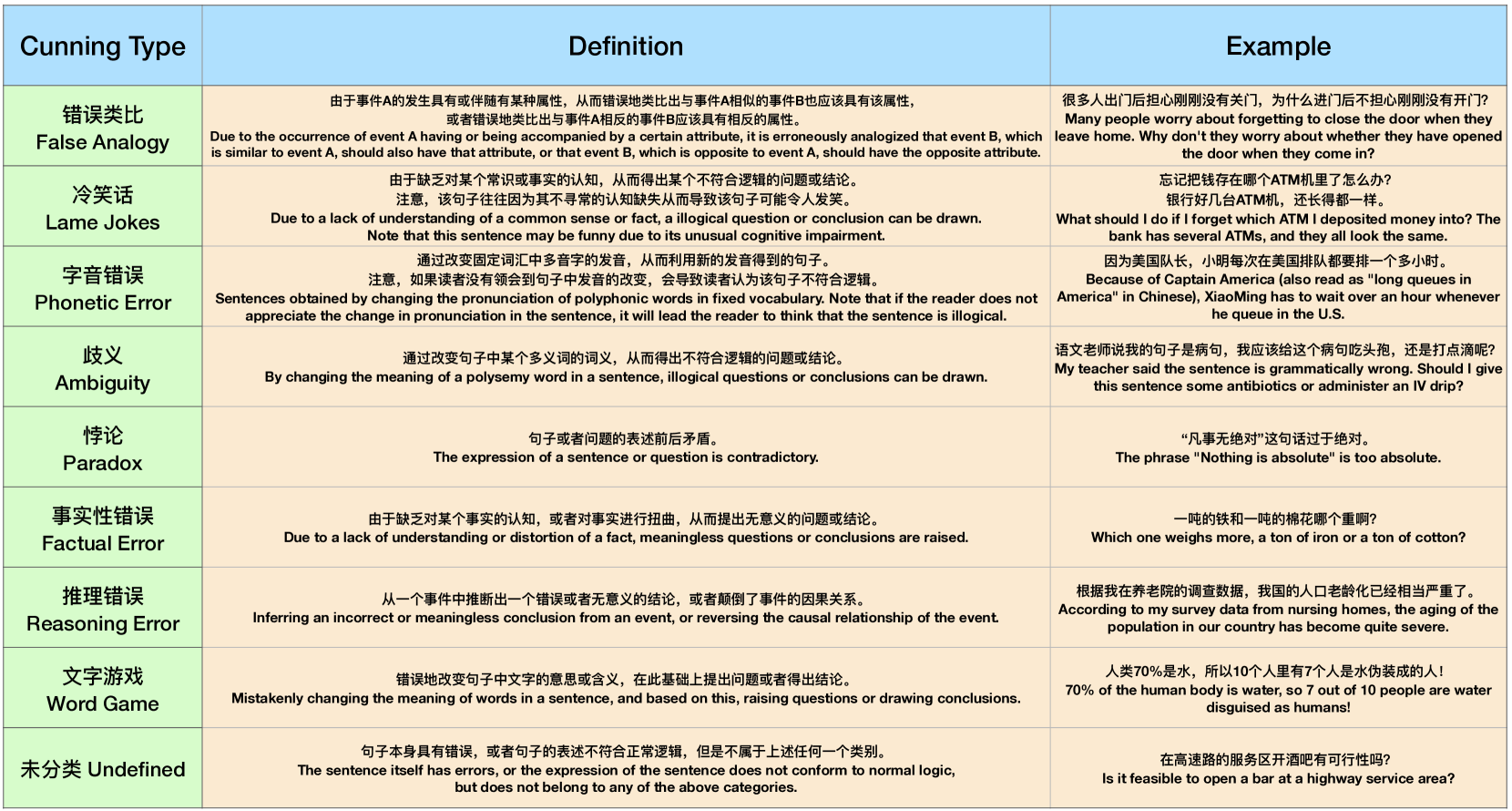
The image presents a table categorizing different types of cunning, providing definitions and illustrative examples. The table is organized into three columns: "Cunning Type" (in English and Chinese), "Definition," and "Example" (in English and Chinese).
### Components/Axes
The table has the following structure:
* **Column 1: Cunning Type** - Lists the name of the cunning type in both English and Chinese.
* **Column 2: Definition** - Provides a detailed explanation of the cunning type, primarily in English.
* **Column 3: Example** - Offers an example illustrating the cunning type, presented in both English and Chinese.
### Detailed Analysis or Content Details
Here's a transcription of the table's content, row by row:
1. **Cunning Type:** 错误类比 (False Analogy)
**Definition:** Due to the occurrence of event A having or similar to event B, it is erroneously analogized that event B, which is similar to event A, should also have that attribute, or that event B, which is opposite to event A, should have the opposite attribute.
**Example:** Many people worry about forgetting to close the door when they leave home. Why don't they worry about whether they have opened the door when they come home?
(Chinese Example: 很多人担心出门忘记关门,为什么不担心回家忘记开门呢?)
2. **Cunning Type:** 冷笑话 (Lame Jokes)
**Definition:** Due to a lack of understanding of a common sense or fact, a illogical question or conclusion can be drawn. Note that this sentence may be funny due to its unusual cognitive impairment.
**Example:** What should I do if I forget which ATM I deposited money into? The bank has several ATMs, and they all look the same.
(Chinese Example: 我应该怎么办如果我忘记了把钱存入了哪个ATM?银行有几个ATM,它们看起来都一样。)
3. **Cunning Type:** 语音错误 (Phonetic Error)
**Definition:** Sentences obtained by changing the pronunciation of polyphonic words in fixed vocabulary. Note that if the reader does not appreciate the change in pronunciation in the sentence, it will lead the reader to think that the sentence is illogical.
**Example:** Because of Captain America (also read as “long queues in America”) in Chinese, XiaoMing has to wait over an hour whenever he queue in the U.S.
(Chinese Example: 因为美国队长,小明每次在美国排队都要排一个多小时。)
4. **Cunning Type:** 歧义 (Ambiguity)
**Definition:** By changing the meaning of a polysemy word in a sentence, illogical questions or conclusions can be drawn.
**Example:** My teacher said the sentence is grammatically wrong. Should I give this sentence some ambiguities or administer an IV drip?
(Chinese Example: 老师说这句话语法错误,我应该让这句话含一些歧义还是输液?)
5. **Cunning Type:** 悖论 (Paradox)
**Definition:** A statement that contradicts itself.
**Example:** “凡是说谎的都是骗子”这句话说对了还是错了? ("All liars are deceivers" is this statement true or false?)
6. **Cunning Type:** 偷换概念 (Equivocation)
**Definition:** A deliberate or unintentional misleading by the substitution of one concept for another.
**Example:** The doctor said I need to lose weight. I asked him how much weight I need to lose, and he said, "About 100 pounds." I said, "That's a lot!" He said, "Yes, it is. You should lose 1 pound at a time."
(Chinese Example: 医生说我需要减肥,我问他要减多少,他说“大约100磅”。我说“那太多了!”他说“是的,你应该一次减一磅。”)
7. **Cunning Type:** 强行脱离 (Forced Disconnect)
**Definition:** A logical fallacy in which a statement is made that is not relevant to the topic at hand.
**Example:** My friend asked me if I like to swim. I said, "I like to eat apples."
(Chinese Example: 我朋友问我喜欢游泳吗,我说“我喜欢吃苹果”。)
8. **Cunning Type:** 稻草人谬误 (Straw Man Fallacy)
**Definition:** A misrepresentation of someone's argument to make it easier to attack.
**Example:** Person A: I think we should invest more in education. Person B: So you're saying we should defund the military?
(Chinese Example: A:我认为我们应该在教育上多投资。B:所以你是说我们要削减军费吗?)
9. **Cunning Type:** 以偏概全 (Hasty Generalization)
**Definition:** Drawing a conclusion based on insufficient evidence.
**Example:** I met two rude people from France, therefore all French people are rude.
(Chinese Example: 我遇到了两个粗鲁的法国人,所以所有法国人都很粗鲁。)
10. **Cunning Type:** 诉诸人身 (Ad Hominem)
**Definition:** Attacking the person making the argument, rather than the argument itself.
**Example:** You can't trust anything John says about economics; he's a convicted criminal.
(Chinese Example: 你不能相信约翰说的任何关于经济学的东西;他是个有罪的罪犯。)
### Key Observations
The table provides a structured overview of various cunning tactics, demonstrating a clear categorization and explanation of each. The inclusion of both English and Chinese examples enhances understanding for a broader audience. The definitions are relatively concise and focus on the core principle of each cunning type.
### Interpretation
This table serves as an educational resource for understanding different forms of deceptive reasoning and rhetorical tactics. It highlights how seemingly logical arguments can be flawed due to subtle manipulations of language, logic, or perception. The examples provided are relatable and effectively illustrate each cunning type in a practical context. The dual-language presentation suggests the material is intended for a bilingual audience or for language learning purposes. The table's organization and clarity make it a valuable tool for critical thinking and communication skills development. The inclusion of Chinese translations suggests a focus on cross-cultural understanding of these rhetorical devices.