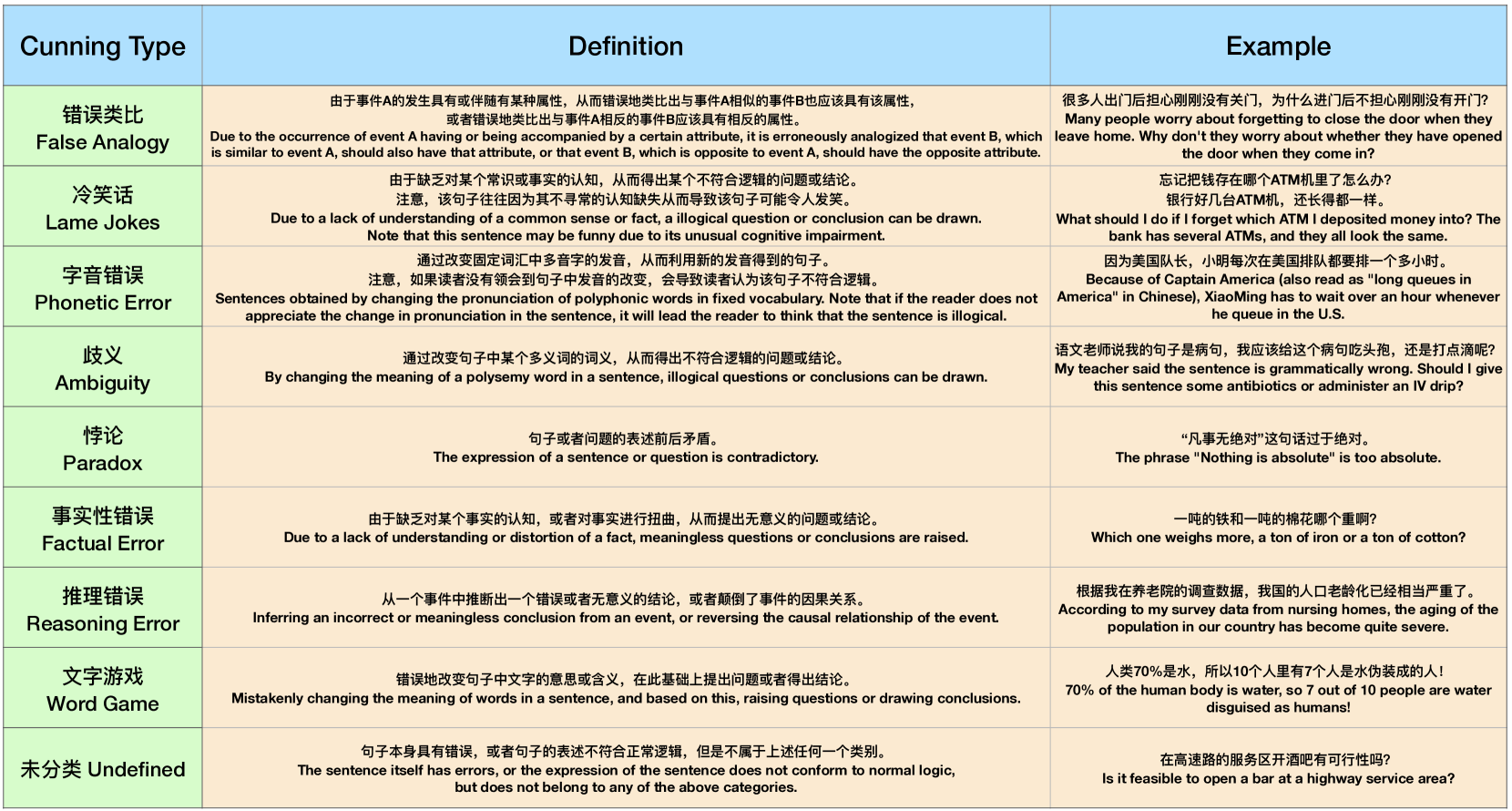
## Table: Logical Fallacies and Cognitive Errors Classification
### Overview
The image presents a bilingual (Chinese/English) taxonomy of logical fallacies and cognitive errors, organized into three columns: Cunning Type (中文分类), Definition (定义), and Example (例子). Each row represents a distinct cognitive error pattern with corresponding explanations and illustrative scenarios.
### Components/Axes
1. **Headers**:
- **Cunning Type (中文分类)**: Chinese terms for cognitive errors
- **Definition (定义)**: Explanations in Chinese with English translations
- **Example (例子)**: Scenario illustrations in Chinese with English translations
2. **Key Categories**:
- False Analogy (错误类比)
- Lame Jokes (冷笑话)
- Phonetic Error (字音错误)
- Ambiguity (歧义)
- Paradox (悖论)
- Factual Error (事实性错误)
- Reasoning Error (推理错误)
- Word Game (文字游戏)
- Undefined (未分类)
### Detailed Analysis
1. **False Analogy (错误类比)**:
- **Definition**: "When event A and B share an attribute, assuming B must have the opposite attribute of A"
- **Example**: "Why don't people worry about forgetting to open the door when leaving home? (Implies they must remember to close it when entering)"
2. **Lame Jokes (冷笑话)**:
- **Definition**: "Illogical conclusions drawn from common sense misunderstandings"
- **Example**: "Why deposit ATM money into a bank with multiple ATMs? (Ignores ATM functionality)"
3. **Phonetic Error (字音错误)**:
- **Definition**: "Misinterpretation due to homophonic word changes"
- **Example**: "Changing 'Captain America' to 'XiaoMing' creates confusion about waiting in line"
4. **Ambiguity (歧义)**:
- **Definition**: "Polysemy causing illogical interpretations"
- **Example**: "Should 'My teacher said the sentence is wrong' mean grammatical error or medical advice?"
5. **Paradox (悖论)**:
- **Definition**: "Self-contradictory statements presented as absolute truths"
- **Example**: "Absolute nothingness is impossible" (Self-defeating claim)
6. **Factual Error (事实性错误)**:
- **Definition**: "Misunderstandings from distorted facts"
- **Example**: "Which weighs more: a ton of iron or cotton?" (Both weigh one ton)
7. **Reasoning Error (推理错误)**:
- **Definition**: "Incorrect causal inferences from events"
- **Example**: "Aging population severity inferred from nursing home data"
8. **Word Game (文字游戏)**:
- **Definition**: "Deliberate word meaning manipulation"
- **Example**: "70% human body water = 7/10 people are water" (Misleading statistic)
9. **Undefined (未分类)**:
- **Definition**: "Statements violating normal logic without clear categorization"
- **Example**: "Can bars open at highway service areas?" (Contextually ambiguous)
### Key Observations
- **Bilingual Structure**: All entries include Chinese originals with English translations
- **Cognitive Patterns**: Focus on reasoning flaws (7 categories) vs linguistic errors (2 categories)
- **Illustration Style**: Examples use everyday scenarios (ATMs, language, statistics)
- **Ambiguity Category**: Contains the most complex interpretation challenges
- **Undefined Category**: Highlights gaps in classification system
### Interpretation
This taxonomy reveals systematic patterns in human reasoning errors, emphasizing:
1. **Cognitive Biases**: False analogies and reasoning errors dominate the classification
2. **Linguistic Vulnerabilities**: Phonetic errors and word games show language's role in flawed thinking
3. **Paradoxical Thinking**: The inclusion of self-contradictory statements as a distinct category
4. **Classification Gaps**: The "Undefined" category suggests incomplete taxonomy development
The bilingual presentation indicates this serves as an educational tool for cross-cultural understanding of logical fallacies, with practical examples demonstrating real-world applications of these cognitive errors.