## Tree Diagram: Search, Prune, Verify, Infer Reward & Value
### Overview
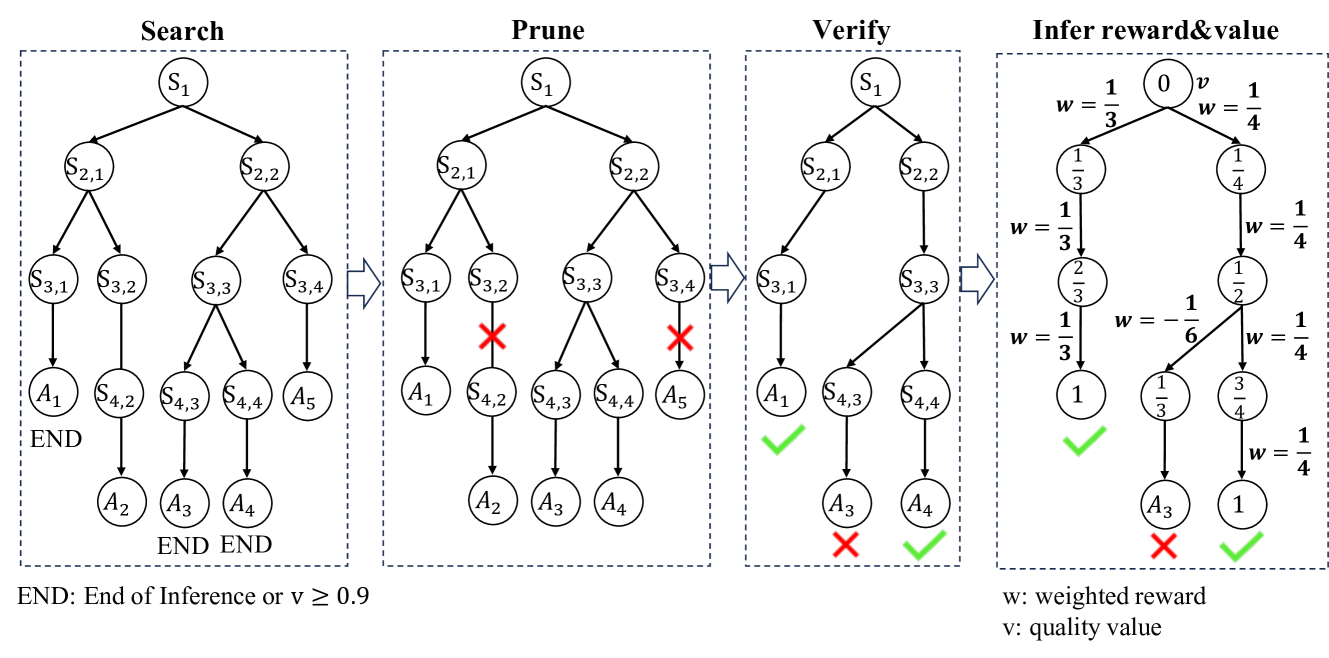
The image depicts a tree diagram illustrating a process involving search, prune, verify, and inference of reward and value. The diagram is divided into four stages, each represented by a tree structure. The nodes in the trees represent states (S) and actions (A), with connections indicating transitions between them. The diagram shows how the tree is explored, pruned based on certain criteria, verified, and finally used to infer reward and value.
### Components/Axes
* **Titles:** The four stages are labeled "Search", "Prune", "Verify", and "Infer reward&value" from left to right.
* **Nodes:** Each node is represented by a circle containing a label. The labels are of the form "S<sub>i,j</sub>" for states and "A<sub>i</sub>" for actions, where i and j are indices.
* **Edges:** The edges are represented by arrows indicating the flow of the process.
* **Pruning Markers:** Red "X" marks indicate pruned branches.
* **Verification Markers:** Green checkmarks indicate verified branches, while red "X" marks indicate unverified branches.
* **Reward and Value Labels:** In the "Infer reward&value" stage, each edge is labeled with "w = value" representing the weighted reward, and each node is labeled with "v = value" representing the quality value.
* **Legend:** Located at the bottom-right of the image, it defines "w" as weighted reward and "v" as quality value.
* **End Condition:** Located at the bottom-left of the image, it defines "END" as the End of Inference or v ≥ 0.9.
### Detailed Analysis
**1. Search Stage:**
* The tree starts with a root node labeled "S<sub>1</sub>".
* "S<sub>1</sub>" branches into two nodes: "S<sub>2,1</sub>" and "S<sub>2,2</sub>".
* "S<sub>2,1</sub>" branches into two nodes: "S<sub>3,1</sub>" and "S<sub>3,2</sub>".
* "S<sub>2,2</sub>" branches into two nodes: "S<sub>3,3</sub>" and "S<sub>3,4</sub>".
* "S<sub>3,1</sub>" leads to "A<sub>1</sub>".
* "S<sub>3,2</sub>" leads to "S<sub>4,2</sub>".
* "S<sub>3,3</sub>" leads to "S<sub>4,3</sub>" and "S<sub>4,4</sub>".
* "S<sub>3,4</sub>" leads to "A<sub>5</sub>".
* "A<sub>1</sub>" is marked as "END".
* "S<sub>4,2</sub>" leads to "A<sub>2</sub>".
* "S<sub>4,3</sub>" leads to "A<sub>3</sub>".
* "S<sub>4,4</sub>" leads to "A<sub>4</sub>".
* "A<sub>2</sub>", "A<sub>3</sub>", and "A<sub>4</sub>" are marked as "END".
**2. Prune Stage:**
* The tree structure is identical to the "Search" stage.
* The branches leading to "S<sub>4,2</sub>" and "A<sub>5</sub>" are marked with a red "X", indicating they have been pruned.
**3. Verify Stage:**
* The tree structure reflects the pruning from the previous stage.
* The branch leading to "A<sub>1</sub>" is marked with a green checkmark, indicating it has been verified.
* The branch leading to "A<sub>3</sub>" is marked with a red "X", indicating it has not been verified.
* The branch leading to "A<sub>4</sub>" is marked with a green checkmark, indicating it has been verified.
**4. Infer reward&value Stage:**
* The tree structure is simplified, reflecting the verified branches.
* The root node "S<sub>1</sub>" has a value "v = 0".
* The edge from "S<sub>1</sub>" to the next level on the left has a weighted reward "w = 1/3".
* The edge from "S<sub>1</sub>" to the next level on the right has a weighted reward "w = 1/4".
* The left child node has a value "v = 1/3".
* The right child node has a value "v = 1/4".
* The edge from the left child to the next level has a weighted reward "w = 1/3".
* The edge from the right child to the next level has a weighted reward "w = 1/4".
* The left grandchild node has a value "v = 2/3".
* The right grandchild node has a value "v = 1/2".
* The edge from the left grandchild to the next level has a weighted reward "w = 1/3".
* The edge from the right grandchild to the left has a weighted reward "w = -1/6".
* The edge from the right grandchild to the right has a weighted reward "w = 1/4".
* The left great-grandchild node has a value "v = 1".
* The left great-great-grandchild node "A<sub>3</sub>" is marked with a red "X".
* The value of the left great-great-grandchild node "A<sub>3</sub>" is not explicitly stated, but it is implied to be less than 0.9, as it is not marked as "END".
* The right great-grandchild node has a value "v = 3/4".
* The edge from the right great-grandchild to the next level has a weighted reward "w = 1/4".
* The right great-great-grandchild node has a value "v = 1".
* The right great-great-grandchild node is marked with a green checkmark.
### Key Observations
* The diagram illustrates a decision-making process where the search space is explored, pruned based on certain criteria, and then verified.
* The "Infer reward&value" stage assigns values to the nodes and edges, representing the quality and reward associated with each state and action.
* The pruning and verification steps help to focus the search on the most promising branches.
### Interpretation
The diagram represents a reinforcement learning or decision-making process. The "Search" stage explores possible actions and states. The "Prune" stage eliminates less promising branches, possibly based on some heuristic or initial evaluation. The "Verify" stage confirms the validity of the remaining branches, possibly through simulation or real-world interaction. Finally, the "Infer reward&value" stage assigns values to the states and actions, allowing the agent to make informed decisions in the future. The red "X" and green checkmarks indicate the outcome of the verification process, guiding the agent towards optimal actions. The values assigned in the final stage are crucial for learning and improving the agent's performance over time. The "END" condition signifies the termination of the inference process when a satisfactory value is achieved or the end of the inference horizon is reached.