## Time-Series Line Chart: Additive WeakL vs. Online WeakL Performance
### Overview
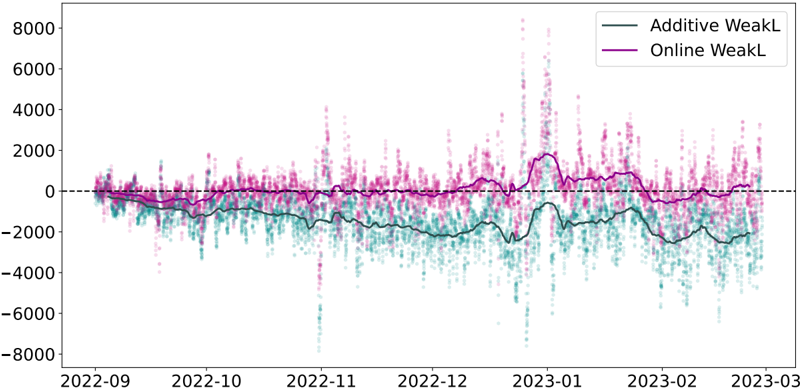
The image displays a time-series line chart comparing the performance of two methods, "Additive WeakL" and "Online WeakL," over a period from September 2022 to March 2023. The chart plots a numerical metric (y-axis) against time (x-axis). Both series exhibit significant volatility, with "Online WeakL" showing much larger amplitude fluctuations, including sharp positive and negative spikes, compared to the relatively more contained, though still noisy, "Additive WeakL" series.
### Components/Axes
* **Chart Type:** Time-series line chart with overlaid scatter points (likely representing daily or frequent measurements) and smoothed trend lines.
* **X-Axis (Horizontal):** Represents time. Labels are in `YYYY-MM` format.
* **Markers/Labels:** `2022-09`, `2022-10`, `2022-11`, `2022-12`, `2023-01`, `2023-02`, `2023-03`.
* **Y-Axis (Vertical):** Represents a numerical value, likely a performance metric, error, or return. The scale is linear.
* **Range:** Approximately -8000 to +8000.
* **Major Tick Labels:** `-8000`, `-6000`, `-4000`, `-2000`, `0`, `2000`, `4000`, `6000`, `8000`.
* **Baseline:** A dashed horizontal line is drawn at `y=0`.
* **Legend:** Positioned in the **top-right corner** of the chart area.
* **Entry 1:** A teal/dark cyan line labeled `Additive WeakL`.
* **Entry 2:** A magenta/pink line labeled `Online WeakL`.
* **Data Series:**
1. **Additive WeakL (Teal):** Composed of a dense scatter of teal points and a thicker, smoothed teal trend line.
2. **Online WeakL (Magenta):** Composed of a dense scatter of magenta points and a thicker, smoothed magenta trend line.
### Detailed Analysis
**Trend Verification & Spatial Grounding:**
* **Additive WeakL (Teal Line & Points):**
* **Visual Trend:** The smoothed teal trend line begins near 0 in September 2022, trends downward into negative territory through October and November, reaching a local minimum around late November/early December. It recovers slightly in December, dips again in early January, and then shows a gradual upward trend through February, ending near -2000 in early March 2023. The scatter points show high volatility around this trend.
* **Key Data Points (Approximate from trend line):**
* Start (Sep 2022): ~0
* Local Minimum (Late Nov 2022): ~ -2500
* Local Peak (Late Dec 2022): ~ -1000
* Local Minimum (Early Jan 2023): ~ -2000
* End (Early Mar 2023): ~ -2000
* **Extreme Scatter Points:** The teal scatter points show extreme negative spikes, with the most severe occurring around **early November 2022**, plunging to approximately **-8000**. Other significant negative spikes (below -6000) occur in late December 2022 and late January 2023.
* **Online WeakL (Magenta Line & Points):**
* **Visual Trend:** The smoothed magenta trend line is more volatile than the teal line. It starts near 0, fluctuates around zero with a slight negative bias until December, then exhibits a dramatic positive surge in **early January 2023**, peaking near +2000. It then declines sharply back towards zero, with another smaller positive hump in late January/early February, before settling near 0 by March 2023.
* **Key Data Points (Approximate from trend line):**
* Start (Sep 2022): ~0
* Pre-Spike (Dec 2022): Fluctuating between -500 and +500.
* Major Peak (Early Jan 2023): ~ +2000
* Secondary Peak (Late Jan 2023): ~ +1000
* End (Early Mar 2023): ~ 0
* **Extreme Scatter Points:** The magenta scatter points show extreme volatility in both directions. The most prominent feature is a cluster of massive positive spikes in **early January 2023**, with the highest point reaching approximately **+8000**. Significant negative spikes (below -4000) are also present, notably in late November 2022 and late January 2023.
### Key Observations
1. **Divergent Behavior:** The two methods show fundamentally different patterns. Additive WeakL has a persistent negative bias after September 2022, while Online WeakL oscillates around zero with a major positive excursion.
2. **Volatility Disparity:** Online WeakL exhibits dramatically higher volatility, especially evident in the January 2023 spike where its scatter points span nearly the entire y-axis range (from ~-6000 to +8000).
3. **Synchronized Extreme Events:** Both series show extreme scatter points (spikes) around the same times, suggesting they are reacting to the same underlying market or data events, but in opposite directions or with different magnitudes. Notable synchronized volatile periods are early November 2022, late December 2022, and early January 2023.
4. **Trend Line vs. Scatter:** The smoothed trend lines capture the general direction, but the dense scatter points reveal that the day-to-day or period-to-period values are extremely noisy for both methods.
### Interpretation
This chart likely compares the performance of two algorithmic trading strategies, machine learning models, or financial risk metrics over a six-month period. The y-axis could represent daily P&L (Profit and Loss), prediction error, or a similar performance indicator.
* **Additive WeakL** demonstrates a strategy or model that, after an initial period, consistently underperforms a zero baseline (negative values), suggesting a persistent loss or error. Its volatility, while high, is more contained.
* **Online WeakL** appears to be a more reactive or aggressive method. Its performance is highly unstable, characterized by periods of near-zero results punctuated by extreme positive and negative shocks. The massive positive spike in January 2023 could indicate a successful capture of a market anomaly or, conversely, a dangerous overfitting or risk exposure event that later reversed.
* **The Relationship:** The methods are not inversely correlated; they react to events with different signatures. The fact that both experience extreme volatility simultaneously indicates they are exposed to similar external shocks, but their internal mechanisms process these shocks very differently. The chart suggests that while Online WeakL had a period of spectacular gain, it comes with significantly higher risk and unpredictability compared to the more steadily negative Additive WeakL. An investigator would need to examine the specific events of early January 2023 to understand the cause of the dramatic divergence.