## Diagram: Neural-Symbolic Architectures
### Overview
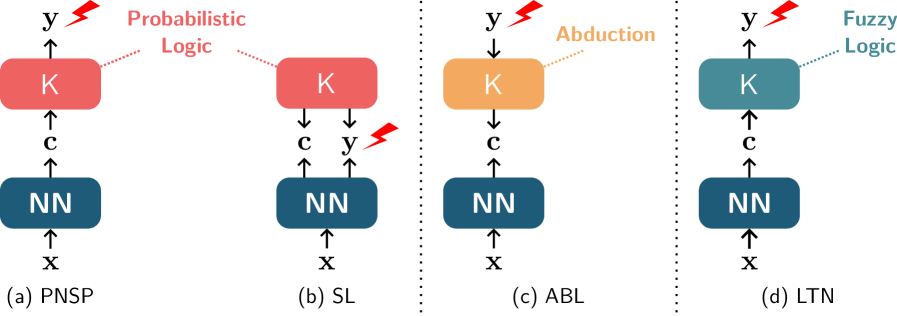
The image presents a comparative diagram illustrating four different neural-symbolic architectures: PNSP, SL, ABL, and LTN. Each architecture combines a neural network (NN) with a symbolic component (K) and depicts the flow of information between them. The diagrams highlight the type of logic associated with each architecture, such as Probabilistic Logic, Abduction, and Fuzzy Logic.
### Components/Axes
* **NN:** Represents the Neural Network component, depicted as a rounded rectangle. Input is 'x', output is 'c'.
* **K:** Represents the symbolic knowledge component, depicted as a rounded rectangle.
* **x:** Input to the Neural Network.
* **c:** Output from the Neural Network, input to the symbolic component K.
* **y:** Output from the symbolic component K.
* **Arrows:** Indicate the direction of information flow.
* **Dotted Lines:** Connect the symbolic component K to the type of logic it represents.
* **Lightning Bolt:** Indicates a point of potential error or uncertainty.
* **(a) PNSP:** Probabilistic Neural-Symbolic Program.
* **(b) SL:** Semantic Loss.
* **(c) ABL:** Abductive Learning.
* **(d) LTN:** Logic Tensor Networks.
### Detailed Analysis
**Diagram (a) PNSP:**
* **NN:** Located at the bottom, receives input 'x' and outputs 'c'.
* **K:** Located above the NN, receives input 'c' and outputs 'y'. K is colored red.
* **Logic:** "Probabilistic Logic" is associated with K via a dotted line. The text "Probabilistic Logic" is colored red.
* **Flow:** Information flows from NN to K.
* **Error:** A red lightning bolt is present near the output 'y' of K, indicating a potential error.
**Diagram (b) SL:**
* **NN:** Located at the bottom, receives input 'x' and outputs 'c' and 'y'.
* **K:** Located above the NN, receives input 'c' and 'y'. K is colored red.
* **Flow:** Information flows from NN to K.
* **Error:** A red lightning bolt is present near the output 'y' of the NN, indicating a potential error.
**Diagram (c) ABL:**
* **NN:** Located at the bottom, receives input 'x' and outputs 'c'.
* **K:** Located above the NN, receives input 'c' and outputs 'y'. K is colored orange.
* **Logic:** "Abduction" is associated with K via a dotted line. The text "Abduction" is colored orange.
* **Flow:** Information flows from NN to K.
**Diagram (d) LTN:**
* **NN:** Located at the bottom, receives input 'x' and outputs 'c'.
* **K:** Located above the NN, receives input 'c' and outputs 'y'. K is colored teal.
* **Logic:** "Fuzzy Logic" is associated with K via a dotted line. The text "Fuzzy Logic" is colored teal.
* **Flow:** Information flows from NN to K.
### Key Observations
* All four architectures share a common structure: an NN feeding into a symbolic component K.
* The architectures differ in the type of logic associated with K and the flow of information between NN and K.
* PNSP and SL diagrams include a lightning bolt symbol, suggesting potential errors or uncertainties in these architectures.
* The color of the K component and the associated logic text are consistent within each diagram.
### Interpretation
The diagram illustrates different approaches to integrating neural networks with symbolic reasoning. Each architecture leverages a specific type of logic (Probabilistic, Abductive, Fuzzy) to enhance the capabilities of the neural network. The presence of error indicators in PNSP and SL suggests potential challenges or limitations in these specific approaches. The diagram provides a high-level overview of the design and information flow in these neural-symbolic systems, highlighting the diversity of approaches in this field.