\n
## Diagram: Neural Network Logic Architectures
### Overview
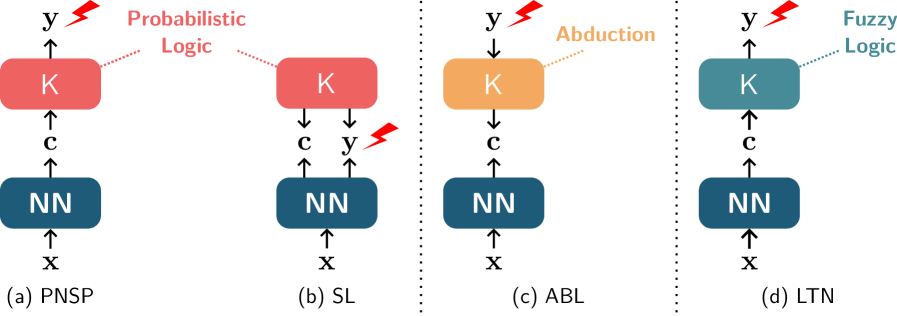
The image presents a comparative diagram illustrating four different neural network logic architectures: PPSP, SL, ABL, and LTN. Each architecture is depicted as a series of connected components, with arrows indicating the flow of information. The diagram highlights the different logical approaches (Probabilistic Logic, Abduction, Fuzzy Logic) employed in each architecture.
### Components/Axes
The diagram consists of four distinct sections, labeled (a) through (d), each representing a different architecture. Each section contains the following components:
* **X:** Input variable.
* **NN:** Neural Network (teal/dark blue).
* **C:** Intermediate variable.
* **K:** Knowledge component (orange/red).
* **y:** Output variable.
* **Arrows:** Indicate the direction of information flow.
* **Labels:** Each architecture is labeled with an abbreviation (PPSP, SL, ABL, LTN) and a descriptive term indicating the logic used (Probabilistic Logic, Abduction, Fuzzy Logic).
### Detailed Analysis or Content Details
**(a) PPSP (Probabilistic Logic)**
* Input (X) flows to the Neural Network (NN).
* NN outputs to C.
* C flows to K (orange).
* K flows to output (y).
* A dashed line connects K to y, labeled "Probabilistic Logic".
**(b) SL (Probabilistic Logic)**
* Input (X) flows to the Neural Network (NN).
* NN outputs to C.
* C flows to K (red).
* K flows to output (y).
* A dashed line connects K to y, labeled "Probabilistic Logic".
**(c) ABL (Abduction)**
* Input (X) flows to the Neural Network (NN).
* NN outputs to C.
* C flows to K (orange).
* K flows to output (y).
* A dashed line connects K to y, labeled "Abduction".
**(d) LTN (Fuzzy Logic)**
* Input (X) flows to the Neural Network (NN).
* NN outputs to C.
* C flows to K (teal).
* K flows to output (y).
* A dashed line connects K to y, labeled "Fuzzy Logic".
### Key Observations
* All four architectures share the same basic structure: X -> NN -> C -> K -> y.
* The primary difference between the architectures lies in the logical approach used to connect K to y, as indicated by the dashed lines and labels.
* The color of the 'K' component changes between architectures, potentially indicating different implementations or roles.
* The 'NN' component is teal in (a), (c) and (d) and dark blue in (b).
### Interpretation
The diagram illustrates different ways to integrate logical reasoning with neural networks. Each architecture attempts to bridge the gap between the data-driven learning of neural networks and the symbolic reasoning of logic.
* **PPSP and SL** utilize Probabilistic Logic, suggesting a focus on uncertainty and probability distributions. The fact that both use probabilistic logic, but have different color schemes for 'K' suggests a nuance in implementation.
* **ABL** employs Abduction, a form of logical inference that seeks the best explanation for observed data.
* **LTN** leverages Fuzzy Logic, which deals with degrees of truth rather than absolute truth or falsehood.
The diagram suggests a progression or exploration of different logical frameworks for enhancing neural network capabilities. The consistent structure across all architectures highlights the core components of a neural network-based reasoning system, while the varying logical approaches represent different strategies for incorporating symbolic reasoning into the learning process. The color coding of the 'K' component may indicate different types of knowledge representation or processing within each architecture.