## Diagram: Comparative Framework of Cognitive Processing Models
### Overview
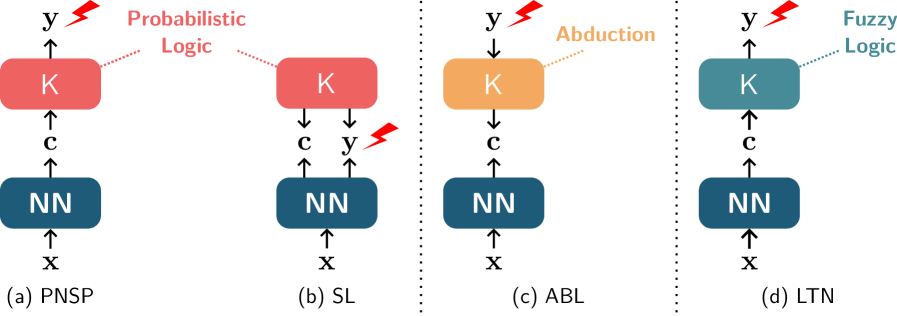
The image presents a comparative diagram of four cognitive processing models: Probabilistic Neural Symbolic Processing (PNSP), Symbolic Learning (SL), Abductive Learning (ABL), and Fuzzy Logic-based Neural Tuning (LTN). Each model is represented as a vertical pipeline with distinct components and interconnections, emphasizing differences in logic, flow, and processing mechanisms.
---
### Components/Axes
1. **Vertical Pipeline Structure**:
- **Input (x)**: Bottom-most node, feeding into a neural network (NN).
- **Neural Network (NN)**: Central processing unit, depicted as a blue block.
- **Knowledge Module (K)**: Top-most node, receiving output from NN and producing final output (y).
- **Arrows**: Represent data flow and logical operations, with labels indicating specific processes (e.g., "Probabilistic Logic," "Abduction").
2. **Key Elements**:
- **Lightning Bolts**: Highlight critical or dynamic processes (e.g., top arrow from y to K in all sections).
- **Dashed Lines**: Indicate indirect or probabilistic connections (e.g., between K blocks in PNSP and SL).
- **Color Coding**:
- **Red K**: PNSP and SL.
- **Orange K**: ABL.
- **Teal K**: LTN.
3. **Labels**:
- **PNSP (a)**: "Probabilistic Logic" (dashed arrow between K blocks).
- **SL (b)**: "SL" (dashed arrow between K blocks).
- **ABL (c)**: "Abduction" (dashed arrow from K to y).
- **LTN (d)**: "Fuzzy Logic" (dashed arrow from K to y).
---
### Detailed Analysis
1. **PNSP (a)**:
- **Flow**: x → NN → K → y.
- **Key Features**:
- Solid arrow labeled "c" connects NN to K.
- Dashed arrow labeled "Probabilistic Logic" links K to another K (external or secondary module).
- Lightning bolt on the top arrow (y → K) suggests dynamic feedback or error correction.
2. **SL (b)**:
- **Flow**: x → NN → K → y.
- **Key Features**:
- Two solid arrows from K to NN: one labeled "c" (input) and another labeled "y" (output).
- Dashed arrow labeled "SL" connects K to another K, implying symbolic integration.
- Lightning bolt on the top arrow (y → K) mirrors PNSP’s dynamic process.
3. **ABL (c)**:
- **Flow**: x → NN → K → y.
- **Key Features**:
- Solid arrow labeled "c" connects NN to K.
- Dashed arrow labeled "Abduction" links K to y, emphasizing hypothesis generation.
- Orange K distinguishes it from other models.
4. **LTN (d)**:
- **Flow**: x → NN → K → y.
- **Key Features**:
- Solid arrow labeled "c" connects NN to K.
- Dashed arrow labeled "Fuzzy Logic" links K to y, highlighting uncertainty handling.
- Teal K differentiates it from other models.
---
### Key Observations
1. **Consistency in Core Structure**:
- All models share the same core pipeline (x → NN → K → y), suggesting a universal framework for input processing and output generation.
- Variations arise in the logic applied at the K block and interconnections.
2. **Logic-Specific Differentiation**:
- **PNSP**: Uses "Probabilistic Logic" for uncertainty-aware reasoning.
- **SL**: Employs "Symbolic Learning" for rule-based integration.
- **ABL**: Focuses on "Abduction" for inferring causes from effects.
- **LTN**: Applies "Fuzzy Logic" to manage imprecise data.
3. **Dynamic Elements**:
- Lightning bolts on top arrows (y → K) across all models indicate real-time adjustments or feedback loops.
- Dashed lines suggest modular or probabilistic interactions between K blocks.
---
### Interpretation
1. **Model Comparison**:
- The diagram highlights how each model adapts the core NN-K pipeline to address specific cognitive tasks. For example:
- **PNSP** and **SL** use dashed K-K connections to represent hybrid symbolic-neural reasoning.
- **ABL** and **LTN** focus on specialized logic (abduction, fuzzy) at the K-y interface.
2. **Implications**:
- **PNSP/SL**: Suitable for tasks requiring probabilistic or symbolic reasoning (e.g., decision-making under uncertainty).
- **ABL**: Ideal for diagnostic or explanatory tasks (e.g., medical diagnosis).
- **LTN**: Effective for handling ambiguous or imprecise data (e.g., sensor fusion).
3. **Design Intent**:
- The use of color (red, orange, teal) and labels emphasizes the unique contributions of each model.
- The lightning bolts and dashed lines visually reinforce the dynamic and probabilistic nature of the processes.
---
### Conclusion
This diagram illustrates a taxonomy of cognitive models, each optimized for distinct reasoning paradigms. By isolating the role of logic (probabilistic, symbolic, abductive, fuzzy) and their integration with neural networks, the framework provides a roadmap for designing systems that balance data-driven learning with rule-based or uncertainty-aware reasoning.