\n
## Textual Comparison: Training Manuals
### Overview
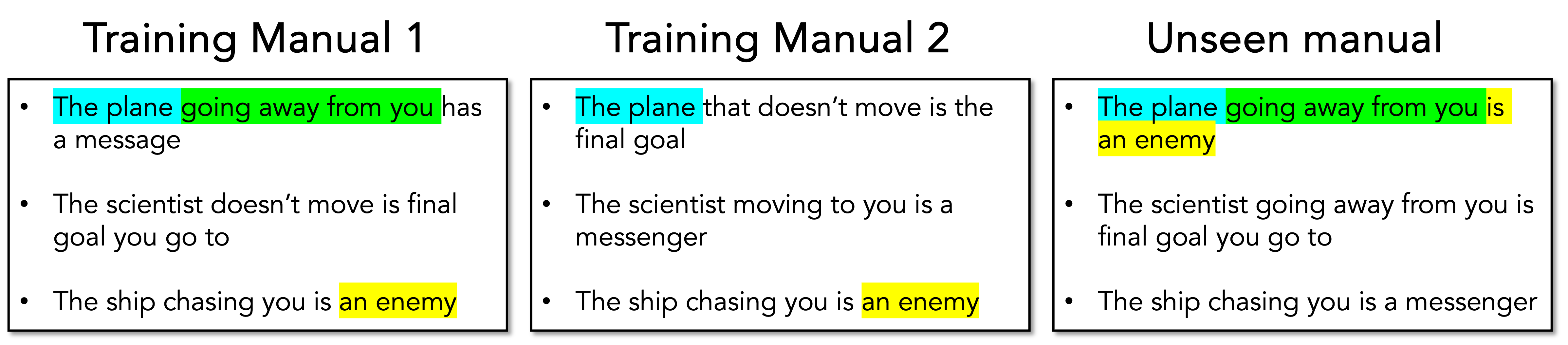
The image presents a side-by-side comparison of three training manuals, labeled "Training Manual 1", "Training Manual 2", and "Unseen manual". Each manual contains three bullet points describing interpretations of scenarios involving a plane, a scientist, and a ship. The key difference lies in how these elements are interpreted as messages, goals, enemies, or messengers. Certain phrases are underlined in green.
### Components/Axes
The image consists of three distinct rectangular blocks, each representing a training manual. Each block contains a title at the top and three bullet points below. The titles are aligned horizontally. The bullet points are vertically aligned within each block.
### Detailed Analysis or Content Details
**Training Manual 1:**
* "The plane going away from you has a message" (Underlined in green)
* "The scientist doesn't move is final goal you go to"
* "The ship chasing you is an enemy" (Underlined in green)
**Training Manual 2:**
* "The plane that doesn't move is the final goal"
* "The scientist moving to you is a messenger"
* "The ship chasing you is an enemy"
**Unseen manual:**
* "The plane going away from you is an enemy" (Underlined in green)
* "The scientist away from you is final goal you go to"
* "The ship chasing you is a messenger"
### Key Observations
* The interpretation of "the plane going away" varies significantly across the manuals, being a "message" in Manual 1, an "enemy" in the Unseen manual, and not addressed in Manual 2.
* The interpretation of "the ship chasing you" is consistent between Manual 1 and Manual 2 as "an enemy", but is a "messenger" in the Unseen manual.
* The interpretation of "the scientist" is also inconsistent.
* Manual 1 and the Unseen manual both have two phrases underlined in green.
### Interpretation
The image demonstrates a divergence in training protocols or perspectives. The differing interpretations suggest that the meaning assigned to these scenarios is not fixed, but rather dependent on the specific context or training regimen. The underlining in green may indicate key points or warnings within the manuals. The "Unseen manual" presents a notably different worldview, potentially indicating a shift in strategy or a contrasting approach to threat assessment. The inconsistencies highlight the subjective nature of interpreting events and the importance of clear communication and standardized training. The manuals could be used to test the ability of trainees to adapt to changing circumstances or to identify potential biases in their interpretations.