## Histogram: Tensor Distribution Analysis
### Overview
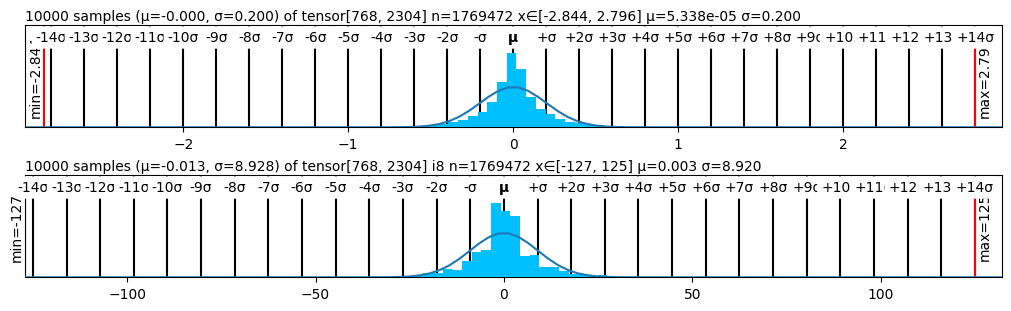
The image presents two histograms, each displaying the distribution of values within a tensor. The top histogram shows a distribution with a small standard deviation, while the bottom histogram shows a distribution with a larger standard deviation. Both histograms are overlaid with a Gaussian curve.
### Components/Axes
**Top Histogram:**
* **Title:** "10000 samples (μ=-0.000, σ=0.200) of tensor[768, 2304] n=1769472 x∈[-2.844, 2.796] μ=5.338e-05 σ=0.200"
* Indicates 10000 samples were used.
* μ (mean) = -0.000
* σ (standard deviation) = 0.200
* Tensor shape: [768, 2304]
* n = 1769472
* x ∈ [-2.844, 2.796]
* μ = 5.338e-05
* σ = 0.200
* **X-axis:** Labeled with multiples of σ (standard deviation) relative to μ (mean). The labels range from -14σ to +14σ. Numerical values are implied based on the standard deviation.
* **Y-axis:** Implicitly represents frequency or count of values within each bin.
* **Minimum Value:** Indicated by a vertical red line labeled "min=-2.84" on the left side.
* **Maximum Value:** Indicated by a vertical red line labeled "max=2.79" on the right side.
* **Histogram Bars:** Cyan colored bars representing the frequency of values within each bin.
* **Gaussian Curve:** A grey curve overlaid on the histogram, representing a normal distribution.
**Bottom Histogram:**
* **Title:** "10000 samples (μ=-0.013, σ=8.928) of tensor[768, 2304] i8 n=1769472 x∈[-127, 125] μ=0.003 σ=8.920"
* Indicates 10000 samples were used.
* μ (mean) = -0.013
* σ (standard deviation) = 8.928
* Tensor shape: [768, 2304]
* Data type: i8
* n = 1769472
* x ∈ [-127, 125]
* μ = 0.003
* σ = 8.920
* **X-axis:** Labeled with multiples of σ (standard deviation) relative to μ (mean). The labels range from -14σ to +14σ. Numerical values are implied based on the standard deviation. Approximate numerical values are also shown: -100, -50, 0, 50, 100.
* **Y-axis:** Implicitly represents frequency or count of values within each bin.
* **Minimum Value:** Indicated by a vertical red line labeled "min=-127" on the left side.
* **Maximum Value:** Indicated by a vertical red line labeled "max=125" on the right side.
* **Histogram Bars:** Cyan colored bars representing the frequency of values within each bin.
* **Gaussian Curve:** A grey curve overlaid on the histogram, representing a normal distribution.
### Detailed Analysis
**Top Histogram:**
* The distribution is tightly centered around the mean (approximately 0).
* The histogram bars closely follow the shape of the Gaussian curve, indicating a normal distribution.
* The x-axis ranges from approximately -2.84 to 2.79.
* The standard deviation is small (0.200), resulting in a narrow distribution.
**Bottom Histogram:**
* The distribution is centered around the mean (approximately 0).
* The histogram bars generally follow the shape of the Gaussian curve, but with more spread.
* The x-axis ranges from approximately -127 to 125.
* The standard deviation is significantly larger (8.928) compared to the top histogram, resulting in a wider distribution.
### Key Observations
* Both histograms represent distributions that are approximately normal.
* The primary difference between the two histograms is the scale of the x-axis and the standard deviation. The top histogram has a much smaller standard deviation than the bottom histogram.
* The vertical black lines mark integer multiples of the standard deviation from the mean.
### Interpretation
The two histograms visualize the distribution of values within two different tensors. The top histogram represents a tensor where the values are clustered closely around the mean, indicating low variability. The bottom histogram represents a tensor where the values are more spread out, indicating higher variability. The difference in standard deviations suggests that the tensors might represent different types of data or have undergone different processing steps. The Gaussian curves provide a visual reference for how well the data conforms to a normal distribution, which can be useful for statistical analysis and modeling.